
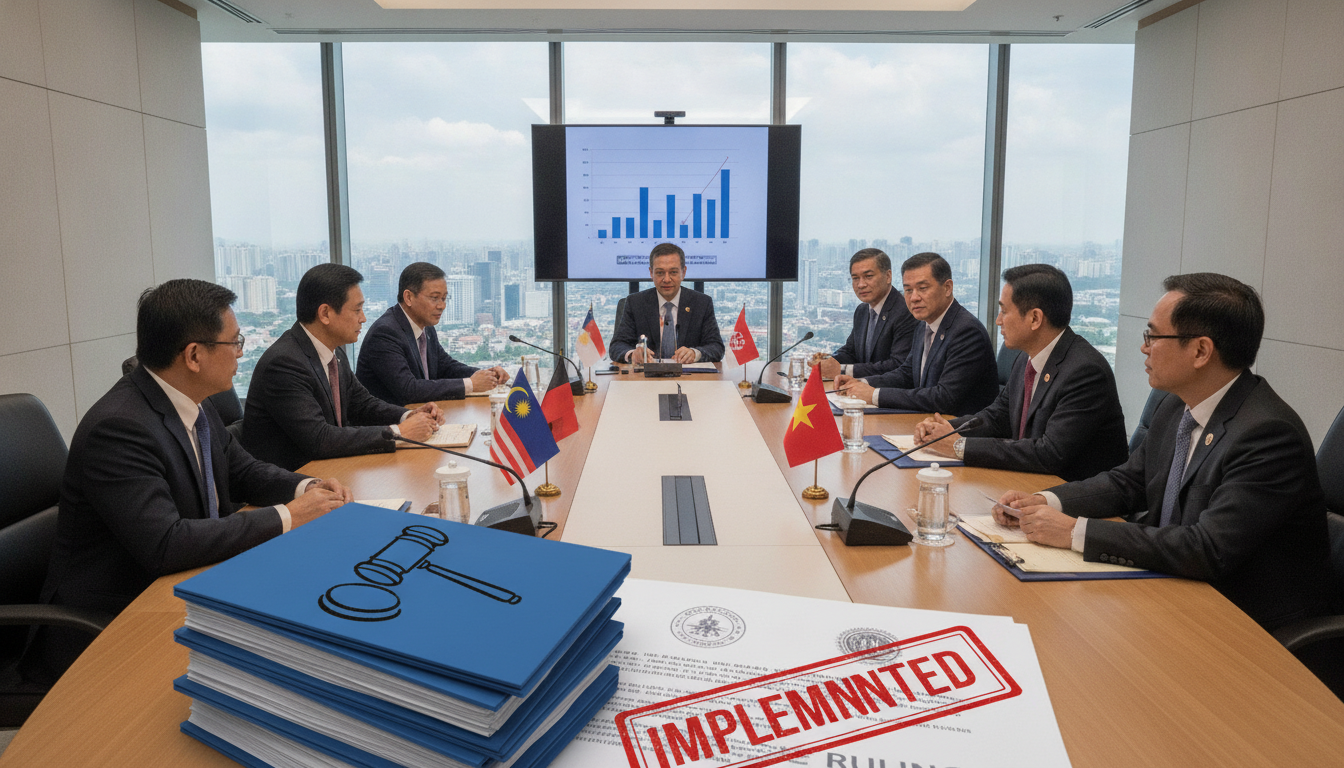
Trump tariffs drive partial compliance in Southeast Asia despite legal challenges
Southeast Asian governments continue to implement parts of trade measures tied to Trump tariffs, U.S. business groups say, even after a court ruling declared some agreements invalid.
Southeast Asian governments are moving ahead with elements of trade agreements linked to Trump tariffs despite dissatisfaction with the agreements’ terms and a judicial ruling that found parts of the pacts invalid, a U.S. business leader said. The partial compliance includes regulatory and administrative steps aimed at preserving market access and investor confidence, according to the business group. Cambodia is among the countries that have enacted measures tied to the U.S. deals, underscoring divergent domestic responses across the region.
Continued implementation despite court ruling
Several governments in the region have implemented selective provisions of the trade deals even though a court has invalidated parts of the arrangements. Officials in capitals from Phnom Penh to Jakarta appear to be prioritizing practical trade flows and business certainty over full legal alignment with the contested agreements. The U.S. business group described the approach as pragmatic: governments are choosing measures that can be enforced administratively while pausing or contesting those that require deeper legal changes.
This piecemeal implementation reflects a balance between external pressure to meet U.S. expectations and internal political, legal and social constraints. In some cases, ministries of trade and investment have issued guidance or regulations that mirror commitments in the pacts without undertaking the legislative reforms a court ruling would demand. The result is a patchwork of compliance that keeps some commercial channels open while leaving other parts of the agreements in limbo.
Cambodia’s partial adoption highlights the trend
Cambodia has been singled out by the U.S. business group as having implemented certain measures linked to its trade understanding with Washington. Cambodian leaders, who met U.S. officials at the ASEAN summit in October 2025, have taken steps intended to reassure investors and maintain preferential access to U.S. markets. Those measures appear to follow the spirit of the bilateral arrangements even as legal challenges complicate full implementation.
Observers say Cambodia’s actions likely reflect a calculation to protect export sectors and attract continued U.S. business engagement. For companies operating across the region, incremental regulatory changes in Cambodia and elsewhere have real effects on supply chains, compliance costs and market strategies, prompting some firms to adjust operations to preserve access while monitoring legal developments.
U.S. business group details mixed reactions
The U.S. business group that reported the continued implementation also noted frustration among private-sector actors over the terms of the agreements. While some businesses welcome measures that facilitate trade and investment, others criticize provisions they view as unclear or operationally burdensome. The business group’s assessment suggests that private-sector support for partial compliance is conditional and uneven across industries.
Trade associations and multinational firms cited by the group emphasized the practical benefits of keeping market channels open, such as tariff preferences and smoother customs procedures. At the same time, they warned that lingering legal uncertainty and vague implementation timelines could deter long-term investment decisions, creating a climate of caution rather than robust expansion.
Legal uncertainty complicates domestic politics
The judicial ruling that declared parts of the agreements invalid has sharpened domestic political debates in several Southeast Asian capitals. Lawmakers and civil society groups have used the ruling to question the legitimacy of rapid reforms tied to external trade pressure. Governments face competing demands: to honor international commitments and to respect national legal standards and political sensitivities.
This legal uncertainty has prompted administrators to favor incremental administrative acts over sweeping legislative change. Politicians in some countries have seized the moment to renegotiate terms or to delay contentious reforms until broader political consensus can be secured. As a result, the trajectory of full implementation remains contingent on court appeals, parliamentary deliberations and diplomatic negotiations with the United States.
Regional trade and supply-chain implications
The pattern of partial compliance has practical consequences for regional trade and global supply chains. Firms that rely on preferential terms related to Trump tariffs are adapting operating models to maintain market access without exposing themselves to legal or reputational risk. Some companies are re-routing shipments, adjusting sourcing arrangements or investing in compliance functions to navigate the uneven policy landscape.
Economists warned that prolonged ambiguity could reduce the agreements’ effectiveness in attracting sustained investment flows. At the same time, maintaining even limited elements of the deals helps to prevent more abrupt disruptions to commerce, cushioning exporters from immediate shocks. Policymakers in the region now face the task of translating conditional, administrative-level compliance into durable legal and institutional frameworks that can withstand domestic challenge and international scrutiny.
Sustained diplomatic engagement and clearer timelines for resolving legal disputes will be key to determining whether the current pattern of selective implementation evolves into full, sustainable compliance. The coming months are likely to see intensified negotiation between Southeast Asian governments and U.S. officials as both sides seek practical ways to stabilize trade relations under the shadow of Trump tariffs and unresolved legal questions.

