
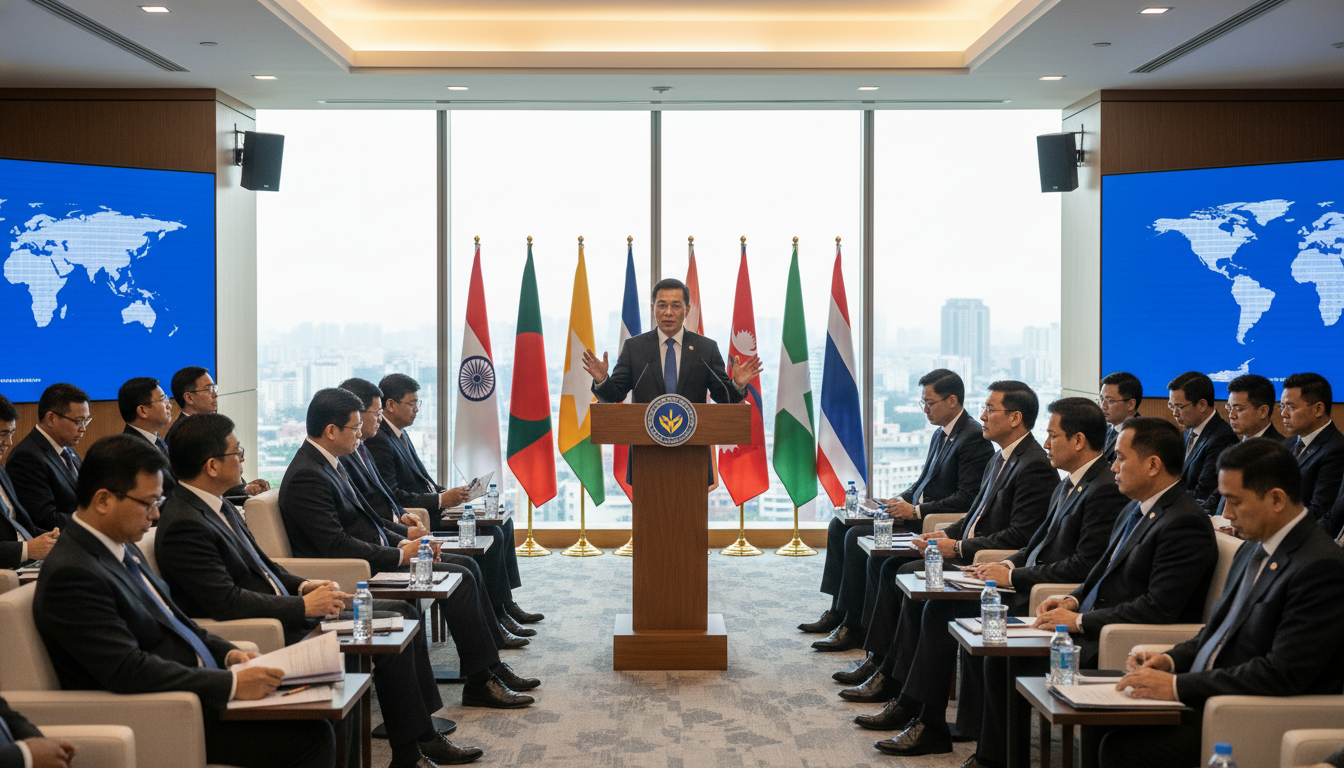
BIMSTEC chief urges deeper Bay of Bengal cooperation as geopolitical tensions mount
BIMSTEC Secretary-General Indra Mani Pandey urges stronger Bay of Bengal cooperation to tackle rising geopolitical tensions, prioritizing trade, security, connectivity and climate resilience.
DHAKA — BIMSTEC Secretary-General Indra Mani Pandey said the seven-nation Bay of Bengal grouping must accelerate practical cooperation as global geopolitical tensions rise, calling for closer economic and security ties among member states. Pandey, speaking in Dhaka, emphasized that BIMSTEC can serve as a stabilizing platform for South and Southeast Asia by focusing on trade facilitation, connectivity and joint responses to transnational threats. His comments reflect a push by members to translate diplomatic momentum into tangible projects that benefit the region’s economies and societies.
BIMSTEC’s growing regional role
BIMSTEC comprises Bangladesh, Bhutan, India, Myanmar, Nepal, Sri Lanka and Thailand, and its secretary-general argued the bloc is gaining traction as members seek alternatives to polarized global alignments. Pandey highlighted an uptick in ministerial meetings, working group activity and interest from the private sector, suggesting the organization is moving beyond rhetoric toward implementation. He framed this momentum as an opportunity to deepen economic integration while maintaining the grouping’s focus on pragmatic, non-controversial cooperation.
Trade and economic integration priorities
Pandey identified trade facilitation and smoother customs procedures as immediate areas where BIMSTEC can deliver quick gains for businesses and consumers. He called for simplified border protocols, harmonized standards and targeted measures to boost small and medium-sized enterprises that already trade across the Bay of Bengal region. The secretary-general said such steps would raise intra-BIMSTEC trade, create jobs and reduce dependency on longer, more costly trade routes.
Connectivity and infrastructure agenda
Improving physical and digital connectivity was central to Pandey’s remarks, with transport links and cross-border infrastructure singled out as enablers of growth. He urged coordination on port development, multimodal corridors and last-mile links that would connect production centers to regional and global markets. Pandey also underscored the importance of affordable digital infrastructure to expand e-commerce, logistics management and public services across member states.
Security and maritime cooperation focus
Against a backdrop of rising geopolitical tension, Pandey made maritime security and domain awareness a priority for BIMSTEC’s agenda, stressing cooperative mechanisms rather than confrontational postures. He advocated intensified information-sharing on piracy, trafficking and marine pollution alongside joint drills and capacity-building for coast guards and navies. The secretary-general said a stable maritime environment in the Bay of Bengal is essential for trade, tourism and sustainable fisheries that many coastal populations depend upon.
Climate resilience and disaster response plans
Pandey highlighted climate change and natural disasters as shared challenges requiring collective action, particularly for low-lying and vulnerable coastal communities. He proposed joint projects for early warning systems, coastal protection and disaster-response training that would reduce loss of life and economic damage from cyclones and flooding. He also urged greater cooperation on climate finance and technology transfer to help member countries adapt infrastructure and agriculture to shifting weather patterns.
Institutional strengthening and private-sector engagement
To turn proposals into results, Pandey called for stronger BIMSTEC institutions capable of monitoring progress, mobilizing resources and coordinating cross-border projects. He urged member governments to deepen ties with the private sector and development partners to leverage capital and technical expertise for priority initiatives. The secretary-general stressed predictable funding streams and clearer project pipelines as key to raising investor confidence and accelerating implementation.
Pandey portrayed BIMSTEC as a practical mechanism for regional states to address shared challenges without importing broader geopolitical competition, arguing that focused cooperation on trade, connectivity, security and climate resilience can deliver measurable benefits. He reiterated the grouping’s interest in inclusive projects that lift living standards while strengthening regional stability.
The coming months will test how quickly BIMSTEC members can convert diplomatic momentum into action on the ground, from customs reform and corridor planning to joint maritime patrols and disaster-resilience investments. Observers say success will depend on sustained political commitment, predictable financing and effective coordination across capitals and with private partners.
If member states follow through on the priorities outlined by the secretary-general in Dhaka, BIMSTEC could strengthen economic ties across the Bay of Bengal while offering a cooperative model for addressing the region’s security and environmental risks. The grouping’s next steps will determine whether the current momentum leads to concrete projects that improve connectivity, boost trade and build resilience for millions of people in South and Southeast Asia.

