
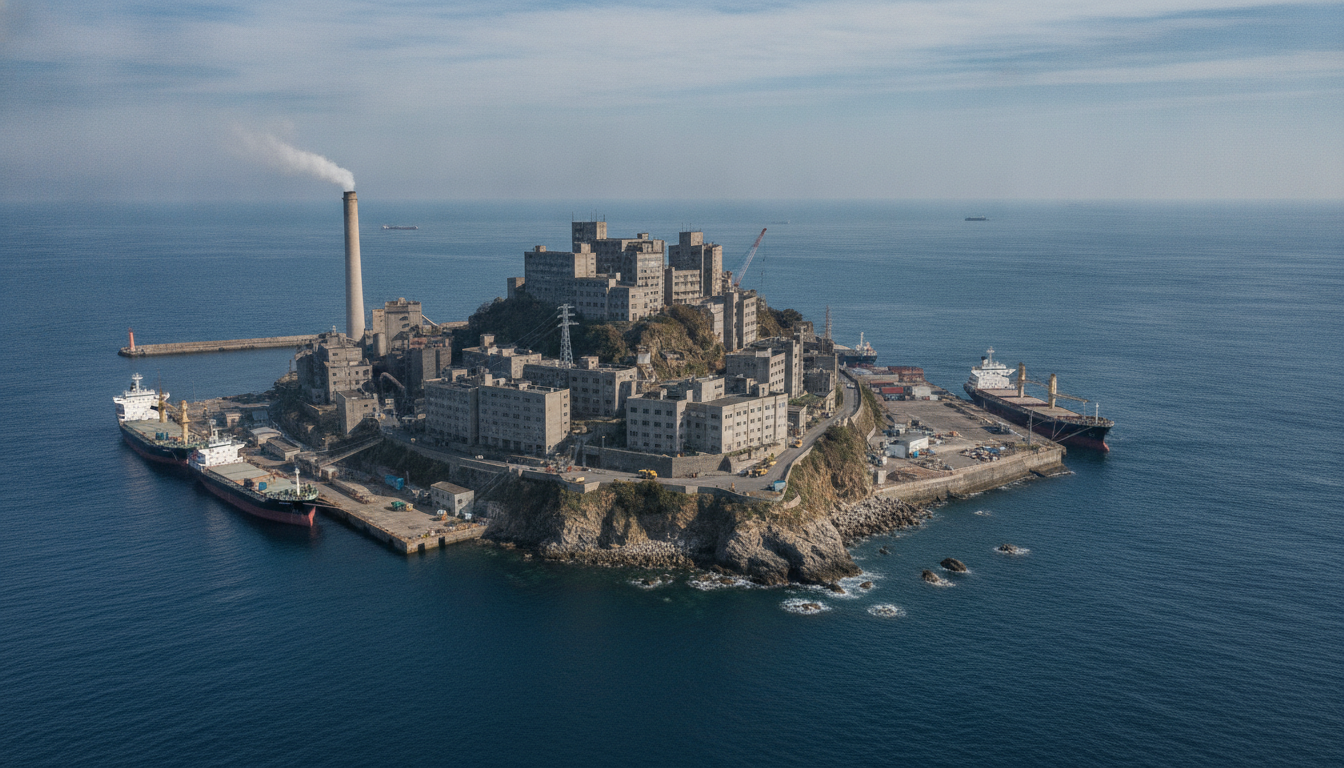
Chigirishima Island: Japan’s industrial islet that resembles Battleship Island but remains active
Chigirishima Island in the Seto Inland Sea stands out for its ship‑like industrial silhouette, a working islet formed by landfill and still in operation amid a quiet marine landscape.
Chigirishima Island, in western Japan’s Seto Inland Sea, presents a striking industrial profile that has drawn comparisons to Nagasaki’s famed Battleship Island while continuing to host active facilities. The island’s compact footprint and dense cluster of industrial structures make Chigirishima a distinctive presence against the region’s largely wooded isles. Visitors from the Honshu coast often note the contrast between Chigirishima’s built environment and the natural terrain of neighboring Ikunoshima. Local officials and maritime operators describe the islet as a functioning node for coastal industry rather than a preserved ruin.
Industrial profile of Chigirishima
Chigirishima’s skyline is defined by storage tanks, piers and processing buildings that cluster tightly along its shorelines. These facilities are arranged to maximize limited land area, giving the island a layered, ship‑like silhouette when viewed from a distance.
Operational activity on the island includes regular vessel movements to and from piers and visible signs of ongoing maintenance around plant structures. The steady movement of barges and small freighters highlights Chigirishima’s role in regional logistics and coastal industry.
Landfill and formation history
Historically, Chigirishima was composed of two separate islets that were connected through successive landfill projects to create a single operational platform. This artificial expansion allowed for concentrated industrial use while minimizing the island’s footprint in the Seto Inland Sea.
Land reclamation altered the shoreline and left the islet with a compact, engineered appearance that differs sharply from naturally accreted islands nearby. The process of fusing the two landmasses reflects wider coastal engineering practices used across Japan to secure space for industrial and port functions.
Contrast with neighboring Ikunoshima
Across short stretches of water, Ikunoshima presents dense woodland and a low, organic profile that emphasizes vegetation over built form. The visual juxtaposition is immediate: a green, rolling neighbor beside a hard‑edged, functional islet.
Residents and tourists traveling the Honshu coast frequently mention the juxtaposition as emblematic of the Seto Inland Sea’s mosaic of uses, where leisure, habitation and industry exist in close proximity. The contrast also underscores differing land‑use priorities within a compact maritime region.
Comparison with Hashima’s Battleship Island
Observers often liken Chigirishima’s outline to Nagasaki’s Hashima, commonly known as Battleship Island, because both present a flattened, ship‑like profile concentrated with human structures. The resemblance, however, ends at appearance: unlike Hashima, which has been abandoned and preserved largely as a historical site, Chigirishima remains actively used for industrial purposes.
Hashima’s history as a closed coal‑mining community that was deserted in the 1970s is well documented, and its decaying concrete ruins now attract heritage interest. Chigirishima’s continuing operations put it in a different category, one of an inhabited industrial islet integrated into contemporary supply chains rather than a relic of industrial decline.
Economic role and maritime activity
Chigirishima functions as a small but practical component of local maritime industry, supporting storage, transshipment and coastal services for nearby ports. Its compact facilities serve businesses that rely on proximity to sea lanes and shorter inland routes along the Seto Inland Sea.
Maritime traffic visible around the islet includes local cargo and service vessels that use the island’s piers for loading and maintenance. For inland shipping operators and regional suppliers, Chigirishima provides a predictable, concentrated base for operations that would otherwise require more dispersed shore infrastructure.
Environmental and community considerations
The industrial concentration on Chigirishima raises routine questions about coastal management, marine habitats and shoreline integrity in a densely used sea. Local authorities balance operational needs with environmental monitoring and regulations that govern coastal reclamation and industrial discharges.
Nearby communities and stakeholders watch development and maintenance activities closely, seeking assurances on pollution controls and maritime safety. The juxtaposition of industrial and residential or recreational uses in the Seto Inland Sea means ongoing dialogue over noise, shipping lanes and habitat protection.
Chigirishima Island remains a functional and visually distinctive element of the Seto Inland Sea, its engineered landform and clustered facilities reflecting both the practical demands of coastal industry and the complex land‑use mosaic of western Japan’s inland waters.

