
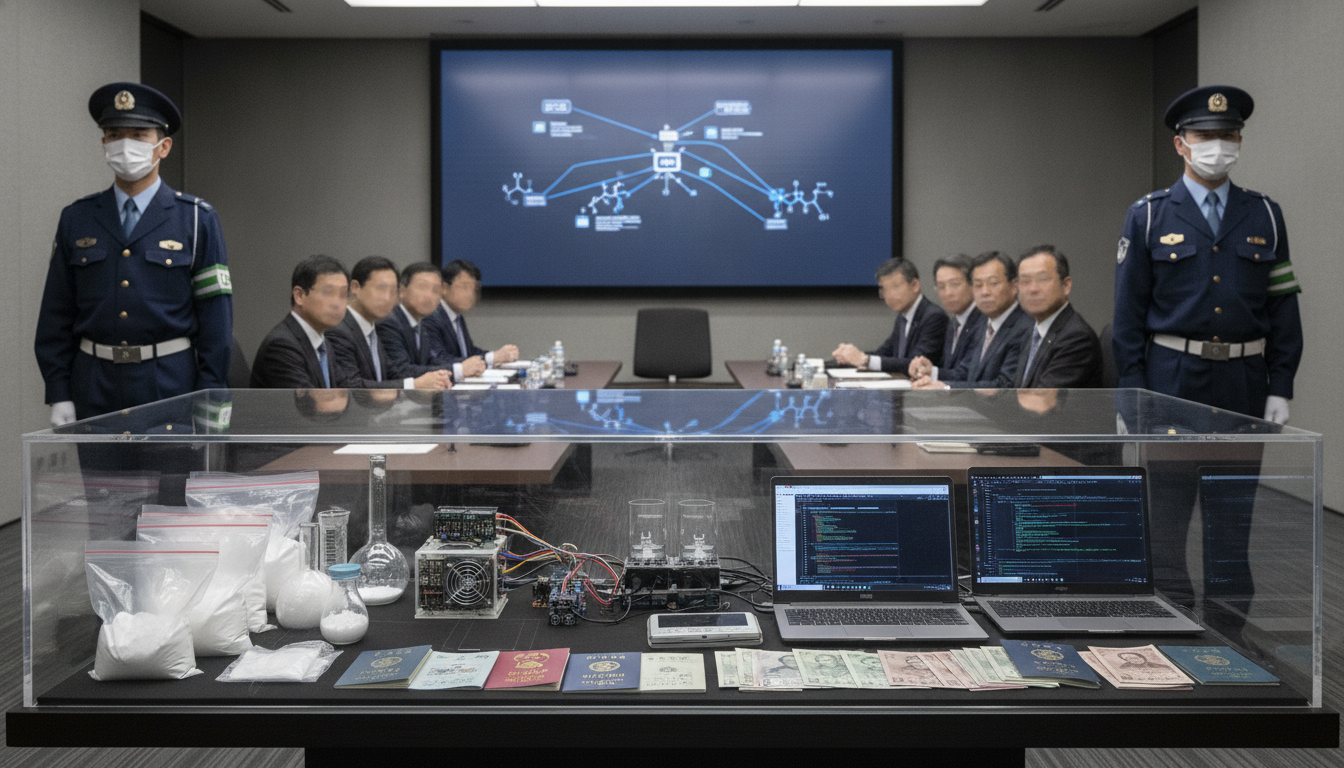
Chinese group accused of exporting fentanyl precursors also linked to cryptocurrency fraud centered in Japan, Nikkei finds
Nikkei finds that a Chinese organization suspected of exporting fentanyl precursors allegedly operated large-scale cryptocurrency fraud from a Japan base, raising cross-border enforcement concerns.
A Nikkei investigation has uncovered what it says is a link between a Chinese organization suspected of illegally exporting chemical precursors for fentanyl and a parallel operation in Japan that ran large-scale cryptocurrency fraud. The probe suggests the same network used a Japan-based hub to convert payments and obscure flows tied to the alleged precursor shipments. The finding brings fresh scrutiny to how illicit chemical supply chains and virtual-asset channels intersect across borders.
Nikkei investigation traces dual activities
A detailed review by Nikkei indicates the group under suspicion engaged in both the production or export of fentanyl precursors and in financial operations that relied on digital assets. Investigators who reviewed corporate connections, transaction trails and local activity in Japan say the two strands appear to be part of a single enterprise. Nikkei described the Japan foothold as a critical link that enabled movement of funds and may have assisted in disguising the ultimate destinations of chemical shipments.
The investigation did not present public evidence of arrests or judicial findings against named individuals at the time of reporting. Nikkei’s reporting frames the activity as apparent and alleged, noting the difficulty in tracing precursor shipments and the opacity of many virtual-asset services.
Operations reportedly used Japan as a conversion point
According to the report, the Japan-based operations acted as a conversion or staging point where proceeds from illicit sales were processed through cryptocurrency-related services. Such hubs can provide access to exchanges, payment rails and intermediaries that complicate cross-border tracing. The Nikkei findings suggest the use of Japan as a strategic location for converting funds into digital assets and then layering those assets through multiple transfers.
The existence of a Japan-connected element underscores the transnational nature of modern precursor and money-movement networks. Authorities and experts warn that even when chemical manufacturers or traders sit in one country, financial and logistical nodes in other jurisdictions can be vital to sustaining illegal flows.
How fentanyl precursors fuel the synthetic opioid trade
Fentanyl precursors are the chemical building blocks used to manufacture the synthetic opioid fentanyl, a substance responsible for a large share of overdose deaths in multiple countries. Controlling the manufacture and export of these precursor chemicals is a central focus of international drug-control efforts because they enable the large-scale production of potent opioids outside formal pharmaceutical channels. The Nikkei investigation connects the alleged precursor trade to wider financial mechanisms that can hide profits and evade enforcement.
Regulators and law enforcement say that identifying and interdicting precursor shipments is challenging because many precursor chemicals have legitimate industrial uses. Smugglers and illicit manufacturers exploit legal trade routes, intermediaries and complex corporate structures to obscure the end use of shipments.
U.S. and Japanese authorities facing enforcement challenges
U.S. agencies have been stepping up efforts to curb the import and distribution of fentanyl and its precursors, and Japan has increased scrutiny of suspicious financial flows involving virtual assets. The photograph accompanying the reporting shows fentanyl stored at a U.S. Drug Enforcement Administration laboratory in New York, underscoring American operational engagement in tracing and securing controlled substances. Officials in multiple countries have emphasized the need for intelligence-sharing as illicit networks use global commerce and crypto services.
Cross-border investigations are often slowed by differing legal frameworks, information-sharing limits and the technical complexity of tracing cryptocurrencies. These gaps provide windows that transnational groups can exploit to move chemicals, funds and finished drugs.
Regulatory gaps in chemical trade and virtual assets highlighted
The Nikkei findings highlight persistent regulatory gaps that can be exploited at the intersection of chemical trade and digital finance. Precursor chemicals that are dual-use — serving both legitimate industry and illicit drug production — require finely calibrated controls, while virtual-asset markets still vary widely in oversight and anti-money-laundering practices across jurisdictions. Observers say harmonizing listing controls for chemicals and strengthening oversight of crypto intermediaries would narrow opportunities for abuse.
Industry representatives caution that curbs must be targeted to avoid harming legitimate commerce and innovation. At the same time, law enforcement agencies argue that more robust red lines and rapid cooperation mechanisms are necessary to stem the flow of precursors and the laundering of proceeds.
Calls for greater international cooperation and intelligence sharing
The investigation has prompted calls from experts for intensified international cooperation, combining customs scrutiny, financial-monitoring, and proactive regulatory steps for virtual assets. Policymakers who study illicit supply chains say joint task forces and automated data exchanges can help close the gaps that allow precursors and proceeds to move with relative ease. The mix of chemical exports and crypto-enabled finance, they add, requires synchronized action rather than isolated measures.
Multilateral institutions and bilateral law-enforcement partnerships are likely to be focal points in any coordinated response, according to observers familiar with similar past operations.
The Nikkei investigation adds to growing evidence that networks trafficking fentanyl precursors may also be active in online and crypto-enabled financial schemes, complicating enforcement and policy responses across jurisdictions.

