
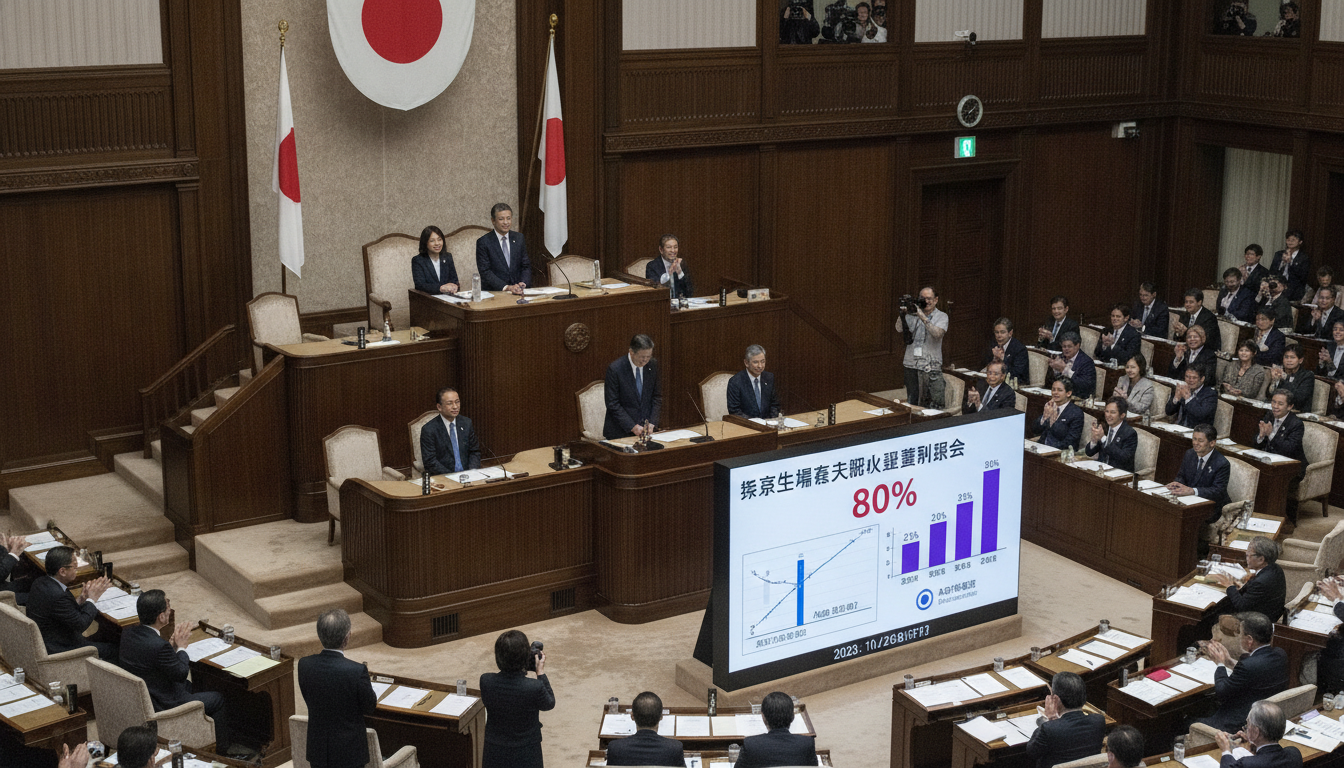
Japan’s debate over Imperial succession intensifies after Diet passes law; poll shows strong support for a female emperor but divided views on adoptee sons’ eligibility.
Nikkei–TV Tokyo poll finds 80% back a female emperor, yet 42% approve and 45% oppose allowing sons of adopted male-line descendants to inherit following the Diet’s July 17, 2026 revision to the Imperial House Law.
The latest Nikkei–TV Tokyo survey revealed broad public support for a female emperor while exposing a near-even split over the new succession route created by legislative changes. The Diet on July 17, 2026 approved a revision to the Imperial House Law enabling a male-lineage male descendant from a former imperial branch to be adopted into the imperial family, a move that would make his male children eligible for imperial succession. Public reaction is mixed: a clear majority backs the idea of a female emperor, yet the specific mechanism of succession through adoptees drew narrow opposition in the poll.
Poll shows overwhelming backing for a female emperor
The Nikkei–TV Tokyo poll recorded support exceeding 80 percent for allowing a female to ascend the Chrysanthemum Throne, reflecting growing public openness to non-traditional succession arrangements. Respondents cited continuity of the imperial household and modernizing the institution as common reasons for support. The result marks a consistent thread in opinion surveys in recent years favoring flexibility in succession rules to address demographic and practical challenges.
Public backing for a female emperor emerged even as lawmakers pursued a parallel legal pathway aimed at preserving male-line continuity. The contrast between strong support for female succession and unease about adoptee-based succession signals nuanced public attitudes rather than a simple preference for one solution. Analysts say the divergence underscores differing priorities among voters: equality and modernity on one side, and concerns about tradition and legitimacy on the other.
Diet approves adoption pathway into imperial family
On July 17, 2026, the Diet enacted a revision to the Imperial House Law that permits the adoption of a male-lineage male descendant from a former imperial branch into the current imperial family. Lawmakers who supported the change argued it creates an additional, legally sanctioned option to secure a male successor without immediately altering long-standing male-line traditions. The statutory amendment formalizes an adoption mechanism that advocates say could stabilize the line of succession for decades.
Supporters in the Diet emphasized the practicality of expanding the pool of eligible male heirs amid a shrinking imperial family. Opponents warned of legal and constitutional questions, and some raised concerns about whether adoptee successors would command the same degree of public acceptance. The new law specifies procedural steps for such adoptions, but it leaves open how eventual succession claims might be received by the public and by the imperial household itself.
Public opinion split over sons of adoptees
While the poll showed broad endorsement for female rulers, it found that 42 percent of respondents considered it appropriate to allow sons of adopted, former-branch descendants to inherit, and 45 percent judged the measure inappropriate. This nearly even split highlights public uncertainty about how best to preserve the monarchy’s continuity. Skeptics cited the importance of historical lineage and questioned whether adopted descendants would be seen as legitimate custodians of imperial tradition.
Supporters of the adoptee route say it preserves the male-line principle while offering a workable solution to demographic constraints. Critics counter that the measure may appear to manipulate family ties for political ends and could prompt further disputes over interpretation of imperial status. The poll results suggest that while the public wants solutions, there is no consensus on the form those solutions should take.
Potential impact on imperial household and future heirs
The law change and the poll’s findings raise practical questions about the future composition of the imperial household and the status of current female members. Allowing a female emperor and simultaneously creating an adoptee pathway for male succession could result in parallel, potentially competing narratives about legitimacy and precedent. Members of the imperial family, including those currently active in public duties, may face new scrutiny as the public weighs competing succession models.
Scholars of constitutional and imperial affairs say the revised law does not automatically determine who will stand next in line, but it does expand legal options available to the government and to the imperial household. Court and constitutional experts note that any future succession will likely involve close consultation between the imperial household agency, the Diet, and the public. The interplay between legal mechanisms and public sentiment will be critical if adoptee-born claimants emerge as potential heirs.
Political outlook and next steps
With the law now in force, lawmakers and political parties will need to navigate follow-up measures, public outreach, and potential challenges that could arise in implementation. Expect continued parliamentary oversight and further debate about the social and ceremonial implications of adopting descendants from former branches. Civic groups and opinion leaders are likely to press for clearer explanations and reassurances about the law’s intent and safeguards.
The government may also invest in public education campaigns and expert consultations to build a broader consensus on succession practices. Given the poll’s split on the adoptee route, political leaders will face pressure to justify the legislative choice to skeptical constituencies and to explain how it complements, rather than conflicts with, the public’s strong support for a female emperor.
Public confidence and clarity around the succession process will be central as Japan balances respect for imperial traditions with evolving public expectations. The combination of robust backing for a female emperor and reservations about adoptee-based succession leaves policymakers with a complex mandate: to maintain continuity while responding to a populace that increasingly seeks both fairness and stability in the future of the Chrysanthemum Throne.

