
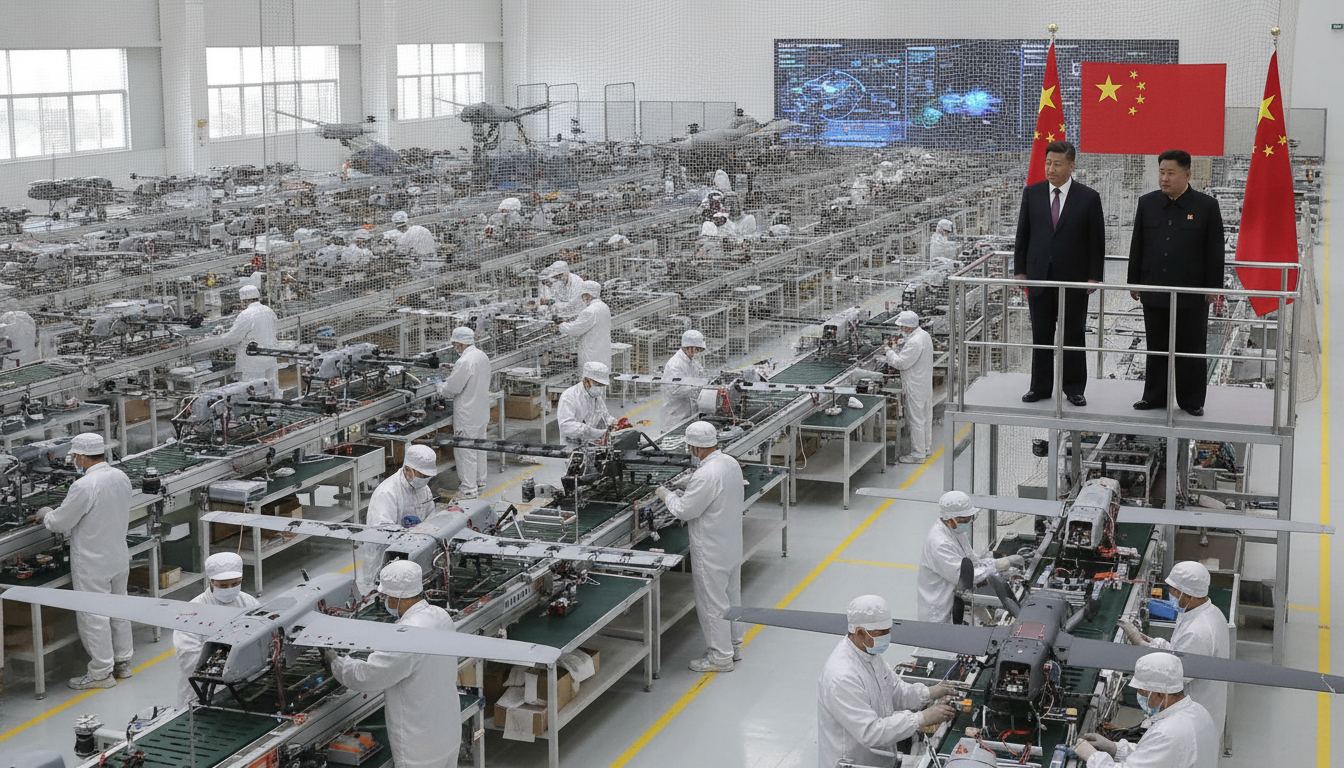
Asia’s Drone Surge Accelerates Networked Warfare
China and North Korea ramp up drone production as Russia’s war accelerates military tech, driving Asia toward networked warfare and prompting defense shifts.
War in Ukraine has become a focal point for military innovation, and recent activity in East Asia shows how drone production is feeding a broader shift toward networked warfare across the region. Chinese and North Korean efforts to scale unmanned systems, together with lessons drawn from Russia’s battlefield adaptations, are accelerating the integration of sensors, communications and autonomous functions into military operations. Governments and militaries in the Asia-Pacific are responding by rethinking procurement, alliance coordination and homeland defenses.
China and North Korea Expand Unmanned Capabilities
China has increased investment in both large and small unmanned aerial systems, combining domestic manufacturing scale with upgrades in sensors and communications. North Korea has similarly prioritized mass production of low-cost drones and missile-delivery adaptations, aiming to field large swarms that complicate traditional air defenses. These parallel paths reflect a strategic calculation that quantity, cost-effectiveness and networked command can produce operational advantages.
Russia’s Battlefield Lessons Drive Technology Transfer
Russia’s conflict in Ukraine has served as an operational testbed for integrating drones, loitering munitions and electronic warfare into combined arms operations. Observers note that combat experience has informed tactics and procurement priorities elsewhere, with several states adapting weapon designs and control systems based on open-source footage and battlefield reports. The result is an expedited learning curve for states seeking to modernize without years of iterative testing.
From Standalone Drones to Integrated Networks
The evolution now underway is less about single platforms and more about how those platforms connect to sensors, command nodes and other weapons in real time. Networked warfare emphasizes shared situational awareness, rapid targeting cycles and remote-controlled or semi-autonomous engagement chains. As communications, data links and battlefield management software improve, drones become nodes in a larger system rather than isolated tools.
Japan Reassesses Defense Posture and Procurement
Tokyo has publicly signaled concern over proliferating unmanned capabilities and the emergence of networked warfare doctrines. Japan’s defense planners are accelerating programs to harden command-and-control networks, field counter-drone technologies and expand intelligence-sharing with allies. This reassessment includes procurement of interceptor systems, electronic warfare assets and resilient communications designed to operate under contested conditions.
Japan’s recent budget proposals and procurement adjustments show a tilt toward layered defenses and redundancy, balancing domestic development with allied interoperability. Officials emphasize that deterrence now requires both physical systems and the ability to integrate information across services and national boundaries.
Export Networks and Technology Diffusion
Commercial supply chains and dual-use manufacturing have made advanced components more widely available, allowing states to acquire or locally produce capabilities faster than in previous generations. Companies and gray-market actors can accelerate diffusion of propulsion, guidance and sensor technologies that enable more capable drones. That diffusion raises concerns about control of advanced components and the effectiveness of export restrictions.
International arms-control regimes face challenges keeping pace with these trends, as low-cost systems and software-driven capabilities complicate traditional monitoring and verification. Policymakers are weighing a mix of export controls, sanctions and cooperative norms to limit destabilizing transfers without undermining legitimate civil and commercial activity.
Escalation Risks and Command Vulnerabilities
Networked warfare can improve battlefield effectiveness, but it also creates new vulnerabilities; centralized data links and common software architectures present potential single points of failure. Adversaries can target networks with cyber intrusions, jamming or deception, aiming to blind or misdirect interconnected systems. The interplay between massed drone attacks and electronic suppression increases the risk of escalation and miscalculation during crises.
Military planners caution that resilience requires distributed command options, secure communications and doctrines that assume intermittent connectivity. Investments in training, redundancy and rapid restoration of degraded networks are becoming as important as investments in kinetic hardware.
The trajectory in East Asia shows drone production is only one element of a larger transformation toward networked warfare, driven by practical battlefield lessons and rapid technological diffusion. Governments in the region will likely continue to adapt procurement, doctrine and alliances to manage both the operational advantages and the strategic risks posed by increasingly networked military systems.

