
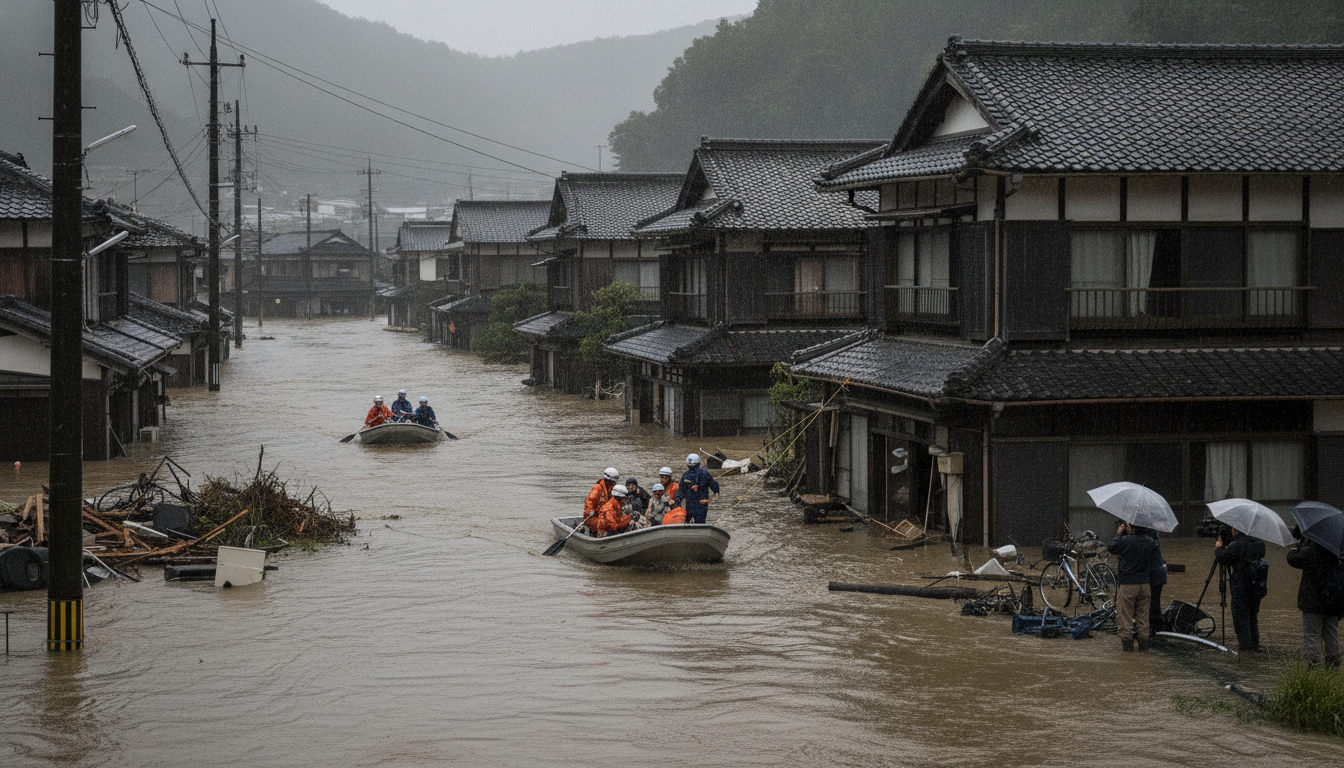
Fukui flooding after record rains leaves at least 117 homes inundated and prompts widespread evacuations
Fukui flooding after record rains on Aug 29-30 left 117 homes flooded, 26 rivers breached and more than 300,000 people warned; authorities press damage surveys.
The prefectoral government reported on August 31 that torrential rain on August 29–30 caused widespread inundation across Fukui Prefecture, with initial tallies showing 117 residential buildings affected. Fukui flooding prompted an unprecedented Level 5 heavy rain special warning in the prefecture, and emergency safety measures were issued to over 300,000 people during the peak of the storm.
Scope of reported residential damage
As of 4 p.m. on August 31, municipal reports to the prefecture recorded 14 houses with floor‑level (above-floor) inundation and 103 houses with below-floor flooding. Officials cautioned that these figures are provisional, since comprehensive inspections in the worst-hit areas have not yet been completed. Fukui City and Sakai City suffered extensive inundation, and local authorities expect the number of affected dwellings to rise as assessments continue.
Record rainfall, unprecedented warning and river damage
The Japan Meteorological Agency and prefectural officials said parts of Fukui City and Sakai City registered their highest 24‑hour rainfall totals on record during the event. For the first time in the prefecture’s history, a Level 5 heavy rain special warning was issued, and more than 300,000 residents received orders for emergency safety measures. The prefecture reported 26 rivers where overflow or embankment damage occurred, and three people sustained minor injuries in scattered incidents.
Flooding in Sakai’s Maruoka area and Fukui’s riverfront districts
In Sakai City, the Maruoka district experienced widespread inundation after nearby waterways overflowed, submerging residential streets and yards. City crisis management officials said damage extended across the municipality and that field teams were still unable to reach many neighborhoods to perform full inspections. In Fukui City, low-lying districts along the Kuzuryu River, including the Morita area, were submerged and many residents faced sudden water rises overnight.
Evacuation at group home Rakuya and care challenges
A group home for elderly residents in the Morita district, known as Rakuya, faced life‑threatening conditions in the early hours of August 30 when rising water approached the facility. The home, which houses 16 elderly people, saw staff move four residents in their late 80s and early 90s to the second floor at about 2 a.m., using wheelchairs and manual assistance as floodwaters advanced. Staff later assisted residents back to ground level after waters receded, underscoring the strain on small care facilities when extreme weather hits without much warning.
Emergency response and damage verification measures
Prefectural officials have opened procedures to accept applications for disaster certification as a means to quantify losses and prioritize relief. Municipal crisis management sections are coordinating with prefectural teams to map flooded zones, inspect embankments and evaluate damage to public works. Recovery planning is being sequenced around lifesaving needs first, then infrastructure repairs and household assistance as confirmation of damage is collected from the field and through resident applications.
Outlook for recovery and ongoing risks
Authorities warned that creeks and riverbanks already weakened by overflow may pose secondary risks if heavy rain returns, and they urged residents near waterways to remain vigilant. Temporary shelters and support centers have been readied in several municipalities, and local governments are advising residents to register for official disaster‑relief procedures to receive aid and certification. Emergency services continue to patrol access routes to prioritize rescue and relief to isolated neighborhoods.
The scale of the Fukui flooding will become clearer in the coming days as survey teams complete on‑the‑ground inspections and households submit official damage notifications. In the meantime, prefectural and municipal authorities have emphasized caution and urged residents to follow evacuation guidance, report any new damage and check updates from local crisis management offices.

