
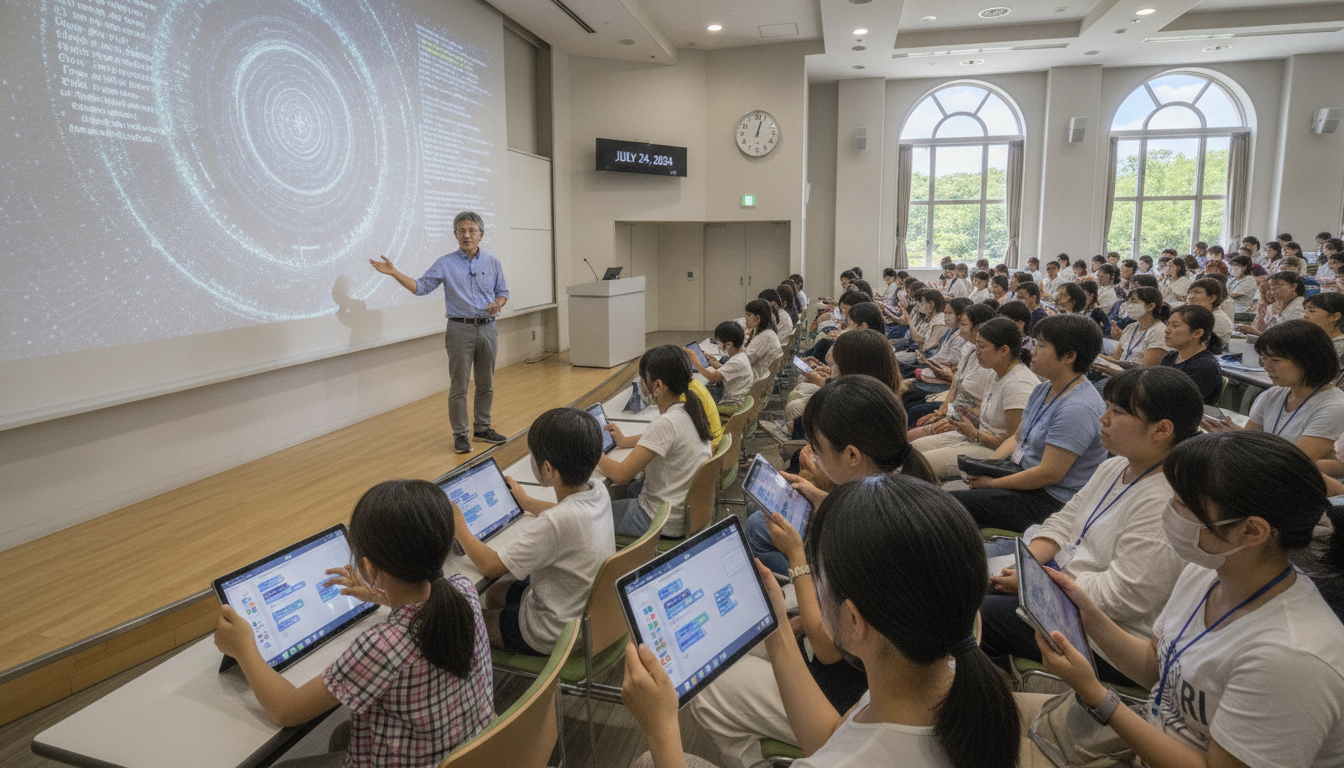
AI for summer homework: expert urges teaching "how," not banning, and warns against full outsourcing
Meta description: Brain researcher Yuji Ikeya urges parents to teach children how to use AI for summer homework, not ban it, and warns that outsourcing harms learning.
Children returning from the start of summer vacation are increasingly turning to generative AI for help with assignments, and brain researcher Yuji Ikeya says parents should treat AI for summer homework as a tool to be taught, not a temptation to ban. Ikeya, whose own daughter told him classmates had used ChatGPT to write graduation essays, argues that forbidding the technology is neither feasible nor beneficial. He urges parents to guide children to ask "How?" rather than "What?" when they consult AI, and to guard against handing work over entirely.
Parents confront AI-written assignments
Many families now discover essays, book reports and other written homework that bear the unmistakable signs of machine generation. Reports of classmates using ChatGPT to draft graduation pieces alarmed some parents and educators this year. Ikeya says such reactions are understandable, but that blanket bans are unrealistic because the tools are already part of children’s daily lives.
Parents often face a choice between strict prohibition and permissive acceptance. Ikeya recommends a middle path: acknowledge AI’s presence and set rules that prioritize learning. He stresses that prohibiting use will not prevent it, and may instead push children to conceal their actions.
"Ask ‘How’, not ‘What’": a practical rule
Ikeya’s core piece of advice is simple and actionable: teach children to ask AI how to approach a task, rather than asking for finished answers. Instead of prompting "What is the answer?" he suggests queries such as "How should I begin solving this?" or "Here is what I have done so far — how can I progress?"
This approach positions AI as a problem-solving coach rather than an author. It encourages the child to attempt the work independently first and use AI to overcome specific obstacles, which helps preserve the cognitive effort essential for learning.
Using AI to broaden reading and analysis
Ikeya describes how AI can expand perspectives when used after a student writes an initial draft. Asking the system to produce several different takes on a book report, for example, can reveal alternative readings and highlight aspects the student missed. Those comparisons can deepen understanding rather than replace it.
When children compare their own writing with AI-generated versions, they may discover new points to explore or stylistic choices to revise. Ikeya frames this as an enlargement of the traditional learning model, where children once learned by imitating teachers and peers; now the sources of imitation include digital agents as well.
Clear lines: why full outsourcing is harmful
Despite AI’s utility, Ikeya is unequivocal that handing over homework wholesale undermines cognitive development. He likens learning to muscle training: mental skills strengthen through effort and repeated challenge. If tasks are consistently completed by a machine, the student loses that exercise.
Allowing AI-generated submissions also risks academic dishonesty and deprives teachers of meaningful assessment. For both ethical and developmental reasons, Ikeya urges families and schools to define what counts as acceptable assistance and to insist on visible student effort.
Guidance steps for parents and teachers
Ikeya recommends several concrete practices parents and educators can adopt immediately. First, require students to produce an initial draft or outline on their own before consulting AI. Second, have children present the AI’s output alongside their draft and explain any changes they made. Third, teach specific prompts that seek process help — for example, asking for step-by-step strategies or suggestions for further reading.
He also advises conversations about intent and integrity: parents should explain why doing the work matters and how reliance on AI can short-circuit skill development. Teachers can support this by designing assignments that reward original reflection and process documentation, making it harder to substitute AI for personal effort.
Balancing assistance and practice during summer
With long vacations and heavy writing assignments, the temptation to lean on AI for speed and convenience is strong. Ikeya acknowledges that children will find ways to use new tools, and he urges adults to prioritize learning over policing. By framing AI for summer homework as a permitted but supervised aid, families can both harness technological benefits and protect the practice that builds competence.
He emphasizes that the broader goal is not to eliminate AI from children’s lives but to cultivate habits that make its use educational. That includes modeling how to question sources, how to iterate on drafts, and how to reflect on what was learned through the process.
Summer assignments will likely remain a touchstone for debates over technology and education. As tools evolve, Ikeya’s message is clear: equip children with guidance on how to use AI responsibly and insist that the work ultimately belongs to them.

