
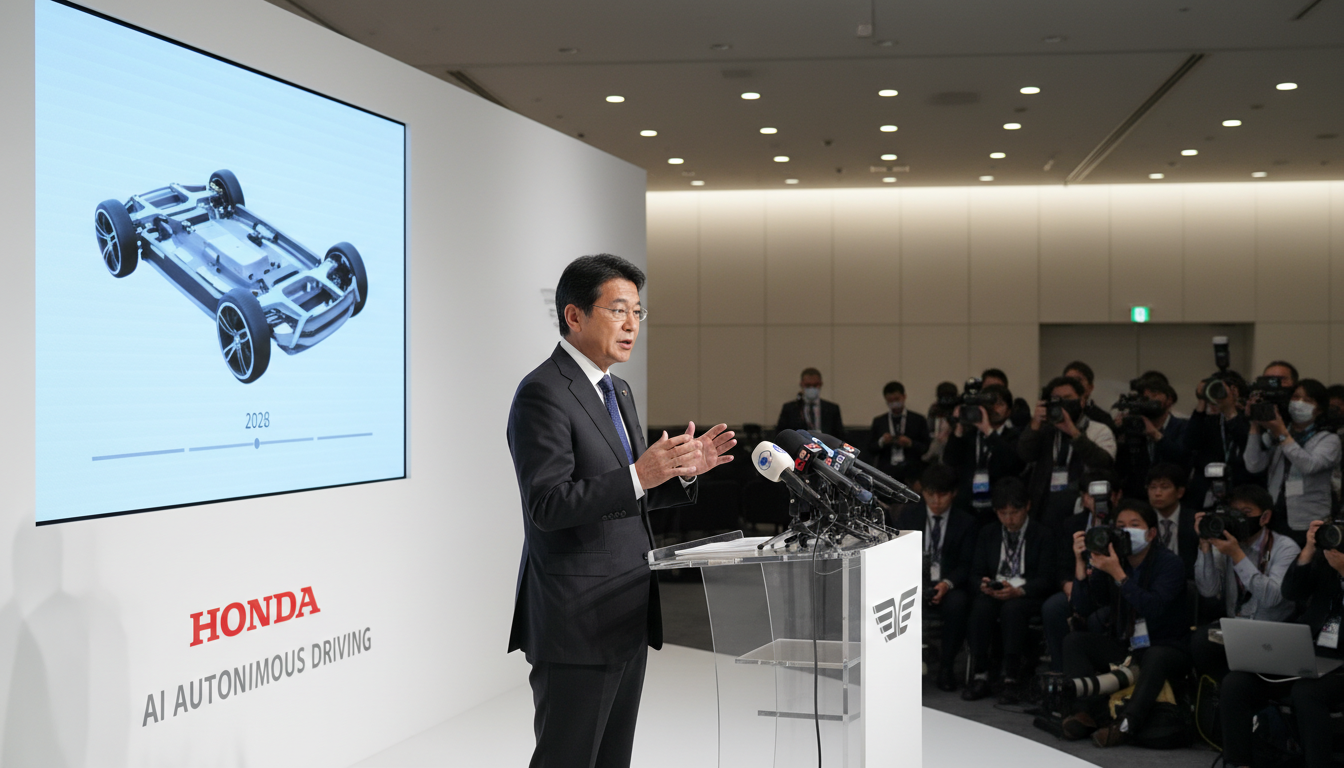
Honda delays autonomous driving to 2028 as it cancels three planned EVs and books multibillion‑dollar losses
Honda will push back its timetable for rolling out AI‑powered autonomous driving to 2028 as the automaker cancels multiple next‑generation electric vehicle projects, prompting a sharp reassessment of its EV strategy and a substantial financial write‑down. The delay in autonomous driving implementation and the withdrawal of the Honda 0 Series Saloon and SUV and the Acura RSX were presented by the company as part of a broader move to rebalance resources toward hybrids and markets with stronger near‑term demand. The shift marks a major strategic pivot for the Japanese firm and raises fresh questions about its competitiveness in software‑defined vehicles.
Cancellation of three North American EV models
Honda announced it will stop development and the planned market launch of three electric models destined for production in the United States: the Honda 0 SUV, the Honda 0 Saloon and the Acura RSX. The company said the decision followed a reassessment of its automobile electrification strategy in light of changing market conditions and policy shifts that have weakened near‑term EV demand. This move effectively halts a flagship segment of Honda’s clean‑sheet 0 Series program that had been intended to showcase next‑generation design and software integration. (global.honda)
Financial impact and large write‑downs
The cancellations will carry a heavy price. Honda told investors it expects to record significant write‑offs and impairment losses linked to assets and development costs for the aborted projects, warning that total losses could reach as much as 2.5 trillion yen across the current and next fiscal periods. The company also revised down its profit forecasts and disclosed that executive compensation will be partially returned or reduced in response to the earnings hit. Management framed the provisions as necessary to stabilise the balance sheet while the business is reorganised. (global.honda)
Autonomous driving timetable pushed back
As part of the strategic reset, Honda said it will slow the timetable for introducing AI‑driven autonomous functions in its passenger vehicles, moving some planned rollouts roughly one year later and now targeting wider implementation in 2028. Company officials described the change as a recalibration aimed at matching technology deployment to viable market demand and regulatory readiness, while concentrating investment in hybrid and cost‑competitive models. Analysts warn the setback narrows Honda’s window to catch up with rivals that are prioritising software platforms and advanced driver assistance systems. (forbes.com)
Pivot to hybrids, India and flexible electrification
Honda’s statement stressed that the company will redirect resources to strengthen its hybrid lineup and expand models tailored to regional demand, notably in India, where cost‑sensitive consumers remain dominant. The automaker plans to implement future EV introductions “flexibly” and to present a reestablished mid‑ to long‑term automobile strategy at a May press conference. Executives framed the shift as a pragmatic response to an uneven global transition to battery electrification, with hybrids offering a more resilient path to profitability in the near term. (global.honda)
Market reaction and competitive risks
Investors reacted swiftly, with analyst commentary highlighting the reputational and technological risks of pausing flagship EV development while competitors deepen ties with software and AI partners. Industry observers note that China’s EV manufacturers and U.S. incumbents have accelerated investments in software platforms, sensor stacks and in‑house AI capabilities, heightening pressure on legacy automakers that scale back their EV roadmaps. Some analysts say Honda’s retreat may reduce its leverage in software‑defined vehicle ecosystems and slow its learning curve in autonomous systems. (oica.net)
Operational and supply chain consequences
Suppliers and U.S. manufacturing plans are already being affected by the cancellations. Factories that had been retooled for the 0 Series models will see changes to production plans, and Honda acknowledged there will be additional expenses tied to halting development and reconfiguring operations. The company said it will work with partners and stakeholders to mitigate disruption, but warned that additional costs could materialise in the next fiscal year as transitions are implemented. (global.honda)
The cancellations and the deferred roll‑out of AI‑enabled driving underline how quickly automakers’ strategic plans can change in response to volatile demand, shifting public policy and intensifying technological competition. Honda’s decision aims to shore up near‑term profitability and preserve cash for core markets, but it also hands rivals an opening in the race for software and autonomous leadership that the company will need to close in the years ahead.

