
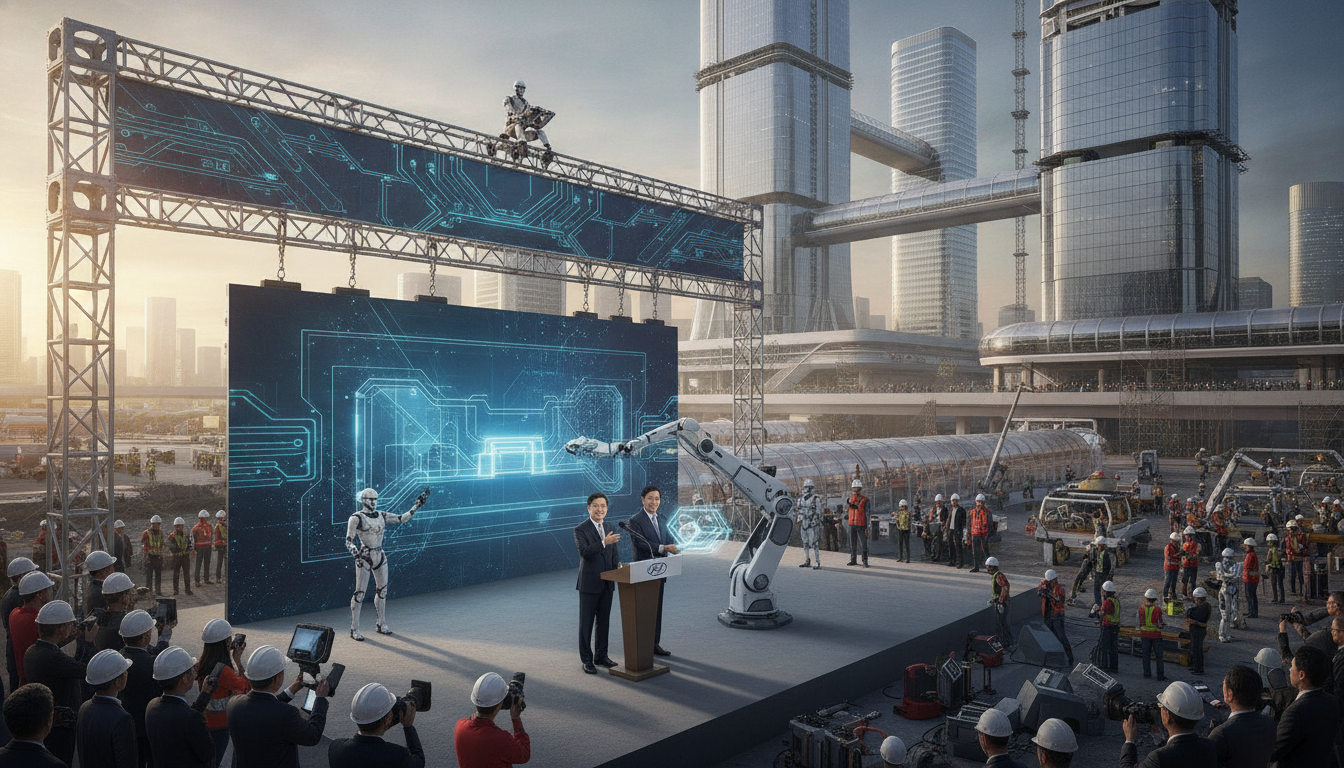
Hyundai Accelerates Hyundai Robotic AI Push with Billion-Dollar Futuristic Urban Center
Hyundai accelerates its robotic AI push, investing billions to build a futuristic urban center and partnering with global tech firms to commercialize robotics.
South Korea’s Hyundai Motor Group has launched an ambitious programme to transform itself from an automaker into a leading developer of robotic physical artificial intelligence, investing billions of dollars in a purpose-built urban development to test and showcase its technology. The move, led publicly by Executive Chair Chung Euisun, seeks to unite vehicle manufacturing, advanced chips and service robots under a single commercial strategy that Hyundai calls a step toward a new industrial future. Industry observers say the company’s scale of spending and visible partnerships position it among a small group of firms pursuing full-stack robotics solutions.
Hyundai’s Strategic Shift to Robotics
Hyundai’s pivot centers on integrating robotic systems and AI into mobility, logistics and urban infrastructure to create what company communications describe as “physical AI.” This strategy expands the firm’s traditional focus on cars to include humanoid robots, autonomous shuttles and automated factories. The company has framed the effort as a long-term bet on platforms that combine software, sensors and hardware to operate in human environments.
The strategy reflects broader trends in the technology sector where manufacturers aim to own both physical devices and the artificial intelligence that controls them. For Hyundai, the decision follows internal investments in software units and external minority stakes in chip and AI companies, signaling an attempt to control more of the value chain rather than remain a parts buyer.
Billions Allocated for Futuristic Urban Center
Hyundai has committed “billions of dollars” to build a futuristic urban center intended as a living laboratory for its robotic AI systems and smart mobility services. The site is designed to host prototypes, pilot commercial services and act as a visible demonstration for investors, city planners and potential corporate partners. Company statements indicate the center will include testing corridors, demonstrator homes and public spaces equipped for autonomous delivery and service robots.
Executives say the urban center is meant to accelerate product maturation by exposing systems to dense, real-world conditions that traditional test tracks cannot replicate. Officials also view the project as a way to attract talent, showcase commercial use cases and shorten the timeline from prototype to revenue-generating service.
Partnerships with Chipmakers and Tech Firms
Hyundai’s robotics ambitions have been accompanied by high-profile partnerships with semiconductor and software companies to secure computing power and development platforms. Public appearances by Executive Chair Chung Euisun alongside technology leaders have underscored the importance of collaboration in areas such as AI chips, simulation software and cloud infrastructure. These alliances aim to supply the large-scale data processing and inference capabilities required by real-time robotic systems.
Industry analysts note that robotics projects are capital- and compute-intensive, and that hardware partners are essential to making advanced vision, motion planning and interaction capabilities feasible. Hyundai’s emphasis on partnerships suggests a strategy to combine its manufacturing scale with outside expertise in specialized chips and AI stacks rather than attempting to build every component in-house.
Commercial and Industrial Implications
If successful, Hyundai’s robotic AI push could reshape several of its existing businesses while creating new revenue streams in services and platform licensing. Potential commercial outcomes include autonomous ride and delivery services, industrial automation contracts and consumer-facing home robots. The company’s manufacturing operations could also benefit from increased automation and flexible production architectures tailored to robot-integrated supply chains.
Transforming an auto-centric culture into a diversified robotics firm will require changes across corporate governance, talent recruitment and capital allocation. Observers say Hyundai’s ability to monetize services and secure regulatory approvals for public deployments will be critical to justifying the heavy upfront investment.
Technical and Regulatory Challenges Ahead
Delivering safe, reliable robotic systems that interact closely with people remains technically challenging and legally complex. Developers must solve perception and decision-making problems in unpredictable environments while meeting stringent safety and data privacy regulations. Urban deployments face additional hurdles such as municipal permitting, insurance frameworks and public acceptance.
Hyundai’s approach of using a controlled urban center as a testbed aims to mitigate some of those risks by allowing iterative deployment under monitored conditions. Nevertheless, scaling demonstrations into widespread commercial operations will require sustained engineering effort and close coordination with regulators and local governments.
Market Competition and Talent Acquisition
The race to lead in robotic physical AI pits Hyundai against established tech giants, specialized robotics firms and other industrial conglomerates investing in similar areas. Competition for skilled AI researchers, robotics engineers and systems integrators is intense, and companies often complement hiring with acquisitions and partnerships. Hyundai’s investments in facilities and visibility through demonstrator projects are intended to strengthen its appeal to top talent.
Securing a steady pipeline of engineering expertise and maintaining productive collaboration with academic and corporate partners will be crucial for maintaining momentum. Observers caution that technological leadership can shift quickly, placing a premium on execution speed and adaptability.
Hyundai’s decision to commit substantial capital to robotics and a dedicated urban test environment marks a clear attempt to redefine its corporate identity for the next decade. The initiative weaves together manufacturing scale, strategic alliances and public demonstrations to accelerate the adoption of robotic physical AI. Success will hinge on Hyundai’s ability to turn prototypes into repeatable, safe and profitable services while navigating technical, regulatory and market hurdles.

