
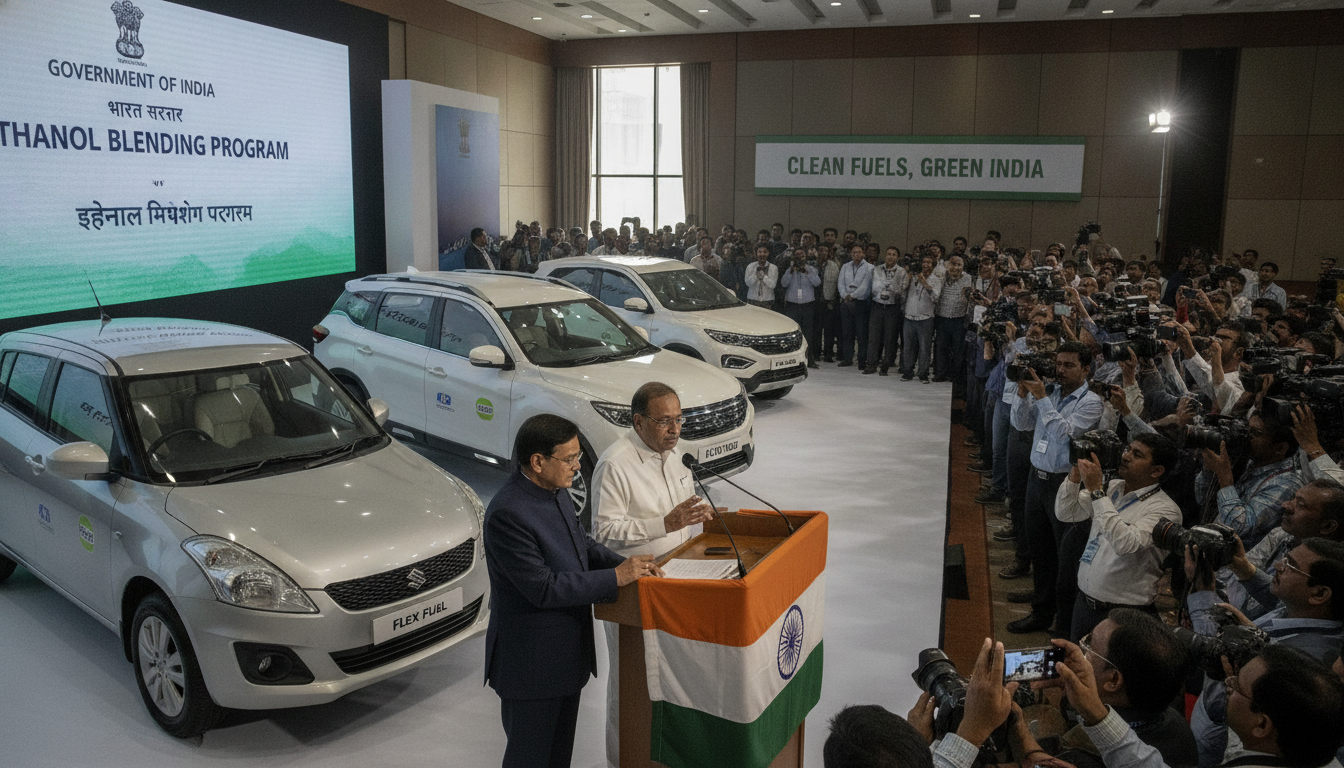
India pushes ethanol blends to reduce reliance on Middle East oil
India accelerates ethanol blends in petrol to curb Middle East oil dependence, as automakers like Suzuki and Maruti expand flex‑fuel models and policymakers back biofuel scale‑up.
India’s central government has stepped up efforts to expand ethanol blends in petrol, aiming to reduce reliance on Middle East oil imports while supporting domestic agriculture and industry. The push for ethanol blends is driving automakers to introduce flex‑fuel vehicles and prompting fresh policy measures to increase domestic biofuel supply. Officials and industry leaders cited recent vehicle debuts and regulatory signals as evidence of a broader shift toward ethanol‑compatible transport.
Government signals stronger support for ethanol blends
The government has framed ethanol blends as a strategic tool to lower crude oil import bills and strengthen energy security. Ministers including Nitin Gadkari and Hardeep Singh Puri have publicly endorsed measures that would broaden ethanol integration across the fuel supply chain.
Policy measures under discussion focus on incentives for ethanol production, higher blending targets, and coordination with state governments to create procurement and distribution channels. Officials argue that increasing ethanol content in petrol can be achieved without abrupt disruptions if industry and regulators cooperate closely.
Automakers roll out flex‑fuel models following Suzuki lead
Japan’s Suzuki Motor, through its Indian subsidiary Maruti Suzuki, was the first to bring a mass‑market flex‑fuel car to India, demonstrating manufacturer readiness for ethanol‑compatible vehicles. That debut has encouraged other automakers to introduce or plan models able to run on varying ethanol‑petrol mixes.
Manufacturers say flex‑fuel technology requires modest engineering adjustments compared with conventional models, and they expect economies of scale as demand grows. Automakers also view ethanol compatibility as a marketing point in a market increasingly sensitive to fuel costs and national energy strategy.
Farmers and distillers poised to expand ethanol supply
Scaling up ethanol blends depends on boosting feedstock production and distillation capacity, with sugar mills and grain processors central to the supply plan. The government is engaging with agricultural stakeholders to align cropping choices and procurement mechanisms with ethanol demand.
Distillers are exploring investments to convert sugarcane and other feedstocks into fuel‑grade ethanol, while refiners assess co‑processing arrangements to ensure blend consistency. Industry executives stress the need for stable, predictable pricing to justify investment in new distillation and storage facilities.
Logistics and fuel distribution remain key hurdles
Wider adoption of ethanol blends requires upgrades to storage, transport and blending infrastructure at terminals and retail outlets. Ethanol is hydrophilic and must be handled differently from conventional petrol, so distribution networks need material and procedural adjustments.
Public and private sector players face a timetable challenge: retrofitting terminals and ensuring retail pumps can dispense consistent ethanol blends without contamination. Regulators are weighing phased rollouts and pilot programs to reduce disruption while testing large‑scale logistics capability.
Refiners and oil importers weigh economic trade‑offs
For refiners, higher ethanol blends could change product slates and margins, prompting recalibration of refinery runs and import strategies. Reducing petrol demand in favour of ethanol could lower crude oil imports from the Middle East, but it also raises questions about refinery utilization and downstream margins.
Economists note that the net economic impact will hinge on ethanol pricing relative to petrol, government subsidies or mandates, and the pace at which vehicles capable of higher blends enter the fleet. Consumers may benefit from lower prices at the pump if ethanol is cost‑competitive, but transitional costs could be reflected in fuel logistics and vehicle adaptation.
Environmental and technical debates persist around blends
Proponents highlight ethanol blends as a way to lower greenhouse gas emissions from the transport sector and to provide value to agricultural residues and cane production. However, environmental analysts caution that lifecycle emissions depend on feedstock choices, land use changes and production methods.
Technically, higher ethanol concentrations can affect engine calibration and materials, which is why flex‑fuel vehicle technology and thorough testing remain central to deployment plans. Industry groups and regulators are collaborating on standards to ensure vehicles deliver performance and durability across blend ranges.
Overall momentum suggests a sustained policy and market push toward ethanol blends as part of India’s energy diversification strategy. The combination of government backing, automaker interest and expanding feedstock supply positions ethanol to play a larger role in India’s petrol mix in the years ahead.

