
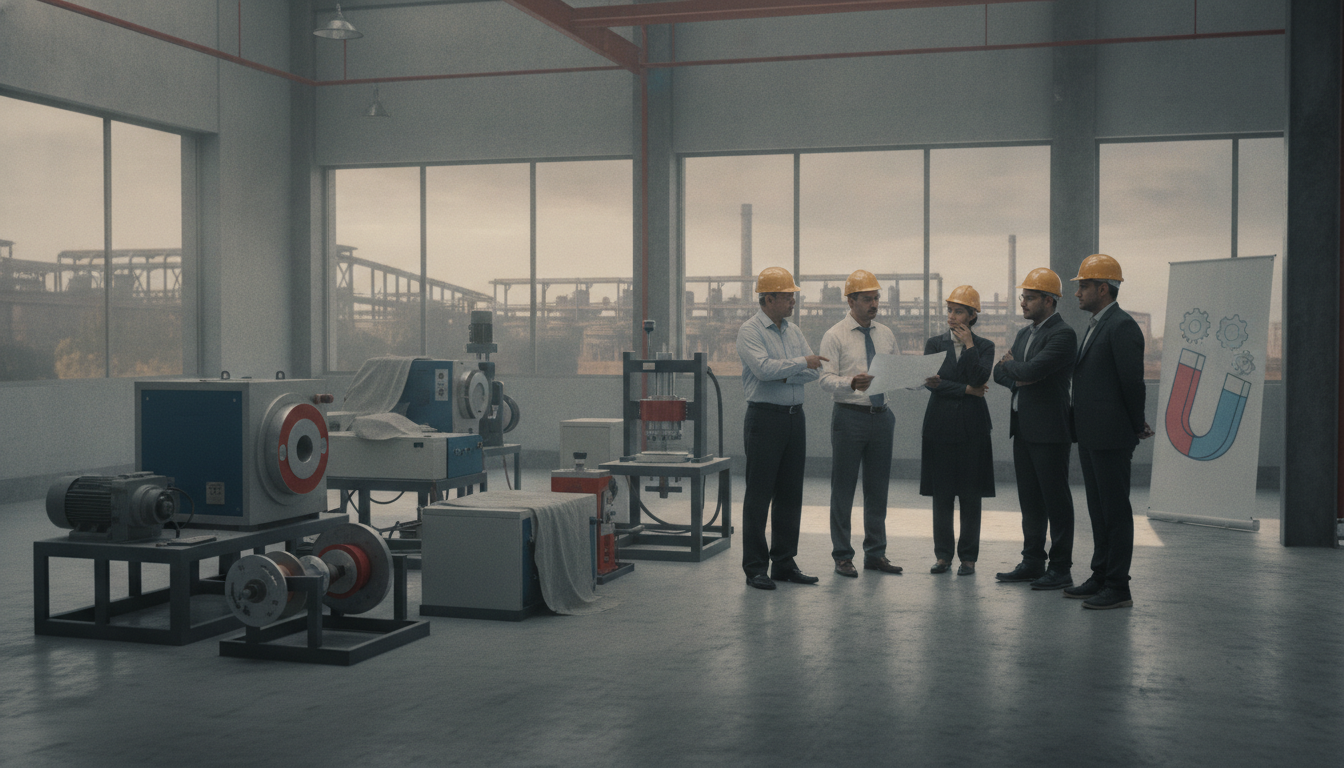
India’s 72.8 Billion Rupee Push for a Rare-Earth Magnet Industry Sparks Industry Debate
India’s 72.8 billion rupee incentive programme to establish a rare-earth magnet industry has attracted a wave of domestic and international bidders, but companies warn that New Delhi’s preference for smaller, vertically integrated plants with time-limited subsidies may hamper global competitiveness.
Bidders have responded quickly to the government’s financial package designed to jump-start domestic magnet manufacture, yet many applicants and industry advisers question whether the chosen model will produce firms able to compete with entrenched global producers. The debate centers on scale, the structure of support, and how to align rapid capacity-building with long-term commercial viability.
New Delhi’s 72.8 Billion Rupee Plan Draws Diverse Bidders
A broad set of companies from India and abroad submitted proposals after the government announced the incentive scheme aimed at reviving the rare-earth magnet industry. Proposals range from small integrated facilities to joint ventures that promise technology transfer and local employment.
Officials framed the programme as a strategic effort to reduce dependence on single-country suppliers and to capture more value along the magnet supply chain. The financial inducement has heightened interest, but it has also focused attention on the policy’s fine print and eligibility conditions.
Industry Voices Raise Concerns Over Small Plant Strategy
Several firms that entered the bidding process told industry observers that they are uneasy about the emphasis on smaller end-to-end plants. Their concern is that vertically integrated sites, while politically attractive, face higher unit costs and steeper learning curves compared with larger, specialized facilities.
Executives argue that the magnet value chain—from rare-earth oxide separation to alloying, sintering and coating—benefits from specialization and scale economies. They caution that time-limited subsidies risk leaving nascent companies exposed once incentive periods end and global competition intensifies.
N.A.N. MagneTech’s Andhra Pradesh Project Offers a Case Study
Developers such as N.A.N. MagneTech are moving forward with projects that illustrate both ambitions and questions about scale. The company’s planned facility at Naidupeta Industrial Park in Andhra Pradesh is being promoted as a step toward localized magnet production and broader supply-chain resilience.
The project’s 3D renderings highlight modern plant design and downstream capabilities, but the timeline for achieving full commercial output and competitive cost structures remains uncertain. Observers note that early-stage facilities can prove critical for skill building, even if they do not immediately match the output of larger international competitors.
Technical and Economic Hurdles Remain Significant
Building a rare-earth magnet industry requires not only capital but also complex metallurgical expertise and secure access to feedstock. Processing rare-earth elements into permanent magnets involves specialized steps that are capital-intensive and sensitive to operational scale.
Analysts point to potential bottlenecks in sourcing high-purity rare-earth oxides, the need for reliable sintering and coating processes, and the long lead times to reach full production efficiency. Those technical hurdles can amplify the cost impact of fragmented, small-scale plants and make it harder to achieve profitable margins without sustained market protection.
Policy Makers Cite Resilience and Rapid Deployment as Priorities
Government officials defending the policy say smaller, vertically integrated plants can be deployed faster and distributed across regions to avoid concentration risks. They emphasize strategic autonomy, job creation and the desire to develop an indigenous industrial base as reasons for the subsidy design.
Proponents also argue that a network of local plants will stimulate supplier ecosystems, encourage innovation and provide training pathways for technicians and engineers. They contend that initial subsidy windows are meant to accelerate capacity-building rather than to underwrite perpetual protection.
Global Market Implications and Regional Competition
The shape of India’s emerging magnet sector will influence broader supply-chain dynamics for electric vehicles, wind turbines, consumer electronics and defence applications. If the policy produces commercially viable players, India could become a meaningful alternative source for certain magnet grades.
Conversely, if small-scale entrants struggle to attain cost competitiveness, the result may be a patchwork of dependent suppliers that fail to displace established producers elsewhere. The strategic balance between resilience and efficiency will therefore have implications not just domestically but for regional manufacturing networks and global buyers seeking diversified supply.
India’s rare-earth magnet industry initiative has catalysed interest and investment, but it has also exposed tensions between rapid capacity expansion and the economic realities of an industry that rewards scale and specialization. The coming months of project implementation and early commercial runs will be critical in determining whether the policy achieves sustainable industrial renewal or requires recalibration to secure long-term competitiveness.

