
Indonesia’s B50 biofuel passes 40,000 km road test as government pushes July rollout
Indonesia accelerates B50 biofuel rollout after a 40,000 km Java road test, testing palm-based biodiesel performance and supply capacity amid methanol constraints.
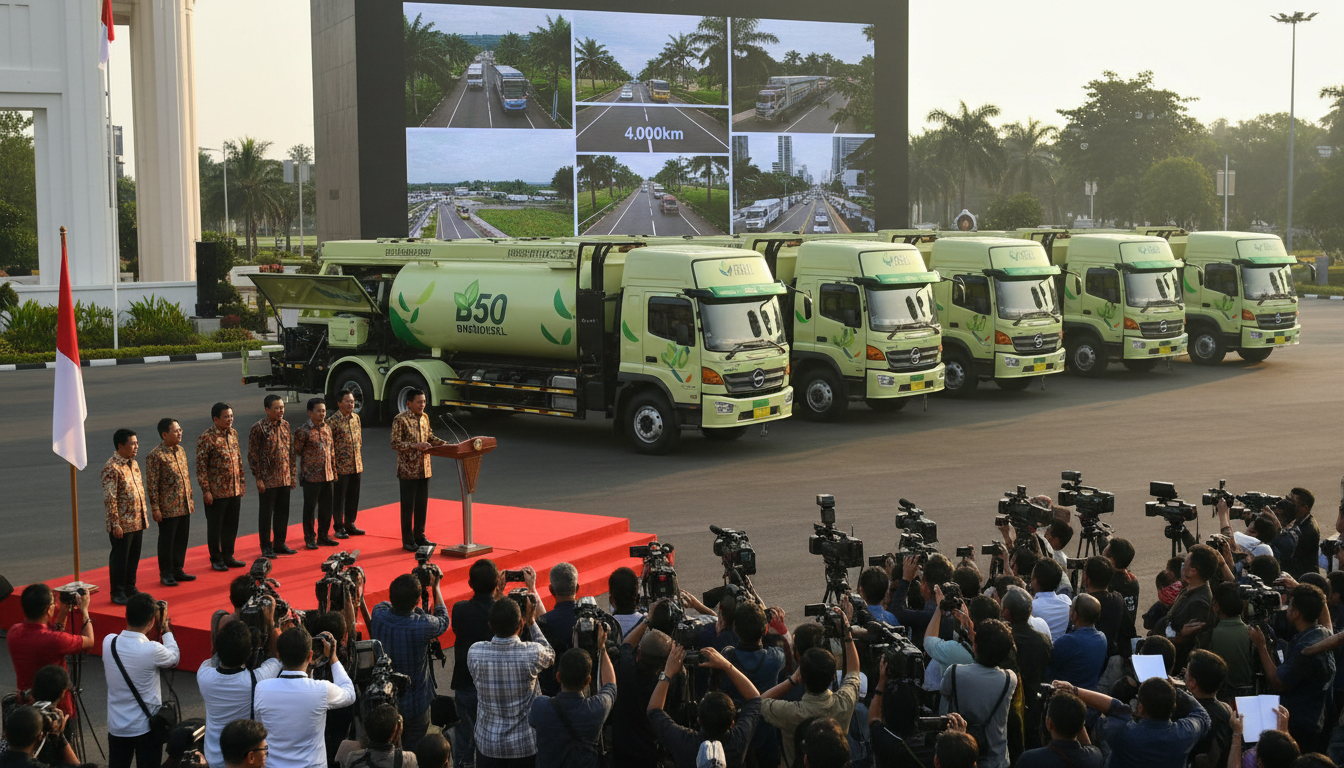
Indonesia completed a 40,000-kilometer road test of B50 biofuel on Java as officials fast-track a nationwide switch to diesel blended with 50% palm-based biodiesel. The road trials are designed to confirm the blend’s performance across coastal plains and highland terrain ahead of a government-targeted rollout in July. The tests, which used trucks, buses and SUVs, aim to provide technical evidence that B50 biofuel can operate reliably in everyday transport fleets.
Road Test Completes Long-Distance Validation Across Java
Four trucks and a passenger bus concluded a multi-week loop around Java, covering a distance roughly equivalent to a global circumnavigation to gauge B50 biofuel resilience. Support vehicles and additional SUVs remain on route to test the blend under cooler, higher-altitude conditions where palm-based diesel can be prone to clouding. Organizers said engine components, lubricants and fuel systems remained within manufacturers’ specifications during the main leg of the trials.
Government Accelerates Timeline Amid Energy Price Pressure
The acceleration to a July rollout reflects rising global fuel costs and a political push for energy sovereignty under President Prabowo Subianto’s agenda. Officials have issued requests to biofuel producers to commit extra volumes to meet the higher blend mandate sooner than previously planned. The move is intended to reduce reliance on imported fossil fuels and limit state subsidy exposure when conventional diesel becomes more expensive than biodiesel.
Industry Capacity Strained by Feedstock and Methanol Shortages
Analysts warn that moving to B50 will require a substantial uplift in production capacity and inputs, including an estimated 1.7 million tonnes of additional biodiesel for full national adoption. A key bottleneck is methanol, used in the transesterification process, with supplies disrupted and prices spiking amid shipping and geopolitical tensions. Producers have also reported storage tanks holding unsold byproducts, complicating logistics and dampening some suppliers’ willingness to commit to the accelerated targets.
Performance Tests Address High-Altitude Clouding Risks
Palm oil–based biodiesel contains higher saturated fats, making it susceptible to clouding and solidification in cooler temperatures that can occur at altitude. The continued trials in Java’s mountainous east will focus on cold-filter plugging point behavior and potential fuel-system clogging under repeated thermal cycling. So far, ministry officials reported that vehicles showed acceptable performance, but engineers remain focused on long-term wear and seasonal variability.
Domestic Demand Shift Could Tighten Global Palm Markets
A nationwide move to B50 would lift domestic palm oil consumption significantly and is likely to reduce export volumes, with implications for global vegetable oil markets and food inflation. Market analysts warn that even a phased increase in blending mandates could push palm oil prices higher, affecting commodity markets from Southeast Asia to global food supply chains. Governments balancing energy security against food-price stability will need to weigh import and export policy carefully as domestic blending rises.
Regional and Global Context of High-Blend Mandates
Indonesia’s scale and state-led structure set it apart from other palm-producing nations, where market-driven or fiscally constrained models have limited blending ambition. Malaysia plans staged increases toward B20, while Brazil and other large agricultural producers are testing higher fossil-biofuel mixes but have not matched Indonesia’s targeted share. Observers say Indonesia’s experience will be watched closely by crop-rich economies considering steep biofuel mandates as a route to energy resilience.
The accelerated push to B50 blends technical, economic and political challenges: proving fuel stability across climates, securing methanol and feedstock at scale, and managing the domestic-versus-export balance for palm oil. Government officials emphasize that the program is about reducing import dependence and safeguarding supply in a volatile global market, while industry voices urge cautious ramping to avoid supply-side shocks. How quickly Indonesia can reconcile these pressures will determine whether B50 becomes a national standard this year or a more gradual transition over 2026–2028.

