
Uranium Enrichment Explained: From Ore to Weapons-Grade Material
Uranium enrichment demystified: how ore becomes fuel or weapons‑grade material, from mining and conversion to centrifuges and global safeguards. Explainer
Opening summary of the process
Uranium enrichment is the central technical step that separates civilian nuclear power programs from potential weapons production. The process begins with mined uranium ore and proceeds through conversion, enrichment and fabrication, with each stage presenting distinct technical and regulatory challenges. Understanding those stages clarifies why enrichment capacity is tightly monitored by international authorities.
From rock to yellowcake
Uranium enters the industrial chain as ore extracted from the ground in open-pit or underground mines. That ore is crushed, chemically treated and concentrated into a powder called yellowcake, a form of uranium oxide that contains uranium in a relatively low concentration. Yellowcake is the first commercially tradable product and the feedstock for downstream chemical conversion.
The yellowcake stage is important because it concentrates uranium and makes transport and storage easier. It also marks the transition from mining to the fuel cycle, where civilian and military pathways begin to diverge depending on subsequent steps.
Conversion to a gaseous form
After concentration, yellowcake is converted into uranium hexafluoride (UF6), a compound suitable for enrichment. UF6 becomes a gas at moderately elevated temperatures, which is essential for the most common commercial enrichment methods. The conversion facilities must meet strict chemical and safety controls because UF6 is corrosive and reactive with water.
Conversion is a dual‑use bottleneck: while it is necessary for producing reactor fuel, it also prepares material for enrichment to higher concentrations of uranium‑235. Consequently, conversion plants are often included in international safeguards and monitoring regimes.
How centrifuges separate isotopes
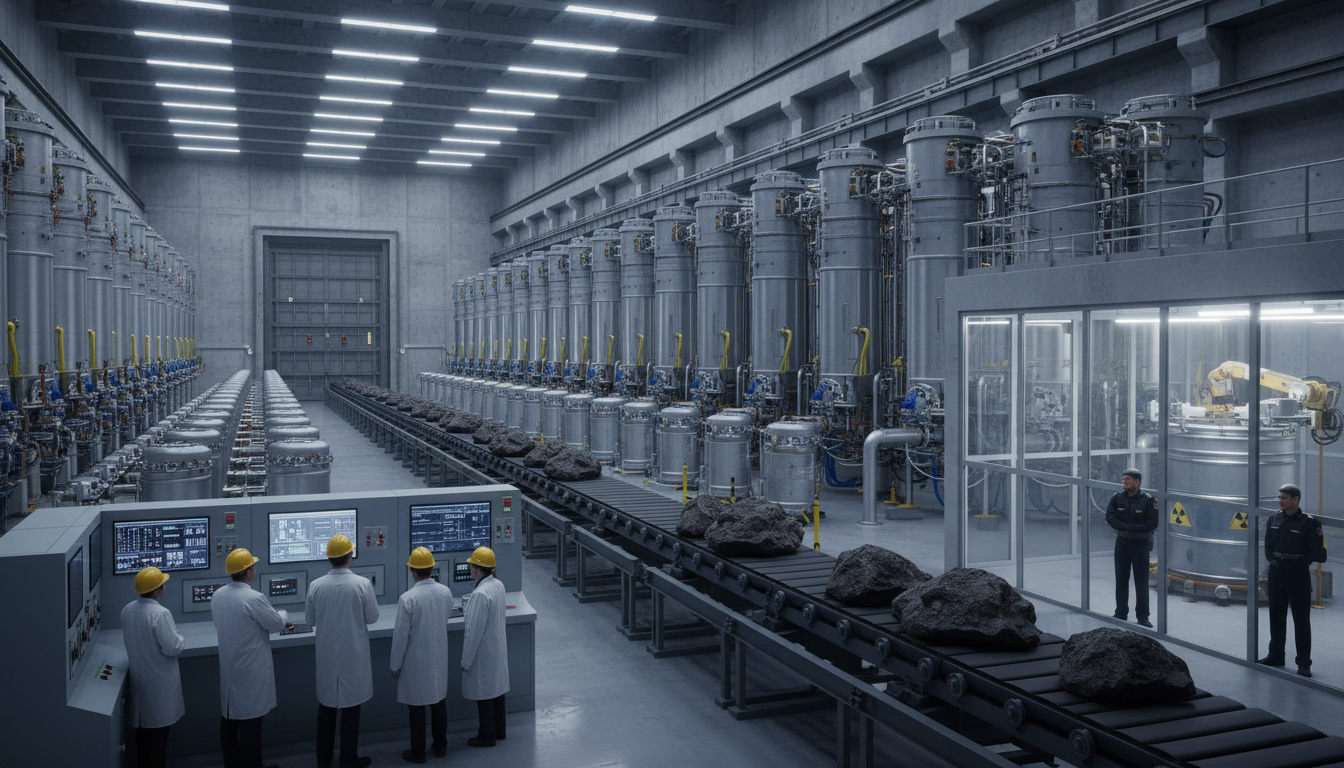
The dominant commercial enrichment technology uses gas centrifuges: rotating cylinders that exploit tiny mass differences between uranium‑235 and uranium‑238. Centrifuges arranged in cascades progressively increase the concentration of uranium‑235 in the product stream. The amount of work required is measured in separative work units (SWU), a technical metric that captures the energy and time needed to achieve a desired enrichment level.
Centrifuge performance depends on rotor speed, materials, and cascade design. Building a reliable enrichment complex requires expertise in precision engineering, materials science and process control, which is why enrichment capability is both technically demanding and closely watched by non‑proliferation authorities.
Enrichment thresholds and weaponization risks
Different enrichment levels correspond to different uses. Low‑enriched uranium (LEU), typically below 5% uranium‑235, is suitable for most power reactors. High‑enriched uranium (HEU), generally above 20%, has possible military applications, and weapons‑grade uranium is often cited at roughly 90% enrichment. Moving from LEU to HEU requires vastly more SWU and time, but the same infrastructure can, in principle, be repurposed for higher enrichments.
The risk of weaponization depends on technical capacity, stockpiles, and political intent. A facility with substantial enrichment capacity and sufficient stockpiled material could shorten a breakout timeline, while smaller or newer programs face longer technical and logistical hurdles.
Technical and logistical barriers to building a bomb
Producing a nuclear weapon requires more than enriched uranium. It demands precise metallurgical processing, weapon design expertise, and mechanisms to assemble and detonate fissile material reliably. HEU must be machined and shaped under specialized conditions, and delivery systems must be developed or acquired for a weapon to be militarily useful.
These non‑nuclear requirements are significant impediments. They add time, cost and detectable activities to any clandestine weapons program, which is why international surveillance focuses both on enrichment and on the ancillary industrial footprint that would indicate weaponization.
International monitoring and non‑proliferation measures
Global oversight of uranium enrichment is led by the International Atomic Energy Agency and underpinned by treaties such as the Nuclear Non‑Proliferation Treaty. Safeguards include material accountancy, inspections, environmental sampling and satellite imagery analysis to detect undeclared facilities or diversion of material. Export controls and technology restrictions further limit the spread of sensitive equipment and designs.
Despite these measures, the dual‑use nature of enrichment technology poses enduring policy challenges. Commercial demand for reactor fuel coexists with the proliferation risks of enriched uranium, and states with enrichment capability occupy a unique position in global nuclear politics.
Policy implications for energy and security
Uranium enrichment sits at the intersection of energy policy and national security. Countries pursuing domestic enrichment argue it secures fuel supply and industrial capability. Critics warn that domestic enrichment can create latent capacities that complicate regional stability and non‑proliferation efforts. International frameworks aim to balance legitimate civilian uses with strong verification and transparency.
As nuclear energy remains part of some states’ climate and energy strategies, effective global governance must adapt to changing demand while maintaining robust mechanisms to deter and detect diversion toward weapons programs.
The technical pathway from mined uranium to weapons‑grade material involves multiple complex steps—mining, chemical conversion, centrifuge enrichment and specialized weapons work—that together shape both the promise of nuclear power and the international determination to prevent proliferation.

