
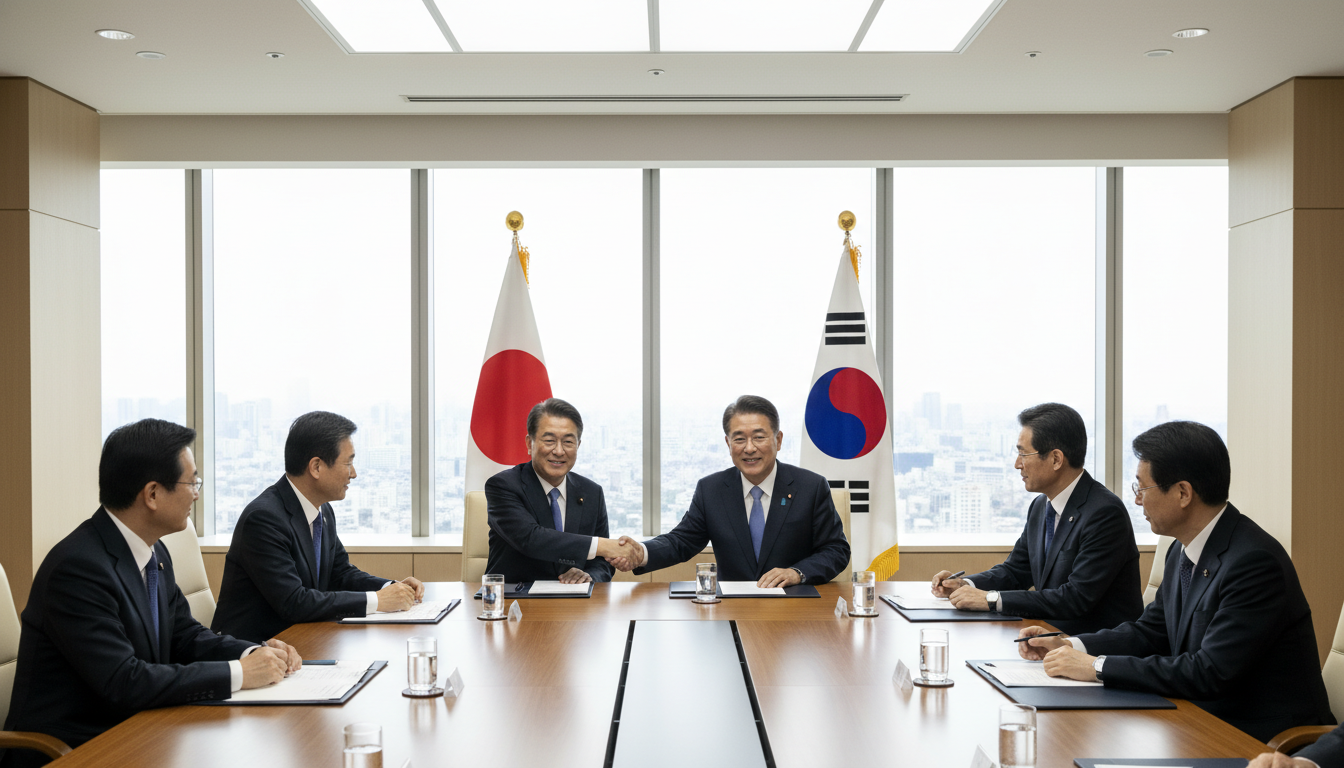
Japan–South Korea summit in Andong sees Takaichi and Lee seek to deepen ties
Japan-South Korea summit in Andong unites PM Sanae Takaichi and President Lee Jae Myung to advance cooperation on security, trade, chips and North Korea.
Japan–South Korea summit in Andong on Tuesday brought Prime Minister Sanae Takaichi and South Korean President Lee Jae Myung together for their second formal meeting of the year, signaling an effort to consolidate recent improvements in bilateral ties. The leaders are using the summit to press forward on a wide-ranging agenda that officials say will include security coordination, economic cooperation and measures to deter North Korean provocations. The meeting follows a series of high-profile, largely cordial encounters this year that have reduced diplomatic tensions after years of strain.
Summit agenda focuses on security, trade and semiconductor resilience
The leaders entered talks with a compact agenda that Japanese and South Korean officials described as prioritizing regional security and economic stability. Both sides have emphasized the need to coordinate on North Korea, streamline trade rules, and strengthen semiconductor and critical supply chains that underpin their high-tech industries. Delegations from each capital included senior foreign and economic policymakers tasked with translating summit-level statements into specific working-group deliverables.
Negotiators are expected to discuss concrete mechanisms for information sharing and crisis communication between defense establishments. While no binding security treaty is on the table, officials from both governments said they aim to enhance practical cooperation such as intelligence exchanges and coordinated response planning. Analysts note that closer security ties between Tokyo and Seoul would also complement trilateral consultations with the United States on deterrence in the region.
January drum encounter provided unexpected diplomatic momentum
The goodwill between the two leaders was visible in January when Takaichi and Lee appeared together at a cultural event in Tokyo and playfully performed on drums, a moment that both capitals later cited as a symbol of thawing relations. That image has been leveraged by diplomats to create a more permissive atmosphere for formal negotiations and to reassure domestic audiences wary of rapid concessions. Officials in Andong framed the summit as a chance to turn that symbolic warmth into institutional cooperation.
Observers caution, however, that symbolic gestures cannot erase deep-rooted disagreements over history and legal claims that have periodically derailed ties. Both governments have sought to manage those sensitivities by compartmentalizing contentious historical issues while advancing pragmatic cooperation in areas of mutual interest. The Andong meeting was therefore pitched as a step toward steadier, predictable relations rather than a comprehensive political settlement.
North Korea and regional security dominate strategic discussions
A central focus of the summit was the shared concern about North Korea’s weapons programs and destabilizing missile tests, which both Tokyo and Seoul say pose an immediate threat to their populations. Takaichi and Lee discussed coordinated responses, including tightened sanctions enforcement, information exchange on missile activity, and diplomatic pressure through international forums. Both leaders signaled an intent to align policies more closely with the United States while preserving independent strategic options.
Military and intelligence officials are expected to follow up with operational plans to improve early warning and joint contingency planning. Experts said enhanced trilateral drills and closer logistical coordination would be plausible near-term outcomes, though Tokyo and Seoul will balance such steps against domestic political sensitivities and regional diplomatic constraints. The summit thus served as a platform to reaffirm deterrence while seeking ways to reduce the risk of inadvertent escalation.
Economic cooperation aimed at trade, chips and supply-chain security
Economic talks at the summit emphasized trade facilitation and industrial cooperation, with a particular focus on semiconductors and related supply chains that both countries view as essential to national competitiveness. Ministers accompanying the leaders discussed measures to ease cross-border investment, harmonize regulations, and promote joint research and development in key technologies. Business delegations from both sides were present to press for agreements that would lower barriers and increase supply-chain resilience.
Officials also explored limited trade liberalization steps and mechanisms to prevent future export disputes that have previously inflicted costs on manufacturers. Both governments highlighted the economic benefits of deeper integration, especially for firms operating in automotive, electronics, and green-technology sectors. While sweeping trade deals were not expected at the summit, negotiators signaled a willingness to pursue targeted, sector-specific agreements that can be implemented quickly.
Domestic politics and diplomatic optics shape outcomes for both leaders
For Prime Minister Takaichi and President Lee, the Andong summit carried domestic political weight in addition to its diplomatic purpose. Each leader must show constituents that bilateral engagement yields tangible benefits without compromising national interests. Takaichi, who faces pressure to demonstrate economic leadership, and Lee, who must address public concerns about security, framed the meeting as pragmatic and results-oriented. Both administrations used the summit to project stability and a shared commitment to regional order.
Political strategists in Tokyo and Seoul said visible cooperation could bolster both leaders’ standing, but they also warned that any perceived concessions could be exploited by domestic opponents. As a result, officials emphasized incremental, verifiable actions and public communications designed to manage expectations on both sides. The careful choreography around the summit suggested a mutual desire to move forward cautiously while preserving room for follow-up diplomacy.
Tuesday’s summit in Andong marked a notable chapter in a year of unusually constructive engagement between Japan and South Korea, driven by converging strategic concerns and economic interests. Leaders in both capitals framed the meeting as the start of a more sustained, institutionalized dialogue aimed at delivering practical cooperation on security, trade and technological resilience. Observers will watch whether the promises made in Andong translate into concrete policy measures and enduring mechanisms for coordination across the two neighbors.

