
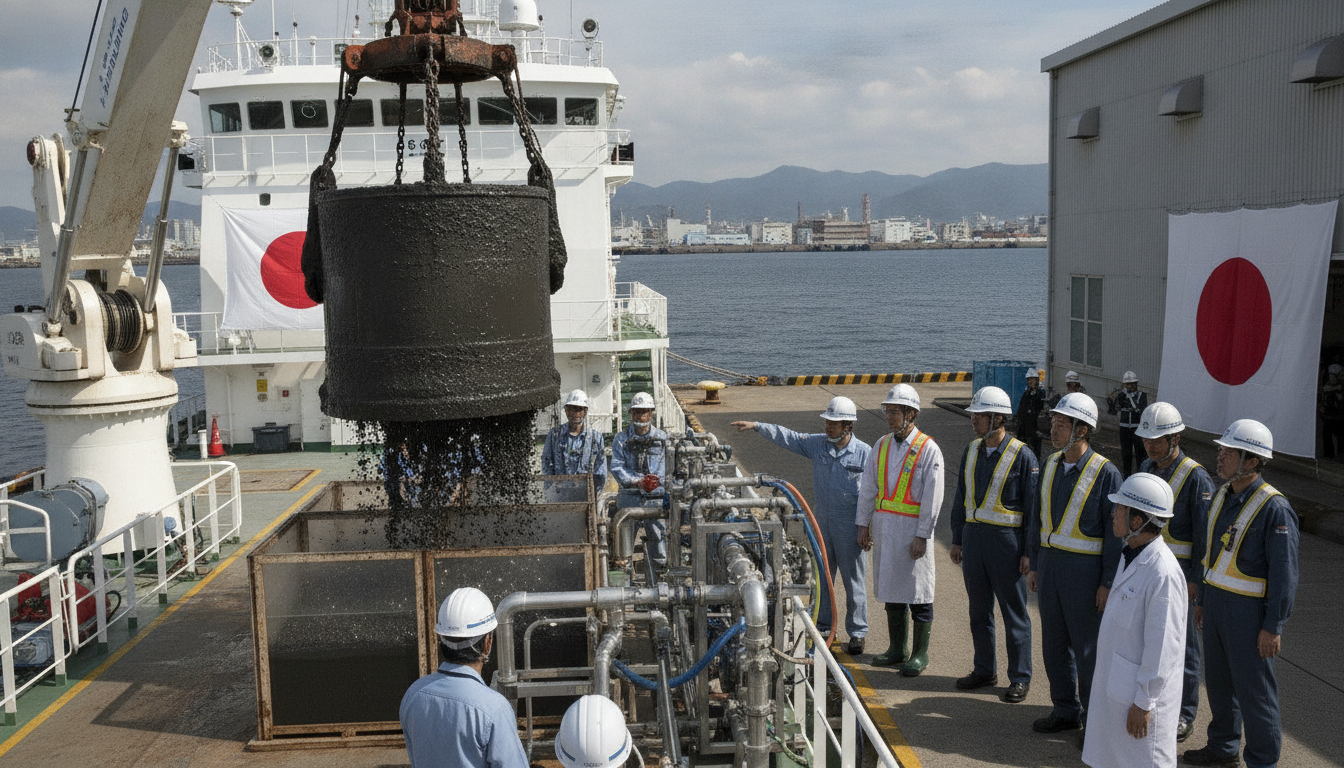
Japan finds rare earths in deep-sea mud near Minamitorishima, but costs cloud commercialization
Japan finds yttrium-rich rare earths in deep-sea mud off Minamitorishima, but high processing costs and market realities may limit hopes of rapidly reducing reliance on China.
Japan’s research teams have recovered deep-sea mud samples near Minamitorishima that analysis shows contain elevated concentrations of rare earths, including yttrium and dysprosium. The discovery has renewed interest in seabed mineral resources and the potential to diversify supply chains for critical elements used in electronics, renewable energy and defence technologies.
Confirmation of yttrium and dysprosium in seabed samples
SIP/JAMSTEC and affiliated researchers reported that laboratory assays of recovered mud show measurable amounts of yttrium and heavier rare earth elements. The findings indicate that the Pacific seabed deposit contains a mix of light and some heavy rare earths that are of strategic and industrial value.
Researchers say the concentration profile is promising compared with some terrestrial ores, but they caution that laboratory presence alone does not equate to an economically viable deposit. Detailed assays and repeat sampling will be needed to establish the size, grade and consistency of the resource over larger areas.
Laboratory testing and mineral composition
Initial chemical analyses revealed that the mud hosts a suite of rare earth elements rather than a single dominant metal, making the deposit potentially useful for a range of industrial needs. Yttrium and dysprosium were highlighted because of their applications in lasers, magnets and high-temperature alloys.
Analysts note that mixed rare earth content can be technically advantageous but also complicates processing, as different elements require tailored separation and refining steps. The presence of associated minerals and the physical properties of the mud will shape the metallurgy and environmental controls needed for extraction.
Technical and environmental challenges for extraction
Extracting rare earths from deep-sea mud requires complex leaching, separation and purification operations that are energy- and reagent-intensive. Deepwater recovery and onshore processing both present logistical hurdles, including handling large volumes of low-grade material and treating potentially contaminated effluents.
Environmental safeguards are likely to add to operational complexity, with regulators and researchers calling for impact assessments to avoid long-term harm to marine ecosystems. The remote location of Minamitorishima also increases costs for mobilizing vessels, equipment and crews for sustained exploration and development.
Cost estimates and commercial feasibility concerns
Preliminary economic assessments indicate that the cost per tonne of recoverable rare earth oxides from seabed mud could be significantly higher than from established terrestrial operations. High capital expenditure for specialized ships and processing facilities, plus operating expenses for chemicals and energy, weigh heavily on feasibility calculations.
Market analysts warn that unless processing methods are substantially improved or commodity prices rise, seabed-derived rare earths may struggle to compete with cheaper, established sources. Investors and policymakers will be looking for pilot-scale demonstrations and realistic cost curves before committing to large-scale projects.
Implications for global supply and China’s role
The discovery has geopolitical resonance because China currently dominates rare earth mining and refining, supplying a large share of global demand. Japanese officials and industry representatives have framed domestic resource development as one part of a broader strategy to reduce reliance on a single supplier for critical materials.
However, experts emphasize that supply diversification requires not only new sources of ore but also downstream processing capacity, technological know-how and stable international trade relationships. Building a complete supply chain outside existing hubs will take time and significant investment.
Government support and next steps for development
Tokyo is expected to continue funding exploration and metallurgical research to assess whether seabed rare earths can be processed more efficiently. Planned next steps include additional sampling, pilot extraction trials and collaborations with private sector firms to test scalable refining technologies.
Officials have signalled a cautious approach that balances strategic interest with fiscal realism, prioritising environmental review and staged pilot programmes. Any decision to move toward commercial production would depend on the outcomes of these technical trials and clearer cost projections.
The discovery of yttrium-rich rare earths in deep-sea mud near Minamitorishima offers a potential new source for critical minerals, but substantial technical, environmental and economic hurdles remain before it can alter current supply dynamics.

