
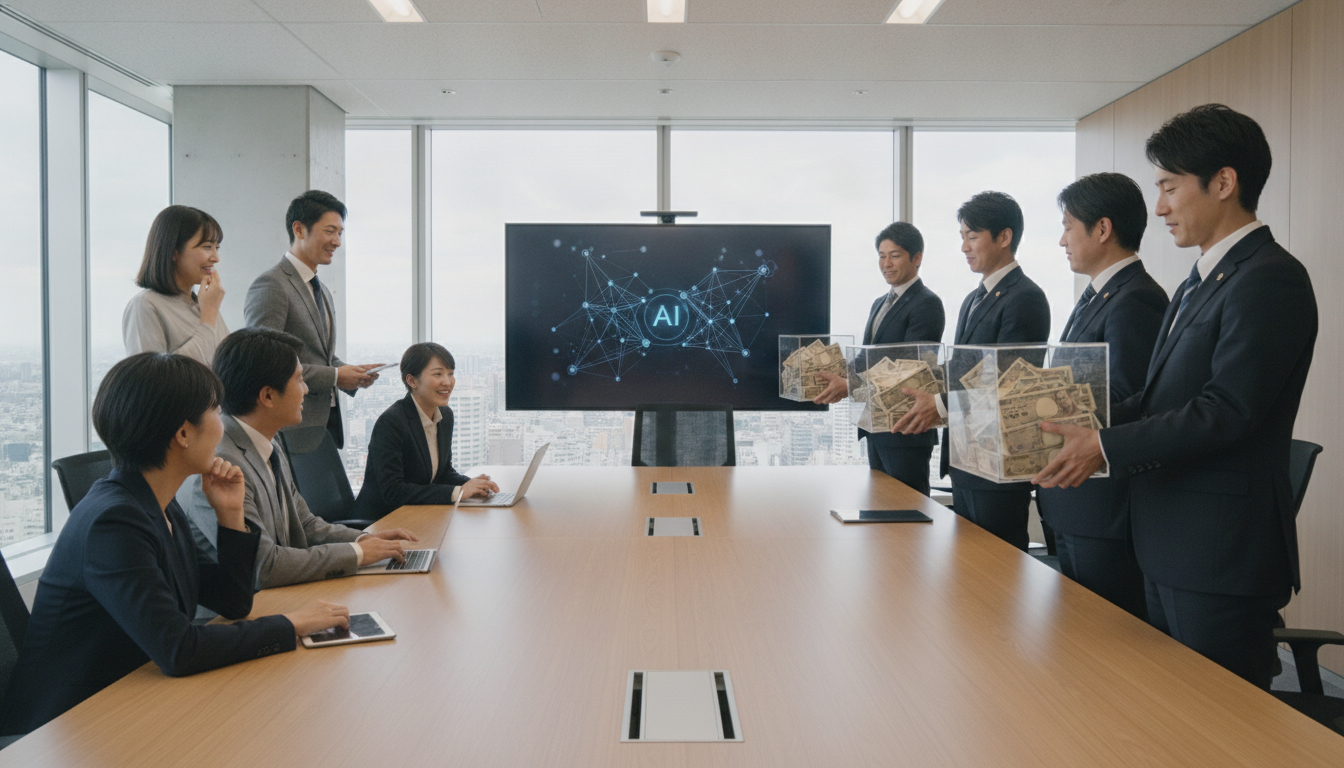
AI adoption in Japan: Employers pay cash and prizes to speed workplace uptake
Japanese firms are offering cash bonuses, prizes and new benefits to nudge AI adoption in Japan, as policymakers and companies push training and pilots to close a skills gap.
Employers add monetary carrots to spur AI use
A growing number of Japanese employers have introduced direct monetary incentives to encourage staff to use generative AI tools in everyday work.
Program designs range from monthly stipends for pilot participants to prize pools for successful internal prototypes, reflecting a pragmatic effort to turn curiosity into routine practice. (itmedia.co.jp)
Human-resources teams say cash and near-cash rewards help overcome hesitation among employees who worry about mistakes, data risk or job security.
Those incentives are often paired with short pilots, usage metrics and coaching so companies can measure adoption and early productivity gains. (windowsforum.com)
LINE Yahoo and other firms paying direct awards
Some high-profile private-sector programs have introduced sizeable financial prizes and stipends to accelerate internal development of AI-driven services.
One major Japanese internet group ran an internal contest offering multimillion-yen awards for team prototypes and paid a monthly stipend to staff assigned to development task forces. (prtimes.jp)
Corporate prize structures are designed to surface practical use cases — scheduling assistants, finance visualizations and domain-specific bots — while signalling top-level commitment to AI tools.
Executives say public, monetary recognition helps change norms around sharing prompts and collaborating with AI rather than hoarding know‑how. (windowsforum.com)
Logistics and shipping firms formalize incentives
Large industrial companies are moving beyond one-off prizes to embed AI participation in structured programs with rewards and measurement.
A major Japanese shipping group launched a company-wide AI implementation program that includes systems to evaluate employee engagement with AI and provide incentives tied to demonstrable improvements. (nyk.com)
Such programs seek to link AI use to operational goals — safety, on-time delivery and process automation — and to make behavioural change visible across business units.
Companies report that when incentives are accompanied by role-specific training, adoption rates and reported time savings rise more quickly. (rbbtoday.com)
Government pilots and public-sector AI training
The Japanese government has launched large-scale pilots to embed AI in public administration and demonstrate “trustworthy” use to the wider economy.
A government-backed program aims to equip hundreds of thousands of civil servants with practical access to government AI tools as part of a coordinated push to build skills and safe operating practices. (digital.go.jp)
Officials argue that public-sector adoption will create exemplars for private companies and reduce legal or ethical uncertainty that can slow workplace uptake.
The state initiatives are being matched by subsidy programs and public–private collaboration to accelerate AI-ready infrastructure and training. (it-shien.smrj.go.jp)
Adoption remains uneven despite growing activity
Surveys and industry analysts say AI adoption in Japan has advanced, but penetration and everyday use remain patchy compared with some other markets.
Data from large-sample industry surveys show that while many big firms now deploy generative AI, smaller companies and some occupational groups lag behind in both access and skills. (sj.jst.go.jp)
Firms and analysts point to cultural, regulatory and organisational reasons: risk aversion, concerns about data leakage, and a shortage of staff trained to integrate AI into workflows.
Those frictions help explain why employers are experimenting with both stick-and-carrot approaches — from revised incentive plans to intensive reskilling programs. (itmedia.co.jp)
Major corporations invest in training and partnerships
Manufacturers, technology groups and service companies are pairing incentive schemes with formal training and external partnerships to build internal capabilities.
One global automaker has launched academic collaborations and company-wide learning programs aimed at ensuring engineers and office staff can use AI tools safely and productively. (global.honda)
Technology firms are also forming alliances with international AI developers to provide enterprise-grade models and operational support for large employee bases.
These commercial partnerships are intended to reduce technical friction and give managers clearer governance frameworks for enterprise AI rollout. (global.fujitsu)
Companies say monetary incentives alone are not enough to sustain change, and are designing multi-faceted programs that combine pay, recognition, training and clearer policies. (aws.amazon.com)
As Japan seeks to move from experimentation to scaled, safe use of AI, employers and government initiatives are converging on a common prescription: reduce barriers, reward early adopters and invest in broad-based reskilling to make AI adoption in Japan durable rather than episodic.

