
Japan semiconductor revival accelerates as Kioxia seeks government backing for AI-driven investments
Japan semiconductor revival gains momentum as Kioxia and other firms press for government support to expand chip production and meet surging AI demand.
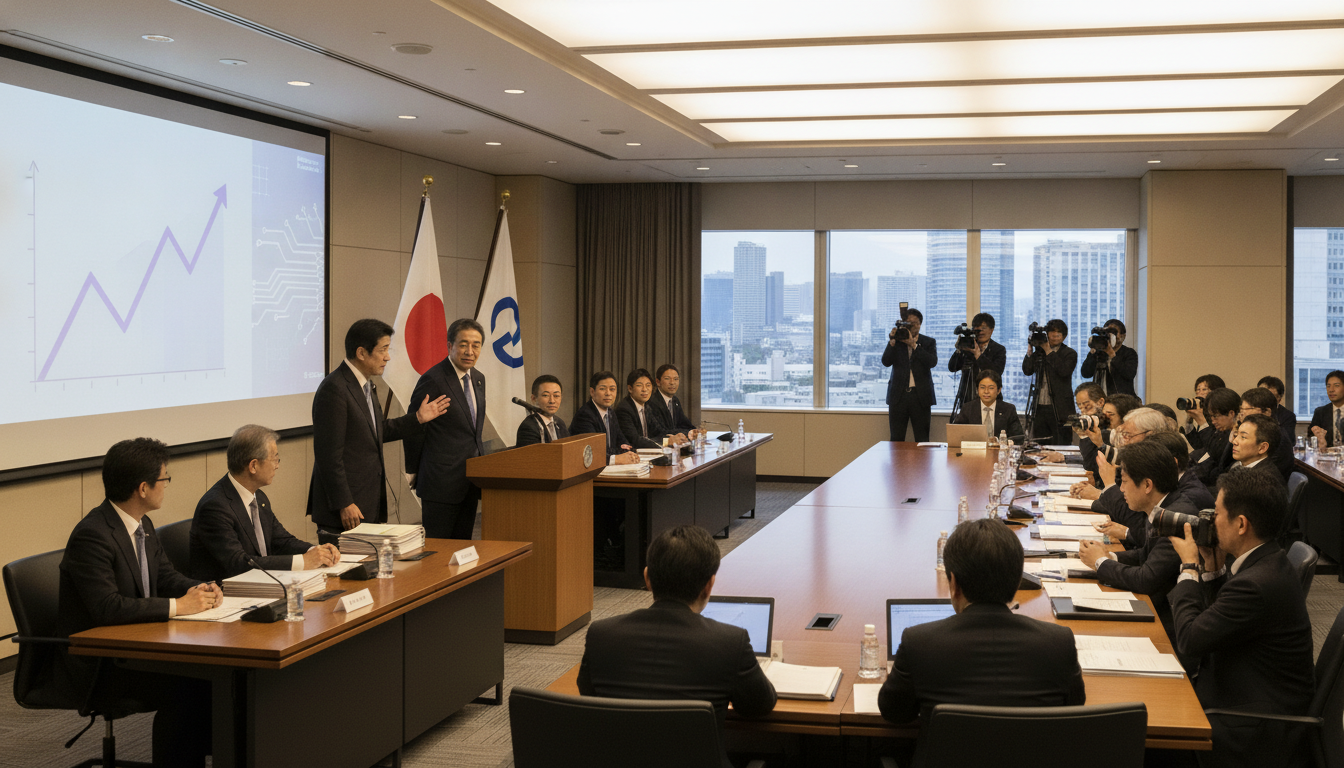
Japan’s push for a semiconductor revival gathered new momentum when Kioxia Holdings’ president met Prime Minister Sanae Takaichi on August 27, 2026 to request government support for accelerated investment. The meeting reflected broader industry moves as firms cite booming AI demand for memory and compute chips. After decades of declining market share, Tokyo and private companies are coordinating large-scale funding to rebuild domestic production capacity.
Kioxia Seeks State Support After Strong Earnings
Kioxia’s leadership told the prime minister’s office the company plans to accelerate capital expenditures to meet rising orders tied to generative AI and data centers. Executives said recent profit improvements have created room for investment, but large-scale projects still rely on public assistance to de-risk multibillion-dollar factory builds. The company framed its request as urgent, saying timing matters to capture demand and secure supply chains.
Government and Industry Mobilize Record Investments
Both central and local governments have signaled willingness to back chip projects through subsidies, tax incentives and infrastructure support to attract fabs and packaging plants. Domestic groups and new entrants such as Rapidus have already announced plans or proposals for next-generation production, prompting officials to coordinate a long-term industrial strategy. Observers say the magnitude of commitments marks a policy shift: semiconductors are now treated as a strategic industry requiring sustained state engagement.
Technology Gaps and Capacity Challenges
Rebuilding a competitive semiconductor industry requires closing gaps in advanced process nodes, materials and packaging technologies that widened over decades. While Japan retains strengths in materials, equipment and specialized substrates, scaling logic and memory production to world-leading nodes demands sustained R&D and partner networks. Analysts caution that factory construction, qualification and ramp-up take years, so capacity will come online only gradually.
Global Partnerships and Supply-Chain Realignment
Industry sources report active discussions with overseas partners to secure equipment, talent and contract manufacturing relationships, including explorations of joint ventures with foreign chipmakers. Such partnerships aim to shorten learning curves and reduce exposure to single-country supply risks, while preserving key domestic capabilities. Geopolitical sensitivities over chips as strategic goods are pushing Tokyo to balance openness with the need to protect critical technologies.
Labor, Skills and Regional Development
Expanding production will require a sizable, specialized workforce across engineers, process technicians and packaging specialists, prompting companies to invest in training and universities to revise curricula. Regional governments are positioning to host plants by offering land, utilities and logistics support, presenting opportunities for local job creation and industrial revitalization. Still, attracting and retaining high-skilled staff remains a bottleneck that both industry and policymakers must address.
Market Outlook and Policy Trade-offs
For investors and planners, the central question is whether coordinated public-private action can translate into sustainable competitiveness rather than short-term capacity additions. Policymakers face trade-offs between heavy subsidies to accelerate build-out and ensuring that new plants operate efficiently in a market that remains technologically dynamic. The coming years will test whether Japan can convert strategic intent into durable industrial advantage in memory and advanced packaging.
Japan’s semiconductor revival hinges on aligning long-term industrial policy with commercial realities, from technology roadmaps to workforce development and international cooperation. The sector’s renewed prominence reflects both economic opportunity from AI and a broader strategic aim to secure critical supply chains, but success will depend on persistent investment and execution over multiple years.

