
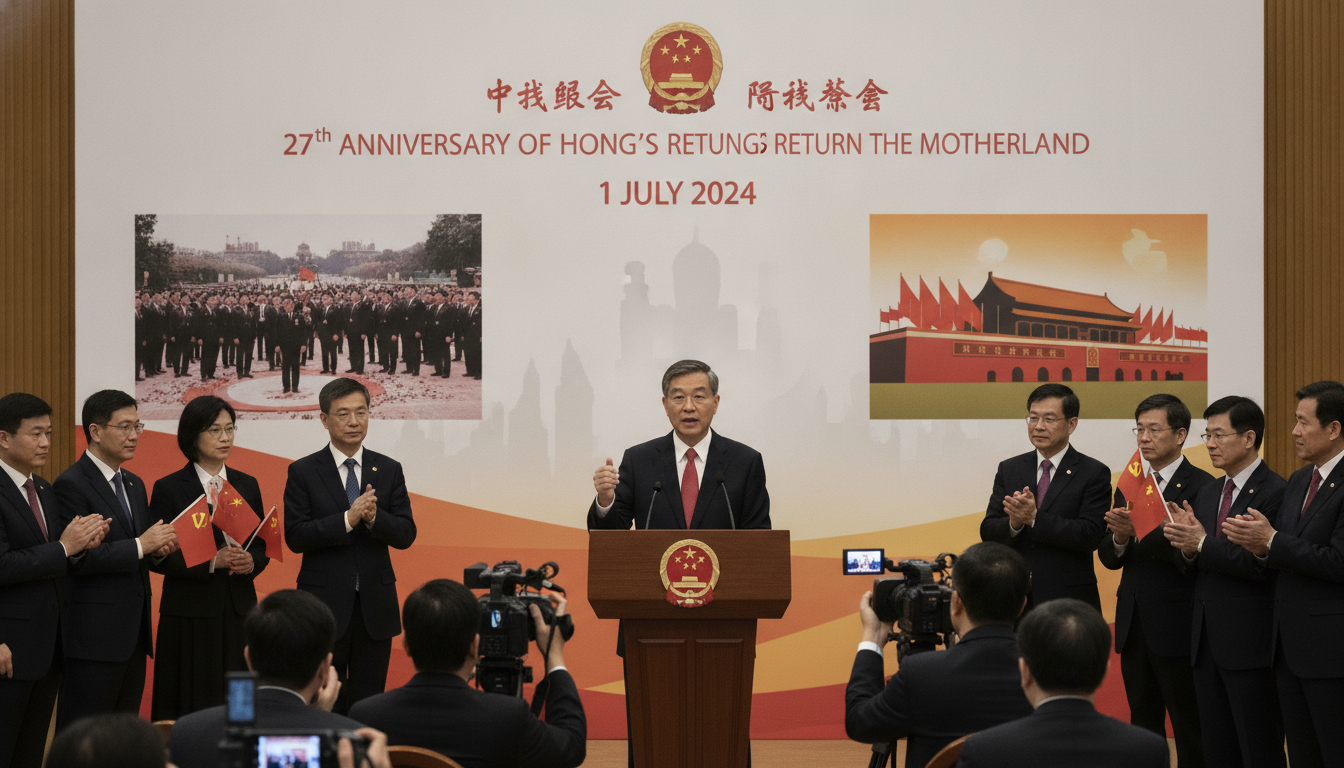
John Lee Frames Hong Kong Handover Anniversary with Communist Party Commemoration Amid Second-Term Talk
Hong Kong Chief Executive John Lee tied the July 1, 2026 handover anniversary to the Chinese Communist Party’s own commemoration during a speech, fueling renewed speculation about his political future and a possible second term.
Hong Kong Chief Executive John Lee used the 29th anniversary of the Hong Kong handover on July 1, 2026 as a platform to reference the Communist Party’s anniversary, underscoring his alignment with Beijing and stirring debate about his intentions for a second term. Lee’s remarks, delivered at an official reception, emphasized stability and patriotism while avoiding explicit confirmation of electoral plans. The linkage of the handover anniversary to the Party’s celebration was noted by political observers as a deliberate signal about governing priorities.
Lee Links Handover Commemoration to Party Anniversary
John Lee explicitly referenced the Communist Party anniversary in remarks made at the July 1 reception marking the 29th anniversary of Hong Kong’s handover from Britain to China. He framed both occasions as intertwined milestones for the city’s post-handover governance and identity. Officials present described the tone as conciliatory toward Beijing while stressing continuity in the administration’s focus on security and economic recovery.
Lee’s approach contrasts with earlier handover ceremonies that emphasized Hong Kong’s unique institutions and legal system separately from mainland political narratives. By drawing the two anniversaries together, Lee sought to position his administration as aligned with central authorities, a posture that carries implications for both local governance and the city’s political direction.
Speculation Over Second Term Intensifies
Commentators and pro-establishment figures immediately linked Lee’s rhetoric to intensifying speculation about a second term as Chief Executive. The office’s succession timetable and Beijing’s endorsement process mean that public signaling can be an important element of any reappointment strategy. Lee’s supporters say his remarks underline a record of enforcing order and promising economic incentives that merit continuation.
Opposition voices, however, interpret the comments as an attempt to cement political loyalty ahead of selection processes that critics describe as narrowly managed. The debate over a second term now centers on whether Lee will pursue a formal campaign of endorsements or rely on behind-the-scenes coordination with pro-Beijing committees.
Details of the July 1 Reception and Speech
At the official reception on July 1, Lee spoke to a mixed audience of officials, diplomats and community leaders, delivering a speech that referenced both the handover’s history and the Party’s longevity. He praised civic resilience and highlighted policy measures undertaken by his administration in the realms of public security and economic revitalization. The speech included calls for unity and pragmatic governance without laying out a detailed policy roadmap.
Attendees noted the presence of high-ranking mainland representatives and the deployment of ceremonial elements that emphasized state symbolism. Photographs released by government sources showed Lee addressing guests in a setting that combined local administrative trappings with clear references to central-state milestones.
Beijing Relations and Political Signaling
Analysts say Lee’s decision to bind the handover anniversary to the Communist Party commemoration serves multiple signaling purposes to Beijing and to local constituencies. It reinforces a narrative of alignment with mainland priorities at a time when the central government remains sensitive to political stability in the financial hub. For Beijing, visible loyalty and consistent messaging from Hong Kong’s leadership are important markers when weighing continued support.
The move also carries domestic implications, as policy choices that emphasize security and integration with mainland economic initiatives may be prioritized going forward. Observers caution that such signaling can further polarize public opinion in a city still navigating the political changes of the past decade.
Public and Opposition Response
Reactions across Hong Kong’s political spectrum were mixed, with pro-establishment media highlighting Lee’s emphasis on continuity and governance, while pro-democracy advocates criticized the conflation of the two anniversaries. Protest groups and civic activists, although constrained by the political climate, issued statements warning that closer rhetorical alignment with the Communist Party may narrow space for dissent and civil liberties.
Business associations took a more measured tone, noting Lee’s references to economic recovery and the need for stability to attract investment. Some corporate leaders welcomed the focus on pragmatic issues, while urging clarity on policies that affect talent recruitment, cross-border finance and the rule of law.
Regional and International Implications
Lee’s speech and the attendant political signaling have attracted attention beyond Hong Kong, as analysts in the region assess what the remarks mean for Hong Kong’s role as an international financial center. Foreign governments and investors are likely to scrutinize whether the alignment with Beijing translates into policy shifts that affect legal predictability and market access. Diplomatic channels will be watching for any concrete commitments tied to cross-border cooperation or national security measures.
The coming weeks are expected to bring further commentary from both Beijing and local bodies on leadership plans and policy priorities, with implications for regional confidence in Hong Kong’s governance model.
Lee’s remarks on July 1, 2026 marked a clear rhetorical alignment with mainland narratives at a ceremony for the 29th anniversary of the handover, and they have intensified discussion about his political trajectory, governance priorities and the city’s future role in the region.

