
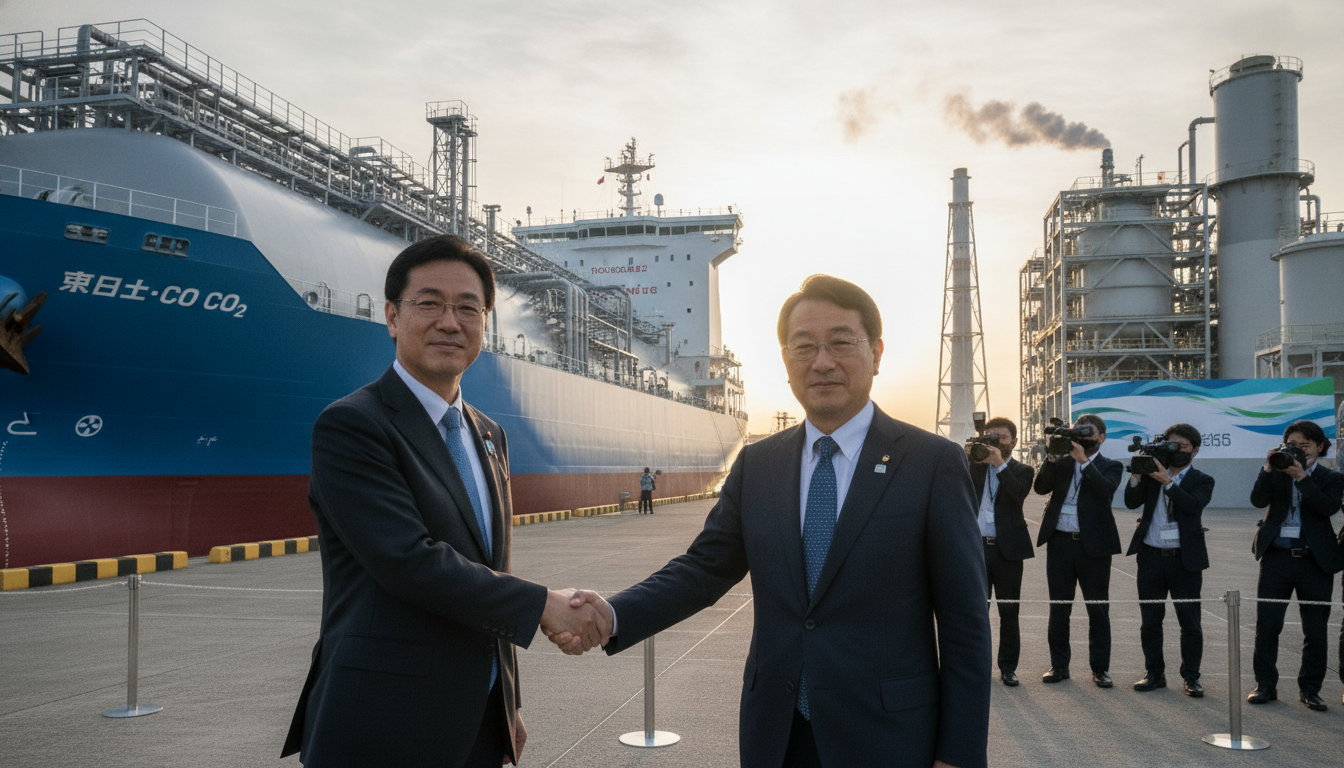
Kansai Electric and Kawasaki to Pilot Carbon Capture and Storage, Targeting Up to 90% CO2 Cuts
Kansai Electric and Kawasaki Heavy Industries will pilot a carbon capture and storage project to transport liquefied CO2 from a coal-fired power plant to remote storage, aiming to cut emissions by up to 90%.
Japan’s Kansai Electric Power and industrial group Kawasaki Heavy Industries have launched a joint effort to test carbon capture and storage (CCS) logistics that would move CO2 produced at a coal-fired plant to an offsite storage location. The initiative focuses on liquefying captured carbon dioxide for transport and aims to establish practical technology for deep reductions in emissions from fossil-fuel generation. Company officials say an initial operational test could begin as early as this fiscal year, marking a significant step in domestic CCS development.
Kansai Electric and Kawasaki to Pilot CCS Transport
A pilot operation will assess the full chain of capture, liquefaction, transport and storage for CO2 emitted by a coal-fired generation unit. The project will use facilities at Kansai Electric’s thermal plant to capture and condense the gas into a liquid form suitable for movement. Kawasaki Heavy will provide engineering for liquefaction and the equipment required to keep the CO2 in a stable state during transport.
The partners describe the exercise as a technology demonstration intended to resolve technical and logistical uncertainties before any large-scale rollout. The objective is to validate handling procedures and confirm that liquefied CO2 can be safely and efficiently moved from a land-based power station to a distant storage site.
Operational Timeline and Project Scope
Project leaders indicate that the trial could commence within the current fiscal year, beginning with limited volumes to test systems and monitoring processes. Initial runs will focus on short-distance transfers to validate liquefaction throughput, containment integrity and transfer interfaces between plant and shipping or pipeline systems. Based on those results, the program could expand to longer-distance transport and larger volumes in subsequent phases.
Stakeholders emphasize that the pilot is explicitly designed to generate operational data rather than to deliver immediate large-scale emission removals. The stepwise approach is intended to lower technical risk before committing to costly infrastructure investments.
Technology: Liquefaction, Transport and Storage Options
The core technology being tested is CO2 liquefaction, which reduces the gas to a dense liquid at low temperature and moderate pressure to facilitate transport by pipeline or specialized vessels. Kawasaki’s engineering expertise in cryogenic and gas-handling systems will underpin the design of liquefaction units and insulated transfer equipment. The trial will also explore logistics such as transfer from tanker to storage and the use of buffer tanks to manage flow rates.
For longer-term storage, options under consideration include geological sequestration in depleted offshore reservoirs or saline aquifers, where injected CO2 can be monitored and contained. The pilot will evaluate not only transport technology but also the sensors and monitoring protocols necessary to satisfy safety and regulatory requirements.
Emissions Targets and Policy Backdrop in Japan
The project comes as Japan seeks pathways to reduce greenhouse gas emissions from heavy-emitting sectors while maintaining energy security. Utilities and industrial players have increasingly turned to CCS as one of a suite of technologies that could allow continued use of thermal power while cutting carbon outputs sharply. The partners say the pilot aims to demonstrate that carbon capture and storage can achieve reductions of up to 90% at the source when combined with effective transport and secure storage.
Government policy frameworks and potential subsidy or regulatory support will play a decisive role in whether CCS moves beyond demonstration into broader deployment. The demonstration’s outcomes are likely to inform policymakers and help shape rules for permitting, monitoring and liability related to CO2 transport and underground storage.
Economic, Safety and Regulatory Challenges
Industry experts caution that CCS faces significant cost hurdles, including expenses for capture installations, liquefaction units, transport networks and long-term monitoring of storage sites. The pilot is intended to quantify these costs and identify where efficiencies can be gained. Safety considerations—such as preventing accidental release during transfer and ensuring long-term containment underground—are central to the trial’s design.
Public acceptance and clear regulatory frameworks for cross-jurisdictional CO2 movement are additional questions the partners will address. Establishing liability rules for potential leakage and securing community consent for storage locations are likely to be major factors shaping any future expansion.
Industry Collaboration and Potential Scale-Up
Kansai Electric and Kawasaki describe the pilot as an early-stage collaboration that could attract other utilities, equipment makers and government support if results are positive. Industry observers say shared demonstrations can reduce duplication of cost and accelerate learning across multiple stakeholders. Should the trial demonstrate reliability and cost-effectiveness, the next phase would likely involve scaling up capture capacity and formalizing transport corridors to regional storage hubs.
International cooperation may also feature in later stages, as companies explore exporting captured CO2 to offshore storage or sharing technical know-how with other nations pursuing similar decarbonization paths.
The pilot marks a notable step for Japan’s power sector as it tests practical tools to lower emissions from existing thermal plants. Results from the trial will be watched closely by utilities, regulators and environmental groups for indications of whether carbon capture and storage can become a commercially viable component of Japan’s net-zero strategy.

