
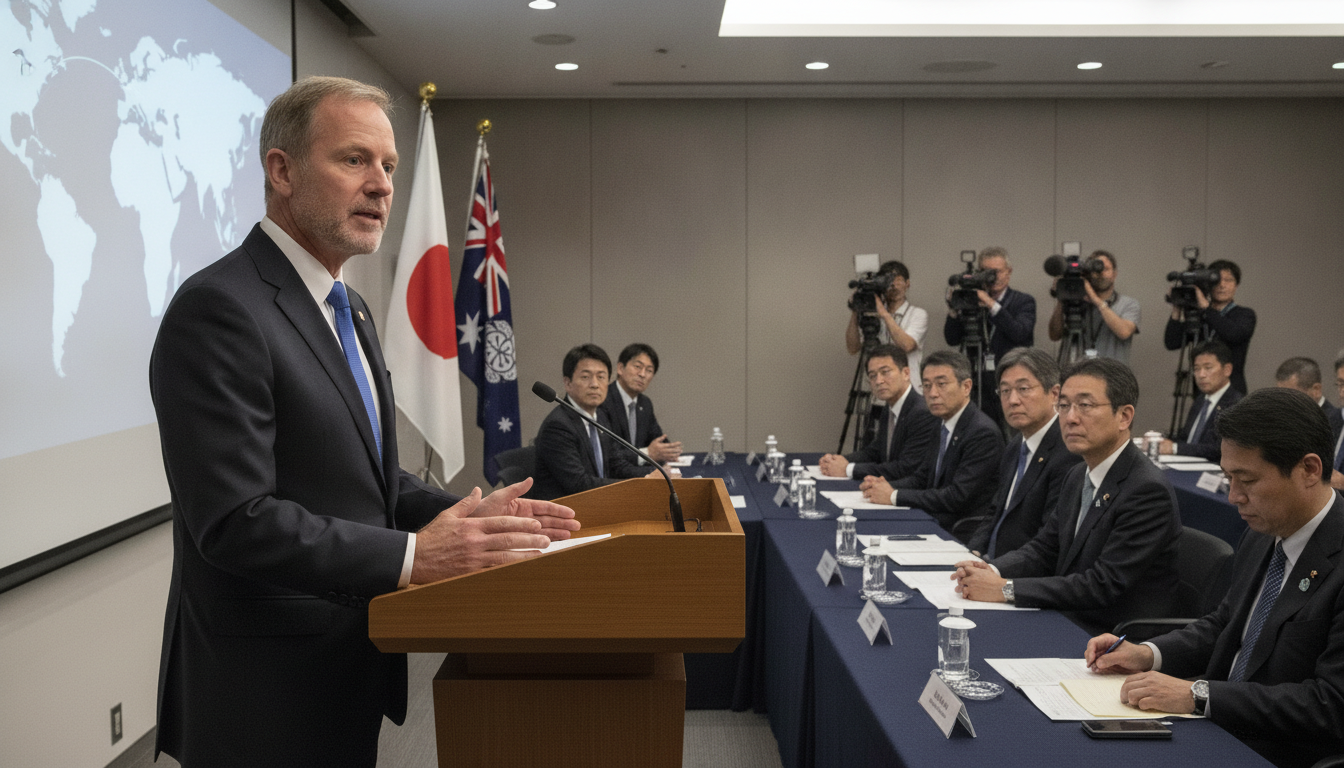
Kevin Rudd urges middle powers, including Japan, to unite in defense of the rules-based order
Kevin Rudd urges Japan and other middle powers to unite diplomatically and economically to preserve the global rules-based order amid geopolitical tensions.
Japan — Former Australian prime minister Kevin Rudd called on Japan and other middle powers to coordinate more closely to preserve the global rules-based order, saying such cooperation is essential as strategic competition intensifies. Rudd made the appeal during a Tokyo appearance, arguing that middle powers possess economic and diplomatic capacity that, when pooled, can shape outcomes on trade, security and international law. He urged nations to act with what he termed “collective self-confidence” to defend institutions that underpin global stability.
Rudd’s appeal made in Tokyo
Rudd delivered his remarks in Tokyo during a public interview and a series of meetings with policymakers and business leaders. He framed the appeal as a response to an “age of uncertainty,” where great-power rivalry and shifting economic ties strain existing rules and norms. The former prime minister emphasized that middle powers must not wait for major powers to define the international agenda.
Rudd used his platform in Japan to press for sustained diplomatic engagement among likeminded states. He stressed that coordinated action could reinforce international law and collective responses to coercive behavior. The Tokyo visit served as a vehicle to press Japanese leaders to assume a more proactive coordinating role.
Ten middle powers and their economic leverage
Rudd highlighted the economic heft of a group of middle powers, noting that ten nations acting together account for a combined gross domestic product that now exceeds that of the United States. He argued that this economic clout gives middle powers leverage in shaping global governance, supply chains and standards-setting institutions. The point underlined his contention that material power is no longer concentrated solely in the hands of a few dominant states.
Economists and diplomats, he said, should translate that economic weight into practical cooperation on trade, investment screening and critical technologies. Rudd suggested that pooled economic policy could both deter coercion and incentivize adherence to international rules. He framed the argument as a pragmatic case for aligning economic strategies without sacrificing national sovereignty.
Threats to the rules-based order identified by Rudd
Rudd identified a series of pressures that, in his view, threaten the rules-based order, including intensifying strategic competition, economic coercion and challenges in maritime and cyber domains. He warned that unilateral actions which disregard multilateral norms risk fragmenting the global system that undergirds trade and security. The former prime minister painted a picture of an international environment where rules can be eroded incrementally unless checked by coordinated responses.
He urged middle powers to focus on preserving norms related to freedom of navigation, sanctions compliance and dispute settlement. According to Rudd, these are areas where coherent collective action can preserve predictability in international relations. His remarks called for both defensive measures and affirmative policies to sustain institutions.
Practical steps for coordination proposed
Rudd outlined a set of practical measures that middle powers could pursue to translate rhetoric into results. He recommended regular high-level consultations, alignment on export controls and investment screening, and deeper cooperation on resilient supply chains for critical goods. He also urged joint initiatives to bolster international institutions and to support rule-making in emerging technology areas.
Rudd proposed that middle powers create working groups to harmonize standards and share intelligence on coercive economic practices. He said such mechanisms would be less costly and more politically feasible than attempting to match great-power military capabilities. The emphasis was on pragmatic, policy-oriented collaboration.
Japan’s role and regional implications
Rudd cast Japan as a pivotal actor among middle powers because of its economic resources, technological base and diplomatic networks. He urged Tokyo to leverage its bilateral ties and multilateral influence to convene partners and sustain momentum. Rudd emphasized that Japan’s active engagement would lend credibility to collective efforts, particularly in the Indo-Pacific.
He called on Japan to balance deterrence with diplomacy, strengthening defense partnerships while investing in regional institutions and development cooperation. Rudd suggested that Japan’s leadership in areas such as infrastructure financing and technological standards could shape outcomes in the region. The strategy he outlined relied on Japan combining hard and soft power in pursuit of a stable order.
Diplomatic momentum and next steps
Rudd encouraged immediate steps to institutionalize cooperation among middle powers, including summit-level dialogue and sectoral task forces on trade, technology and security. He argued that early wins—such as coordinated approaches to supply-chain resilience—would build trust and make further collaboration easier. Rudd warned, however, that momentum would dissipate without political will and consistent follow-through.
He also urged middle powers to invest in public diplomacy to explain the benefits of rules-based cooperation to domestic audiences. Rudd’s prescription combined short-term practical measures with a longer-term campaign to restore confidence in multilateral systems. He framed this as both a strategic and normative project.
The former prime minister’s remarks in Tokyo underscore a broader debate about how middle powers navigate a shifting global landscape. By urging coordinated economic and diplomatic action, Rudd presented a roadmap that places Japan at the center of efforts to preserve predictability and uphold the international rules that facilitate trade and security in the Indo-Pacific and beyond.

