
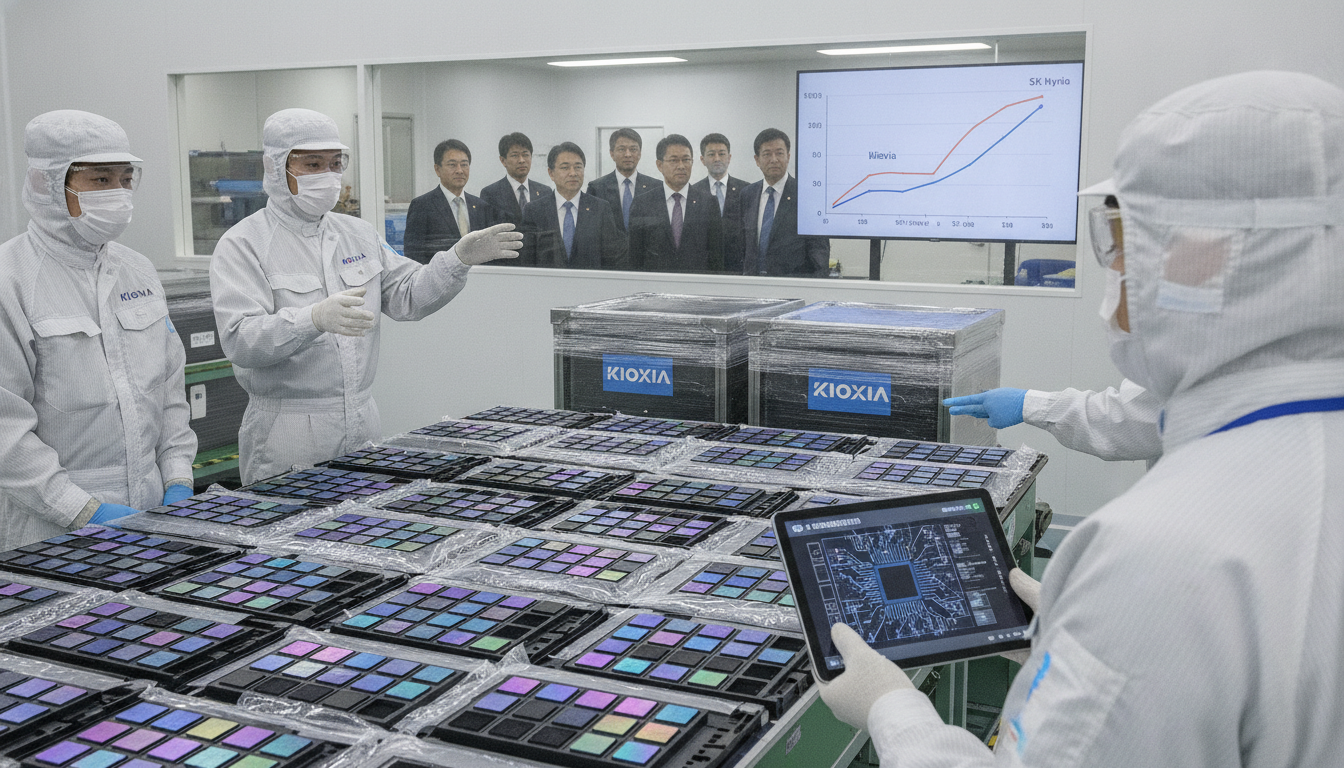
Kioxia Launches 10th-Generation Memory Chips as Lead Over Samsung and SK Hynix Narrows
Kioxia starts shipments of its 10th-generation memory chips, aiming to preserve a shrinking technological lead as Samsung and SK Hynix close the gap with intensified investment.
Kioxia begins commercial shipments of 10th-generation memory
Kioxia has begun shipping its 10th-generation memory chips, stepping up production as it seeks to sustain an edge in the high-performance memory market. Company officials framed the rollout as a strategic move to maintain technological leadership against South Korean and Chinese rivals. The shipments follow a formal ceremony tied to the expansion of the firm’s manufacturing footprint in Iwate prefecture.
Kioxia’s announcement signals a deliberate push to convert laboratory progress into volume production and customer deliveries. The vendor is targeting data center and advanced consumer applications where faster, denser memory can command premium pricing. Management described the shipments as the first stage of a broader commercialization plan for the new node.
Lead over Samsung and SK Hynix narrows to roughly one year
Industry observers say Kioxia’s generational advantage, once estimated at about two years, has contracted to roughly one year as competitors accelerate their roadmaps. Samsung Electronics and SK Hynix have intensified development and capacity programs, reducing the interval between node introductions. Chinese producers are also moving faster, spurred by both market demand and state-backed investment in domestic semiconductor capability.
The narrowing gap raises questions about how long any single supplier can maintain a durable technological lead in memory. Memory roadmaps are cyclical and capital-intensive, and even small differences in yield or process control can shift competitive positions quickly. Kioxia’s latest shipments are an attempt to convert technological advances into real-market momentum before rivals reach parity.
Iwate plant expansion underpins volume output
Kioxia marked the launch by highlighting expanded production capacity in Iwate prefecture, which company executives said is central to ramping the new process. The facility upgrade includes additional cleanroom capacity and equipment investment intended to increase wafer starts for advanced memory products. Local officials attended the ceremony, underscoring the plant’s role in regional industrial strategy and employment.
Scaling from pilot production to mass output typically requires months of yield improvement and process tuning. The Iwate expansion aims to shorten that transition by adding production lines and boosting throughput. Kioxia will need sustained operational performance to meet customer timelines and to defend pricing against competitors with larger scale.
Demand drivers: data centers, AI and edge computing
Demand for high-performance memory remains anchored in data centers and artificial intelligence workloads, which have surged the need for density and speed. Enterprises and cloud providers are upgrading server memory to support generative AI and other compute-intensive services, creating an attractive addressable market for the 10th-generation chips. Kioxia is positioning its product as optimized for those use cases, offering both capacity and performance improvements.
At the same time, customer procurement is sensitive to total cost of ownership, supply security, and roadmap certainty. Buyers are comparing offerings from multiple vendors while weighing price, availability and long-term support. Winning design-ins at major cloud firms and server OEMs will be a crucial determinant of the new chips’ commercial success.
Implications for the global memory supply chain
The commercial rollout has broader implications for the global memory ecosystem, where supply, pricing and national policy intersect. Japan-based manufacturers such as Kioxia play a strategic role in diversifying global supply away from a handful of dominant suppliers. Continued investment in domestic fabs and tooling reinforces industrial resilience but also intensifies competition for specialized equipment and talent.
Geopolitical tensions and export controls continue to shape how firms allocate capacity, source materials and pursue partnerships. Any sustained shift in technological leadership could alter supplier bargaining power and influence contract terms across international customers and subcontractors. Market participants will watch closely for changes in inventory levels and price trajectories.
Analysts see tight race and operational challenges ahead
Analysts caution that technological announcements do not guarantee immediate market dominance, noting the difficulty of translating a process node into profitable, high-yield production. Key challenges include ramping yields, securing advanced lithography and managing the steep capital expenditure required for scale. Competitors are investing heavily to shorten cycles, which could limit the window in which Kioxia can capitalize on its latest generation.
Market forecasts suggest a tight competitive race over the coming 12 to 24 months, with incremental performance and cost improvements determining winners and losers. For Kioxia, maintaining steady output while achieving competitive unit costs will be essential to defend market share. Observers expect continued product updates from all major suppliers as they attempt to outpace one another.
Kioxia’s shipment of 10th-generation memory chips marks a significant milestone in a rapidly evolving memory market, but the firm faces immediate operational tests and fierce competition. How quickly rivals narrow the gap, and whether Kioxia can translate technological progress into consistent, cost-effective supply, will determine its position as customers accelerate upgrades for AI and cloud infrastructure.

