
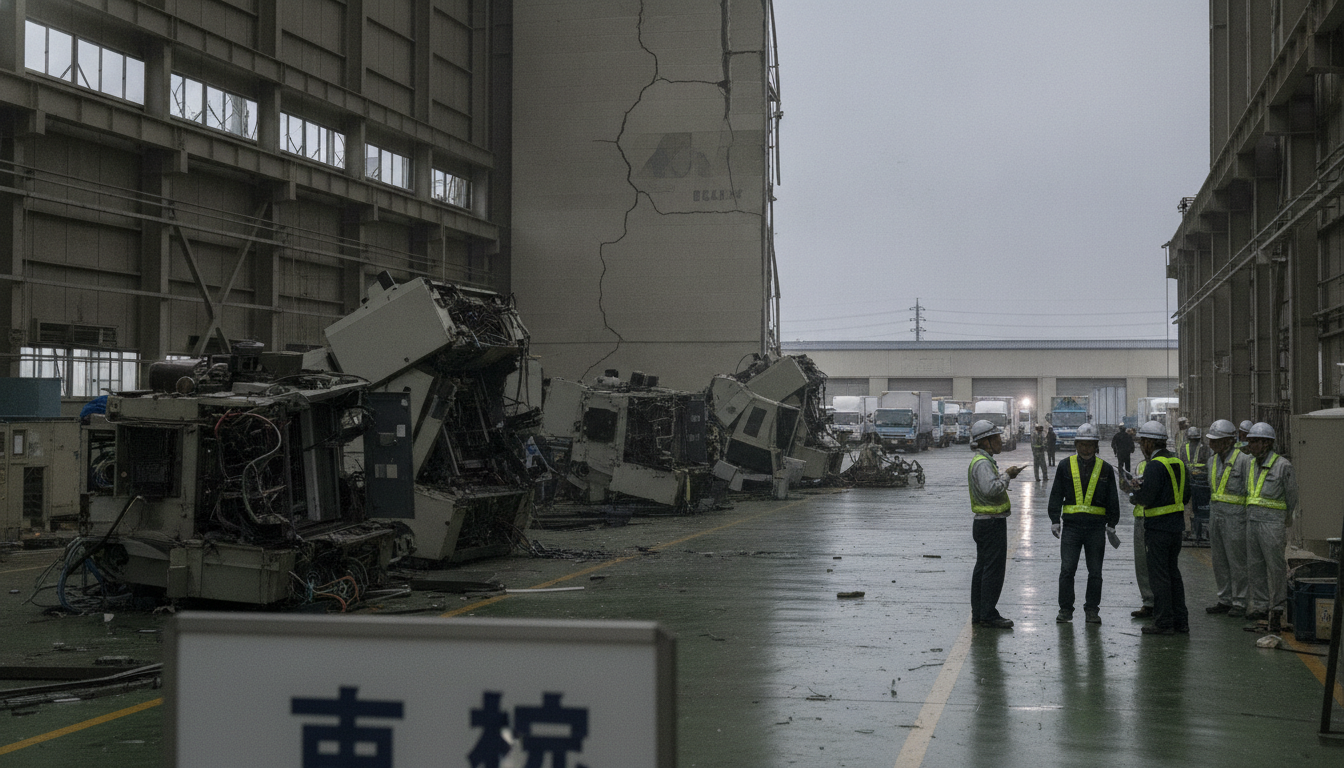
Kumamoto earthquake halts semiconductor production on Kyushu’s "Silicon Island" as restart timelines remain uncertain
Kumamoto earthquake halts semiconductor production across Kyushu’s "Silicon Island", suspending factory lines and raising concerns over global chip supply.
The Kumamoto earthquake on July 28, 2026, which produced a maximum intensity of 7, has forced major semiconductor plants across Kyushu to suspend operations, threatening production continuity on the region known as Japan’s "Silicon Island." Initial company statements and on-site checks on July 29 show plant buildings and precision equipment are under inspection, and many firms cannot yet set a firm restart date. The disruption centers on Kumamoto prefecture but has ripple effects across supply chains that feed global electronics and automotive assembly lines.
Factories remain idle as damage assessments continue
Several large manufacturers with operations in Kyushu reported halted production after the Kumamoto earthquake, citing ongoing safety checks and equipment inspections. Companies named in initial reports include a TSMC subsidiary that began operations in Kumamoto in 2024, as well as Japanese groups such as Sony Group, Renesas Electronics, Tokyo Electron and Mitsubishi Electric. Plant managers told regulators they must verify building integrity and requalify ultra-clean process environments before resuming wafer processing.
Industry engineers emphasized that semiconductor fabrication relies on nanometer-scale precision, meaning even small misalignments or particulate contamination can require lengthy recalibration. Cleanroom air handling, alignment of photolithography tools and wet-process plumbing are among systems that need step-by-step validation. For many fabs, the time between mechanical inspection and safe, certified production can span days to weeks depending on the extent of checks.
Major chipmakers report facility inspections, pause operations
Public statements from the region’s manufacturers on July 29 confirmed work stoppages while teams assess structural and equipment damage. The responses generally described ongoing surveys of buildings and production lines rather than definitive damage lists, reflecting the early stage of postquake investigation. Where equipment shows no obvious external damage, firms still plan staged restarts that begin with non-critical processes and test wafers to confirm yield stability.
TSMC’s local production arm, along with several Japanese suppliers, has prioritized safety and product integrity, according to briefings. Executives noted that wafer contamination or tool miscalibration can lead to large scrap rates and downstream component shortages, so they will not resume volume manufacturing until quality can be guaranteed. This cautious approach aims to limit the risk of producing defective chips that would further complicate supply chains.
Precision equipment and contamination risks prolong shutdowns
Semiconductor fabs depend on tightly controlled environments and movable, high-value machinery that can shift during strong tremors. Even without visible structural failure, vibration can displace microscopic components and introduce contamination into sensitive processes. Engineers must perform alignment checks on lithography systems, inspect chemical delivery lines and requalify cleanroom particle counts before any ramp-up.
Replacing or recalibrating these systems often requires specialist engineers and spare parts that may not be immediately available, particularly during a regional emergency. Tool vendors and maintenance teams are coordinating with plant operators, but travel disruptions and infrastructure damage in the quake-affected area complicate mobilization. The net result is that some lines will remain offline until safety and process stability are demonstrably restored.
Automotive and electronics suppliers face immediate shortages
The shutdowns in Kyushu risk near-term impacts for auto makers and consumer electronics firms that rely on chips produced in the region. Automotive microcontrollers, power management ICs and image sensors are among parts that can be affected if production interruptions persist. Suppliers and OEMs are monitoring inventories and considering allocation measures to prioritize critical production runs.
Analysts caution that the pace at which inventories are drawn down will determine how quickly manufacturing elsewhere feels the impact. Some companies maintain buffer stocks and diversified sourcing, which can blunt short-term shocks, while just-in-time supply models may experience strains within weeks. The situation will be closely watched by manufacturers that depend on Kyushu’s semiconductor output for high-volume products.
Government and industry coordinate emergency response
Local and national authorities activated emergency protocols to support inspections and restore infrastructure after the Kumamoto earthquake. Transportation routes, power and water supplies prioritized industrial sites among other critical facilities, and the Ministry of Economy, Trade and Industry has been reported to engage with affected companies. Safety oversight agencies are expected to issue guidance on structural checks and restart criteria for industrial plants.
Industry bodies are also convening to share information on equipment status, spare-parts availability and technical assistance from tool vendors. Collaborative efforts aim to speed validated restarts where possible while maintaining product quality standards. Officials warned, however, that public safety and thorough inspections remain the overriding priorities.
Market signals and global supply chain watchers respond
Financial markets and procurement managers are already parsing the potential scale of disruption from the Kumamoto earthquake, with attention on lead times for semiconductors and intermediate goods. Global buyers and tier-one suppliers are requesting status updates and contingency plans as they evaluate risk to production schedules. Semiconductor traders and analysts will be watching for formal production restart announcements and tool qualification milestones.
Longer-term implications depend on how quickly fabs can requalify processes and the extent of any physical damage requiring major repairs. A prompt, validated return to full operations would limit impacts, while protracted outages could ripple through electronics and automotive manufacturing worldwide. For now, companies emphasize safety and product integrity as they work to restore Kyushu’s critical semiconductor capacity.
Recovery efforts are ongoing and the full industrial impact of the Kumamoto earthquake will become clearer only after completed inspections and staged production trials. Companies and authorities have signaled a cautious approach: safety and quality checks first, production ramp-up second. Stakeholders both in Japan and abroad are preparing for varying scenarios as they await firm restart dates from the region’s chipmakers.

