
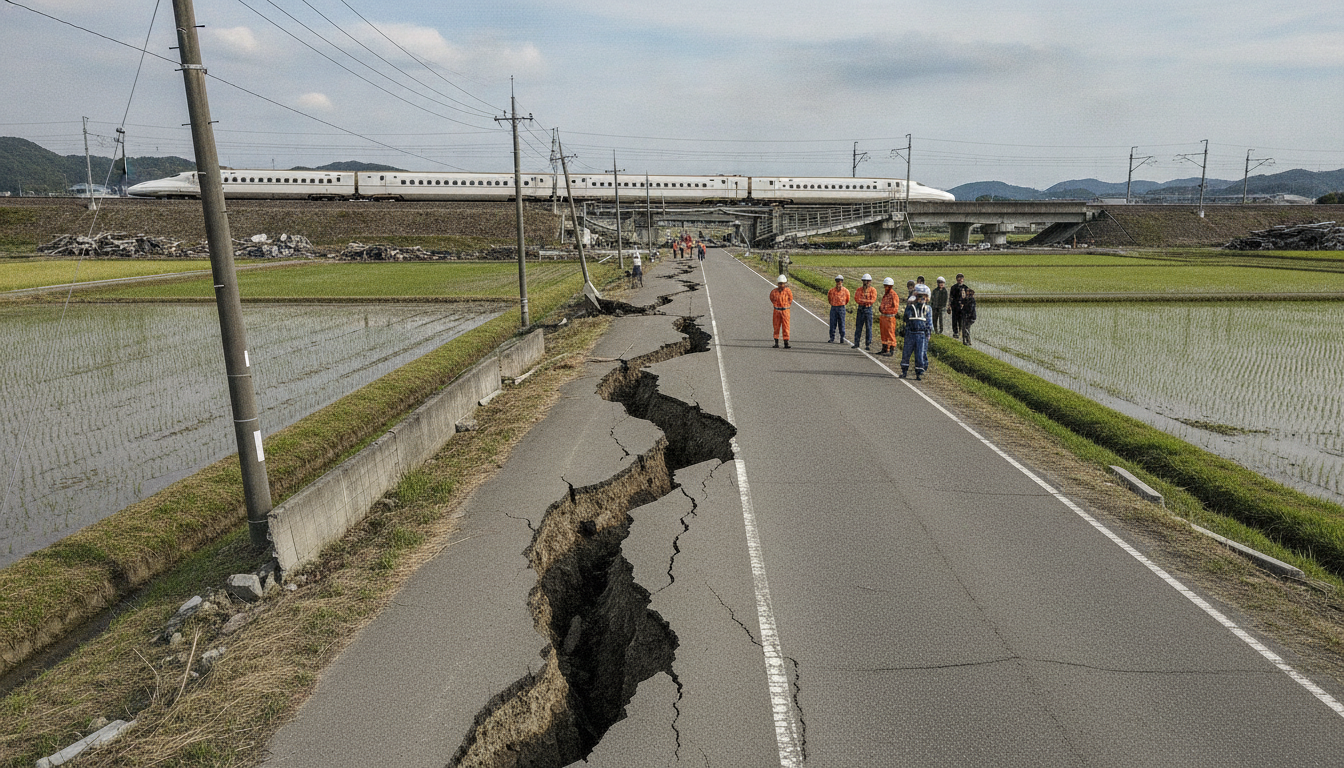
Ground rupture, rail stoppage and mall explosion after July 28 Kumamoto earthquake
Kumamoto earthquake on July 28 produced visible ground rupture along a mapped fault, halted Shinkansen services and triggered an explosion at a major shopping mall, leaving widespread infrastructure damage and uncertainty.
The magnitude shock that struck Kumamoto Prefecture on July 28 caused a clear surface rupture along an active fault that crossed highways and railway lines, officials and experts reported on July 29. The quake left sections of elevated roadway, cracked earth, and suspended rail services as emergency crews worked to assess damage and assist affected communities. Local authorities declared widespread service disruptions to roads, water and power while search-and-rescue operations continued in hardest-hit areas.
Active fault rupture observed along expressway and farmlands
Aerial and ground inspections on July 29 revealed a continuous belt of surface displacement running alongside sections of the expressway and through agricultural land. In places the roadway showed a step change and fissures traced the fault line, with some ground on one side raised roughly a meter above the other.
Seismologists said the rupture appeared to follow a previously mapped active fault that had been identified in hazard studies, and they cautioned that aftershocks could further alter slopes and damaged infrastructure. Engineers began detailed surveys aimed at mapping the full extent of surface breakage to inform repairs and closures.
Shinkansen halted after tracks crossed ruptured ground
Bullet train services were suspended when sections of track were found to lie on or adjacent to the fault rupture, forcing trains to stop and stranding passengers for extended periods. Reports from the scene said some travelers remained aboard halted trains for hours, with one account indicating passengers were held on a stopped train for as long as 14 hours before safe evacuation.
Rail operators and infrastructure inspectors carried out emergency checks on bridges, sleepers and electrification systems while rail speed restrictions remained in force for preliminary safety reasons. Restoring full rail service will depend on subsurface inspections and repairs to track foundations damaged by lateral ground movement.
Explosion at Aeon Mall adds casualties and strains local shelters
An explosion at Aeon Mall Kumamoto shortly after the quake compounded the humanitarian toll and created confusion around the facility’s role as a designated disaster hub. Local officials reported multiple fatalities and injuries in connection with the blast, and emergency responders prioritized extinguishing fires and searching for victims amid unstable conditions.
Authorities and municipal partners said the mall had been designated as a local disaster-relief site under an agreement with neighboring towns, raising concerns about temporary shelter capacity and the safety of congregating evacuees near damaged structures. Company representatives issued apologies and pledged cooperation with investigators and relief efforts.
Water, power and highways remain disrupted across the region
Utilities suffered extensive damage, with tens of thousands of households reporting water outages and localized power interruptions as of July 29. Pipeline ruptures, collapsed supply towers and contamination risks prompted authorities to advise residents to conserve water and follow boil-water notices where issued.
Highways and arterial roads sustained damage including collapsed spans and large offsets near junctions, prompting long-term closures and detours that are already affecting logistics and emergency access. Bridge and tunnel inspections are ongoing, and transport ministries warned that clearance and reconstruction could take weeks in severely affected corridors.
Semiconductor plants and regional industry face uncertain restart
Kumamoto and neighboring prefectures host a concentration of semiconductor and electronics factories often referred to as a regional cluster, and several facilities reported immediate shutdowns after the quake. Company statements and local business groups said operations were suspended to secure personnel safety and to assess structural, utility and clean-room integrity.
Industry analysts warned that prolonged outages at key plants could ripple through global supply chains for a range of products, and they urged rapid but thorough inspections to avoid restarting fragile production prematurely. Local governments pledged to coordinate with manufacturers to prioritize inspections and restore critical infrastructure where possible.
Rescue operations, SDF deployment and central government response
Search-and-rescue teams, firefighters and police continued door-to-door checks and rubble clearing while the Self-Defense Forces were mobilized to support logistics and medical evacuation. Prefectural authorities opened evacuation centers and distributed supplies, though some sites faced operational constraints after structural checks or the mall explosion.
Central government ministers convened emergency meetings on July 29 to coordinate aid, transport rerouting and medical response, and to allocate funds for immediate relief. Officials emphasized the need for caution amid aftershocks and called on residents to follow evacuation orders and official advisories.
Recovery work will hinge on damage surveys, weather and aftershock activity in the coming days, and investigators will seek to establish a full timeline of how the fault rupture propagated to surface structures. As emergency crews continue rescue and stabilization operations, authorities have urged residents to report hazards, heed official notices, and prepare for ongoing disruptions to transport and utilities.

