
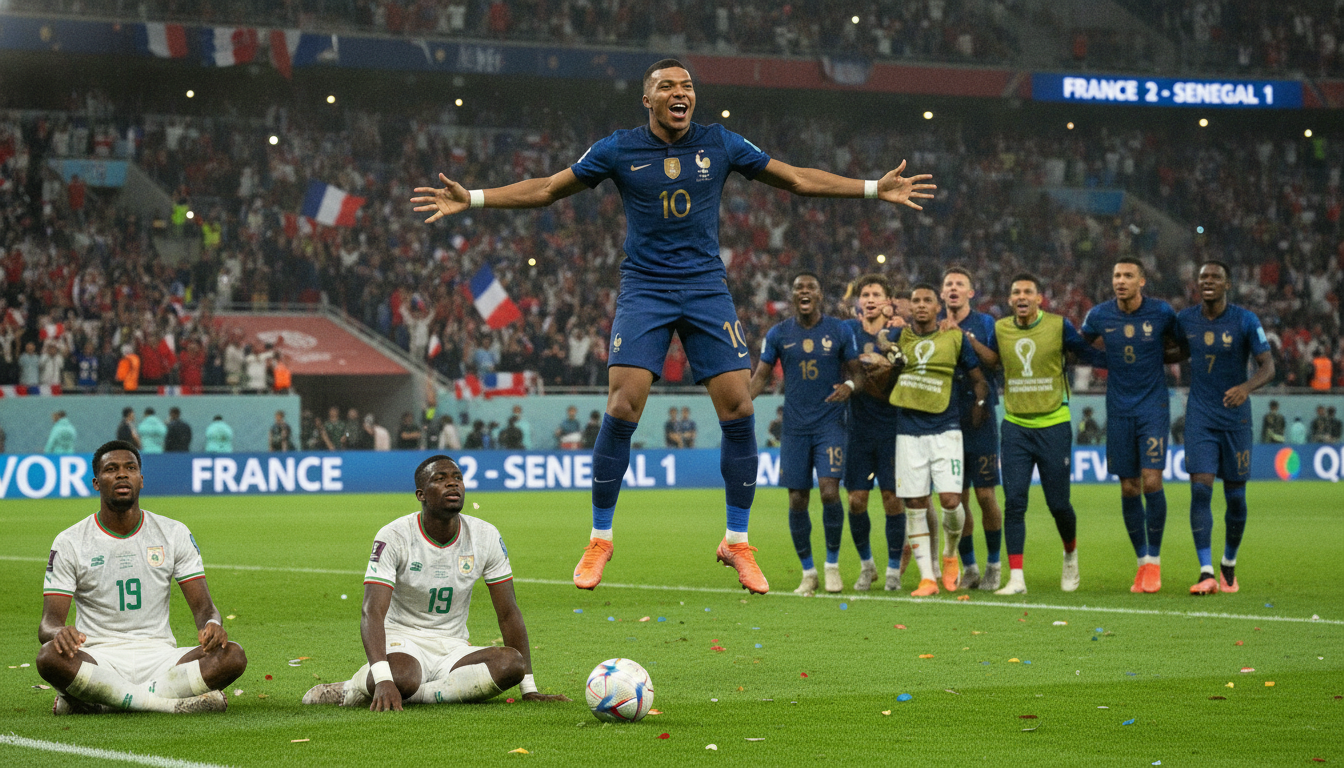
France beat Senegal 3–1 as Mbappé nets twice, Haaland stars for Norway at FIFA World Cup 2026
France defeated Senegal 3–1 and Kylian Mbappé scored twice to reach 14 all-time World Cup goals, while Norway swept Iraq 4–1 as Erling Haaland struck twice at the FIFA World Cup 2026.
France extended its early tournament momentum on June 16, 2026 (June 17 JST), beating Senegal 3–1 in a Group I match that underlined the team’s attacking depth. Kylian Mbappé opened the scoring in the second half and added a late goal to put France in control of the group standings. The result reinforced France’s status among pre-tournament favourites and showcased their blend of experience and youthful pace.
France secures control in Group I with decisive second-half display
France’s victory over Senegal was settled in the second half when Mbappé broke the deadlock and later capped the win with a late strike to make the scoreline 3–1. The French performance combined measured possession with incisive transitions, and they finished the match with a clear margin. Senegal created threats throughout but were unable to convert pressure into enough goals to challenge the final outcome.
Defensive lapses at key moments and France’s clinical finishing proved decisive, with France converting major chances while Senegal struggled to sustain sustained attacking sequences. The win gives France an early cushion in Group I as the tournament moves into the middle phase of the group stage.
Mbappé climbs the World Cup scoring ranks with 14th goal
Mbappé’s brace took his career World Cup tally to 14 goals, moving him up the competition’s all-time scorers list and tying him with one of the historical leaders. The 27-year-old forward’s second goal, struck in the match’s closing stages, underscored his ability to influence results across full matches. His tournament form will be watched closely as France pursue a deep run at this 48-team World Cup.
The milestone also reshapes discussions about World Cup scoring legacies, highlighting Mbappé’s consistency on football’s biggest stage. With group play still to run, continued scoring from him could have a major impact on France’s prospects in the knockout rounds.
Norway overwhelms Iraq as Haaland delivers a brace
In the same group, Norway recorded a convincing 4–1 victory over Iraq, with striker Erling Haaland scoring twice including an early opener that set the tone. Norway, making their first World Cup appearance in 28 years, leaned on Haaland’s finishing and physical presence to assert dominance at both ends of the pitch. The match swung decisively in Norway’s favour once Haaland converted his chances.
Iraq, returning to the tournament after a long absence, showed moments of resilience but could not contain Norway’s front line. Coached by Mark Arnold, who has experience in the J1 League with Sanfrecce Hiroshima, Iraq are in a rebuilding phase and will look to extract lessons as the group stage continues.
Messi starts for Argentina and matches Mbappé’s World Cup tally
Argentina selected Lionel Messi in the starting lineup for their Group J opener, and the veteran forward scored in the first half to reach 14 career World Cup goals, matching the tournament-leading figure at this stage. Messi’s sixth World Cup appearance added another chapter to his storied international career, and his half-time strike gave Argentina an early psychological edge in their group fixture.
Argentina arrive at this World Cup having won the previous tournament and after topping South American qualifying, which positions them as one of the favourites. Algeria, returning to the finals for the first time since their 2014 run to the last 16, present a different tactical challenge and will test Argentina’s defensive cohesion in upcoming matches.
Schedule and key fixtures as group play continues in June
Group J’s Argentina versus Algeria kick-off was scheduled for June 17, 2026 at 10:00 JST, while Austria and Jordan were set to meet later that day at 13:00 JST. These fixtures will help clarify early pecking order in their respective groups and offer opportunities for sides to build momentum. With several teams making their tournament debuts and others returning after long absences, early results are likely to shape both confidence and tactical adjustments.
Tournament organizers will continue to stagger matches across venues in the United States, Mexico and Canada, with broadcasters and fans around the world tracking developments closely as the group phase progresses through late June.
Tournament format and implications for knockout qualification
The expanded FIFA World Cup 2026 features 48 national teams and a format that advances the top sides from each group into a 32-team knockout stage. The competition will total 104 matches, culminating in the final scheduled for July 19, 2026 (July 20 JST) in the New York metropolitan area. That calendar sets a compact schedule for teams seeking to progress, increasing the premium on early points and goal difference.
For top contenders like France and Argentina, strong group-stage performance is critical to avoid difficult draws in the knockout rounds. For emerging teams and debutants, even a single positive result can alter expectations and create momentum heading into the latter stages of the tournament.
France’s win over Senegal and Norway’s emphatic result over Iraq on June 16–17 highlight the early storylines of a tournament that promises high stakes and shifting dynamics. As the FIFA World Cup 2026 group stage unfolds, players such as Mbappé, Haaland and Messi will remain focal points for fans and pundits watching who can carry their nations deepest into the competition.

