
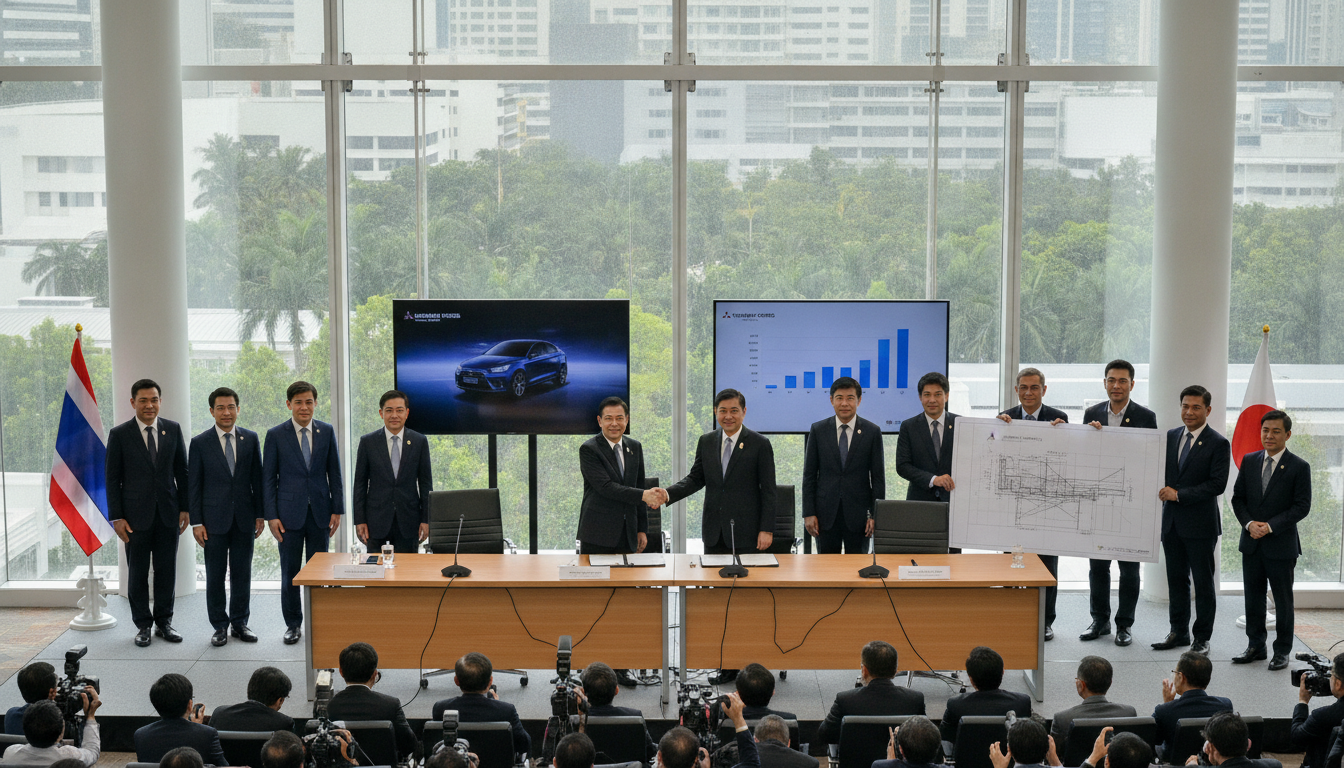
Mitsubishi Motors to Invest 16 Billion Baht in Thailand to Build EV Production and Export Hub
Mitsubishi Motors will invest 16 billion baht in Thailand by 2030 to build a production and export hub for electrified vehicles and boost supply chains.
Mitsubishi Motors investment in Thailand will expand the automaker’s local operations with a fresh 16 billion baht commitment aimed at transforming its Thai factories into a center for electrified vehicle production and exports. The company said the funds will be deployed through 2030 as it accelerates output of hybrid and battery-electric models for regional and global markets. The move underscores the growing importance of Thailand in Mitsubishi’s global strategy and in Southeast Asia’s broader shift toward electric mobility.
Planned 16 billion baht investment by 2030
Mitsubishi outlined a multi-year investment to upgrade facilities, add new production lines and deepen integration with suppliers across Thailand. The 16 billion baht allocation is intended to cover plant modernization, tooling for electrified powertrains and logistics enhancements that support higher export volumes. Company executives framed the investment as a necessary step to meet rising demand for electrified vehicles in Asia and beyond.
The announcement follows growing industry momentum in Southeast Asia where automakers are repositioning capacity for electrified models. Mitsubishi’s plan aligns its timeline with regional policy shifts and anticipated market growth through the end of the decade.
Conversion of Thai plants into a regional export hub
Mitsubishi intends to retool existing sites to serve not only the domestic market but also as an export base to neighboring countries and beyond. Officials described the strategy as converting Thailand from primarily a local manufacturing site to a coordinated export hub for electrified vehicles. That approach aims to leverage Thailand’s established supplier network and logistical links to major markets.
Export-focused production will require expanded quality control, regulatory compliance mechanisms and strengthened port and inland transportation capacity. Executives noted that aligning production standards across factories is central to successfully scaling exports.
Electrified models and production priorities
The investment is targeted at electrified vehicles, a category that includes hybrid, plug-in hybrid and battery-electric models, though Mitsubishi has not published a detailed model-by-model production schedule. Company statements emphasized flexibility, enabling shifts between conventional and electrified assembly depending on demand. Engineers will focus on integrating electric powertrains while maintaining capacity for internal combustion models during the transition.
Mitsubishi also signaled intentions to work with local parts makers on battery pack assembly, power electronics and electric motor components to shorten supply chains and reduce costs. The precise mix of models to be produced in Thailand will depend on market uptake and regulatory developments.
Thailand’s policy push and industry incentives
Thailand’s government has positioned electric vehicles as a pillar of its long-term industrial strategy, offering incentives and infrastructure support to attract investment. Authorities have promoted tax breaks, subsidies for EVs and measures to encourage battery and component manufacturing. The government’s policy posture has been a key factor behind multinational automakers choosing Thailand as a base for electrified vehicle investment.
Officials in Bangkok have signaled willingness to continue incentives tied to local content and export targets, but industry observers note that incentive frameworks may be adjusted as the domestic market matures. Continued government-industry coordination will be critical for Mitsubishi’s plans to move forward smoothly.
Economic effects and supplier opportunities
Mitsubishi’s investment is expected to deepen links with local suppliers and could generate new employment in manufacturing, logistics and engineering services. By expanding electrified vehicle production, the company can create demand for battery assembly plants, wiring harness makers and electronics suppliers. Local firms that adapt to EV components may capture higher-value work and increase exports.
Regional economic benefits could include greater foreign direct investment and higher utilization of Thailand’s existing automotive clusters. However, the scale of job creation and supplier gains will depend on how quickly global and regional EV demand grows and how much of the value chain remains onshore.
Operational and market challenges ahead
Mitsubishi will face competing pressures, including securing stable battery supplies, managing global semiconductor constraints and meeting evolving emissions and safety regulations. Competition from other automakers expanding EV capacity in Southeast Asia also raises the bar for cost and production efficiency. Fluctuations in currency, trade barriers and logistics disruptions present additional risks to an export-focused strategy.
Analysts say Mitsubishi’s success will hinge on timely investments in workforce training, supplier development and local R&D capabilities. Building resilient supply chains and long-term partnerships with battery and component suppliers will be essential to maintain competitiveness.
Mitsubishi Motors’ 16 billion baht investment in Thailand marks a significant commitment to electrified vehicle production and export growth over the coming years. The plan dovetails with Thailand’s industrial ambitions and could strengthen the country’s role in the regional EV supply chain, provided the company and its partners manage logistical, regulatory and market risks effectively.

