
India and Myanmar Agree to Cooperate on Critical Minerals and Rare Earths During Min Aung Hlaing Visit
Myanmar’s Min Aung Hlaing and India’s PM Narendra Modi agreed to cooperate on critical minerals and rare earths in New Delhi on June 1 to bolster supply chains.
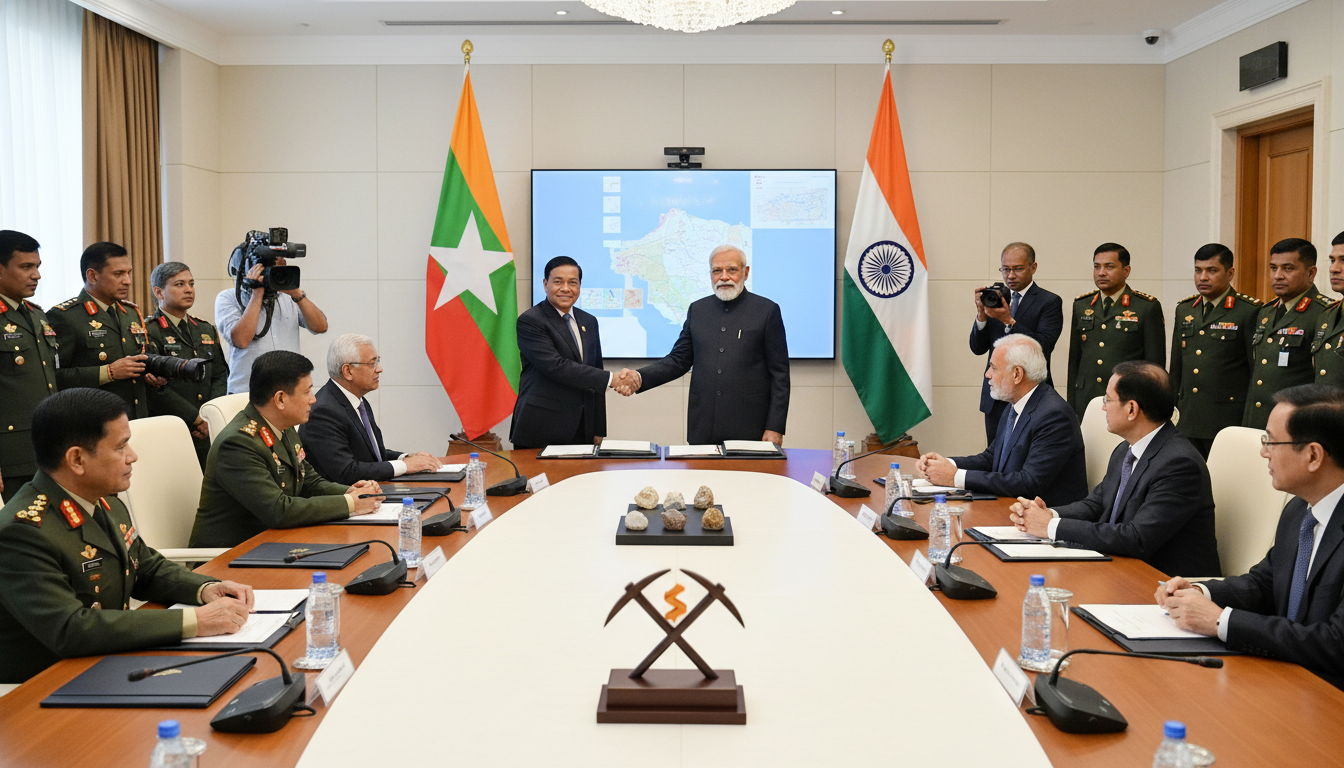
Myanmar’s President Min Aung Hlaing met Indian Prime Minister Narendra Modi in New Delhi on June 1, marking the centrepiece of his five-day visit to India and his first foreign trip since assuming the presidency. The leaders agreed to expand cooperation on critical minerals and rare earths, a sector seen as essential for renewable energy, electronics and advanced manufacturing. The meeting at Hyderabad House underscored both countries’ interest in securing supplies and developing processing capacity for strategic materials.
Meeting at Hyderabad House
The talks took place at Hyderabad House on Monday and were described by officials as substantive and forward-looking. Delegations from both sides discussed trade, investment and technical collaboration tied to mineral exploration and downstream processing. The conversation emphasized practical steps to enhance bilateral ties in a sector that India has been actively seeking to diversify.
Details of the minerals agreement
Both leaders set out a framework to cooperate on critical minerals and rare earths, though details of specific projects were not immediately disclosed. Indian officials said the agreement covers joint exploration, data sharing, and potential collaboration on refining and value-added processing. The emphasis on rare earths reflects their growing importance for high-tech industries and clean-energy technologies.
Economic and industrial implications
For India, access to new sources of critical minerals could reduce reliance on single-country suppliers and support domestic ambitions in electric vehicles, battery manufacturing and electronics. For Myanmar, the pact presents opportunities to attract investment into mining infrastructure and processing plants, potentially creating jobs and new export revenue. Both governments framed the cooperation as mutually beneficial for industrial upgrading and supply-chain resilience.
Regional strategic context
Analysts note the move comes amid broader regional competition to secure mineral resources and build resilient supply chains for emerging technologies. India has been diversifying its partnerships to safeguard inputs for its growing green-energy and defence sectors. Myanmar’s engagement with New Delhi also adds another dimension to its external relations at a time when regional dynamics are shifting.
Implementation steps and institutional follow-up
Officials indicated work will begin immediately to set up technical committees and feasibility studies, with further meetings planned in the coming months. Proposed steps include mapping resource deposits, establishing regulatory frameworks, and exploring public-private partnerships to finance mining and processing facilities. Both governments pointed to the need for environmental safeguards and community consultation as the cooperation advances.
Business and market reaction
Market participants and industry groups in India signalled cautious optimism about the prospect of new supply lines for critical minerals. Domestic manufacturers said clearer access to rare earths and related materials could lower costs and reduce project delays. Investors will likely monitor the pace of regulatory approvals and the emergence of concrete project proposals before committing significant capital.
Myanmar’s trade ministry and Indian commerce officials have not released a full text of any memorandum, and details on financing and timelines remain to be confirmed. Observers said transparent tendering processes and robust environmental assessments will be crucial to secure broad support and sustainable outcomes.
Diplomatic messaging and future engagements
The meeting served as a diplomatic affirmation of growing ties between the two capitals and signalled a pragmatic approach to shared economic interests. Both leaders framed the agreement as a step toward deeper cooperation rather than an endpoint, leaving room for expanded collaboration on energy, infrastructure and technical training. Additional bilateral talks are expected as technical teams work through the operational details.
The remainder of Min Aung Hlaing’s five-day visit includes meetings with business leaders and further talks with Indian officials aimed at translating political agreements into concrete projects. Officials in both countries said they will provide periodic updates as joint studies conclude and pilot initiatives are launched.

