
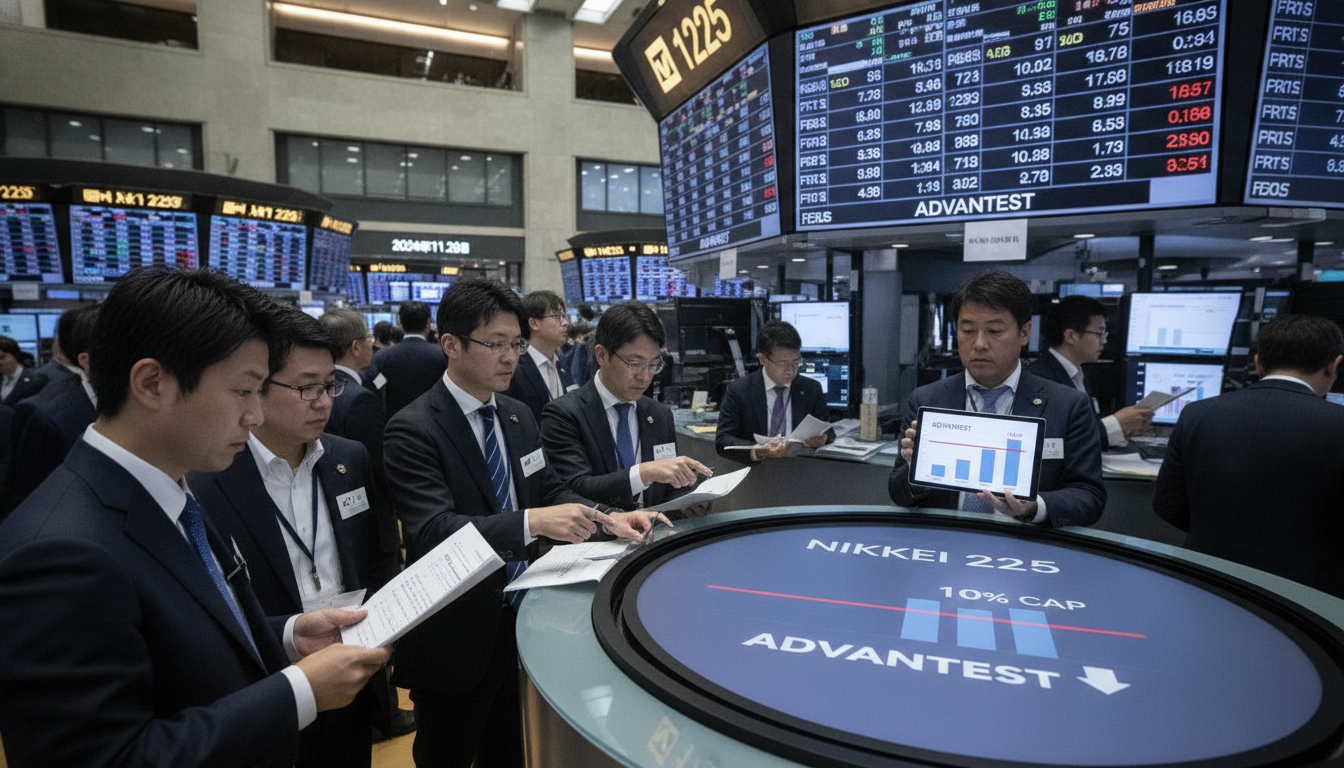
Nikkei to Cut Advantest Weight in Nikkei 225 from October After Stock Tops 10% Cap
Nikkei will lower Advantest’s weight in the Nikkei 225 from Oct. 1 after the stock exceeded the 10% cap, with the price adjustment factor set to fall from 7.2 to 6.4.
The Nikkei 225 operator said it will reduce Advantest’s weight in the Nikkei 225 effective Oct. 1, citing the stock’s share of the index exceeding the 10% cap based on the July 31 reference price. Advantest accounted for 12.2% of the index on the reference date, prompting application of the capping rule introduced by Nikkei in 2022. The adjustment will be implemented by lowering the index’s price adjustment factor from 7.2 to 6.4 at the start of October. Further changes, including any modification or removal of the cap, will be considered during the semiannual reviews after the spring cycle.
Nikkei reduces Advantest weight after July reference date
The company managing the Nikkei 225 said the July 31 closing price served as the reference for this autumn’s periodic review, and that figure placed Advantest above the 10% threshold. The 12.2% share triggered the index’s cap mechanism designed to limit any single constituent’s influence on the benchmark. The operator will apply the cap through a lower price adjustment factor, a technical device that reduces a constituent’s effective contribution without changing its market price. The change takes effect Oct. 1 and aligns with the index’s established timetable for adjustments.
How the 10% cap and price adjustment factor work
The Nikkei 225 is a price-weighted index in which each constituent’s influence derives from its share price multiplied by a price adjustment factor that accounts for historical corporate actions. When a company’s index share exceeds the 10% cap, Nikkei applies a reduction to that factor to bring the weight back within the prescribed limit. For this adjustment, the factor applied to Advantest will move from 7.2 to 6.4, a reduction intended to bring the company’s index weight below the 10% ceiling. The mechanism allows the index to maintain representation while avoiding dominance by a single stock.
Implications for funds and market participants
A change in Advantest’s weight will affect funds that track the Nikkei 225, including ETFs and passive mandates that seek to replicate the index’s performance. Index-tracking vehicles typically rebalance their holdings to match index weightings, which can generate buying or selling flows around the effective date. For active investors, the adjustment may alter relative performance attribution and portfolio tilt, particularly for managers with large Japan equity exposures. Market participants will monitor trading activity as the cap is implemented to gauge short-term liquidity effects on Advantest shares and on broader market dynamics.
Precedent and past uses of the capping rule
Nikkei first applied the capping rule in autumn 2024 when Fast Retailing exceeded the threshold, and it was used again in the spring of 2025. Advantest itself was subject to the cap during this year’s spring review as well, signaling that repeated applications are possible when a company’s share price rises sharply. The rule was introduced in 2022 to protect the index’s representativeness and to prevent concentration risk as certain high-performing stocks grew relative to the rest of the benchmark. Historical uses show the operator’s willingness to deploy the mechanism when market movements push individual constituents beyond the intended limits.
Outlook and timing for future reviews
Nikkei has signalled that any further adjustments or a potential lifting of the cap will be decided in conjunction with the semiannual review process following the spring review next year. The index undergoes periodic reviews tied to fixed reference dates, and operators can revise factors and constituent weights only at those scheduled intervals except in exceptional circumstances. Investors seeking clarity on longer-term index composition will watch the next review cycle for guidance on whether the cap will remain a recurring tool. In the meantime, the October change provides a concrete, rules-based response to the recent run-up in Advantest’s share price.
The application of the cap and the reduction of the price adjustment factor reflect the index manager’s effort to balance accurate market representation with rules to limit concentration risk, and market participants will be observing how the adjustment influences flows and sentiment around both Advantest and the Nikkei 225.

