
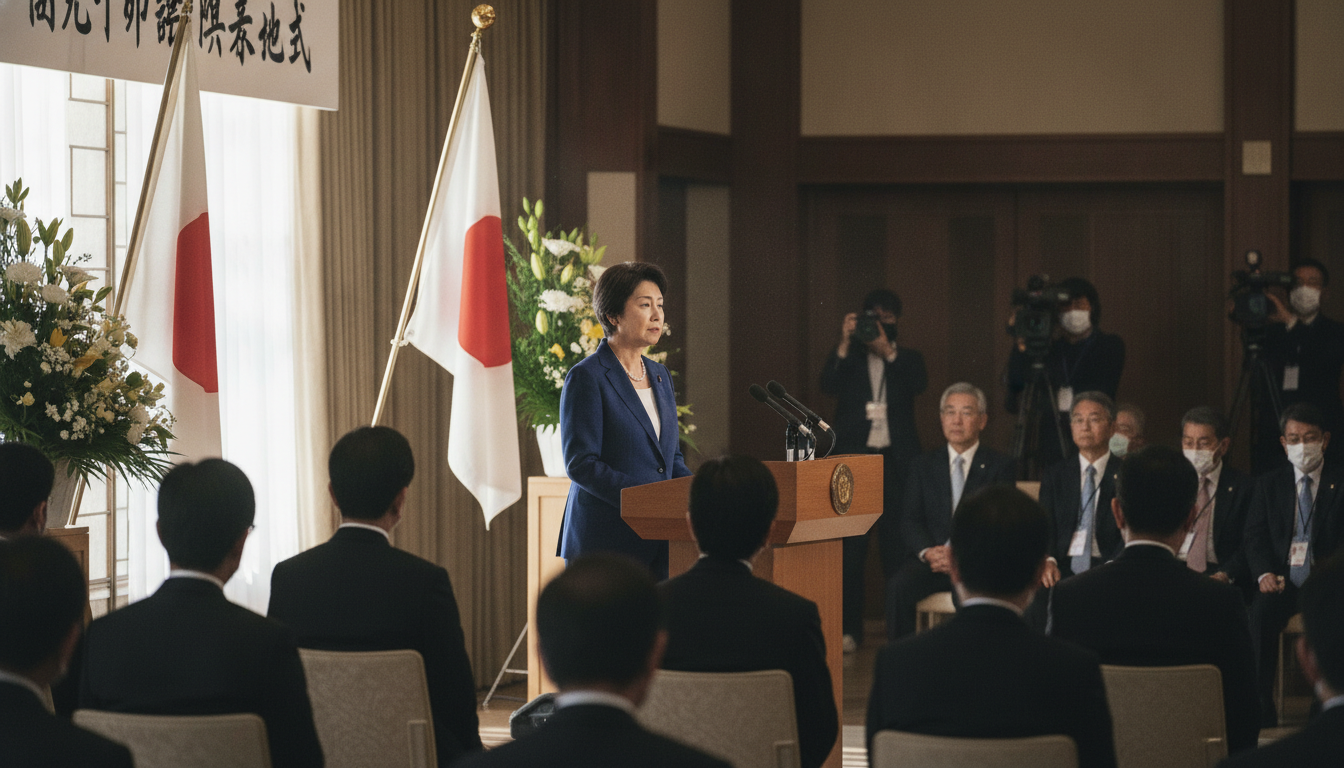
Takaichi Reaffirms Non-Nuclear Three Principles at Hiroshima Peace Ceremony
Japan’s prime minister said on August 6, 2026 that the Non-Nuclear Three Principles remain government policy, reaffirming the nation’s duty as the only country to have suffered wartime atomic bombings.
Takaichi Reaffirms Non-Nuclear Three Principles in Hiroshima Address
On August 6, 2026 Prime Minister Sanae Takaichi attended the Hiroshima Peace Memorial Ceremony and reiterated that Japan will uphold the Non-Nuclear Three Principles as official policy. She framed the commitment as part of Japan’s responsibility — as the sole nation to suffer wartime atomic bombings — to continue efforts toward the realization of a world without nuclear weapons. The remarks, delivered at her first such ceremony since taking office, emphasized continuity rather than announcing any policy change.
First Appearance at Peace Memorial Since Taking Office
Takaichi’s speech marked her first participation in the annual memorial as prime minister and was watched closely for any shift in Japan’s nuclear posture. Observers had expected signal language because previous leaders used the ceremony to indicate future direction on security matters, but Takaichi confined her remarks to reaffirming longstanding policy. Her measured tone underscored an intent to project stability at a moment with heightened public attention to nuclear issues.
Government Spokesman Clarifies Policy Stance
Following the ceremony, Chief Cabinet Secretary Minoru Kihara addressed reporters at the Prime Minister’s Office and reiterated that the government maintains the Non-Nuclear Three Principles as a policy guideline. When questioned about whether the prime minister’s words represented a change in direction, Kihara said the speech reflected the government’s existing stance and was not intended to foreshadow new initiatives. He emphasized that the administration’s public remarks should be read in the context of established policy commitments.
Contrast with Remarks Made Last Year by Shigeru Ishiba
The ceremony’s language also evoked statements made last year by Shigeru Ishiba, who urged Japan to lead international efforts toward a nuclear-free world while maintaining the Non-Nuclear Three Principles. That prior commentary had been interpreted by some as advocating a more proactive diplomatic role for Japan on disarmament issues. Takaichi’s address, by contrast, focused on reaffirmation rather than a call for new leadership initiatives, reflecting differing rhetorical approaches within the political landscape.
Persistent Debate Within the Ruling Camp
Despite the prime minister’s restrained phrasing, debate over nuclear policy continues within ruling circles and among senior officials who occasionally express more expansive views. Some members of the broader political establishment have publicly discussed scenarios that touch on alliance dynamics and deterrence, which keeps the issue under regular scrutiny. Government spokesmen have sought to manage those conversations by repeatedly pointing to the Non-Nuclear Three Principles as the baseline for official policy.
Historical and International Context at the 81st Anniversary
Takaichi’s speech came on the 81st anniversary of the Hiroshima bombing, a date that draws sustained domestic and international attention to questions of nuclear weapons, survivors’ testimonies and disarmament efforts. The annual ceremony serves both as a site of mourning and a platform for articulating Japan’s stance on nuclear abolition, which carries symbolic weight in diplomacy. In that context, reaffirmation of the Non-Nuclear Three Principles signals continuity to allies and to civil society groups focused on nuclear disarmament.
Implications for Japan’s Security and Diplomatic Posture
Analysts say reinforced commitment to the Non-Nuclear Three Principles can coexist with debates over alliance cooperation and regional deterrence without immediately altering legal or constitutional constraints on Japan’s defense posture. The administration’s careful language suggests an attempt to balance domestic expectations for moral leadership on abolition with strategic conversations about national security. How the government translates rhetorical commitments into diplomatic initiatives will be watched closely by partner governments and advocacy groups alike.
Takaichi’s August 6 statement closed no doors to future policy discussion, but it made clear that, for now, the Non-Nuclear Three Principles remain a defining element of official Japanese policy and public messaging. The prime minister’s choice to emphasize continuity at the Hiroshima ceremony reflected both respect for the day’s historical significance and a desire to avoid sudden shifts in a sensitive area of national and international concern.

