
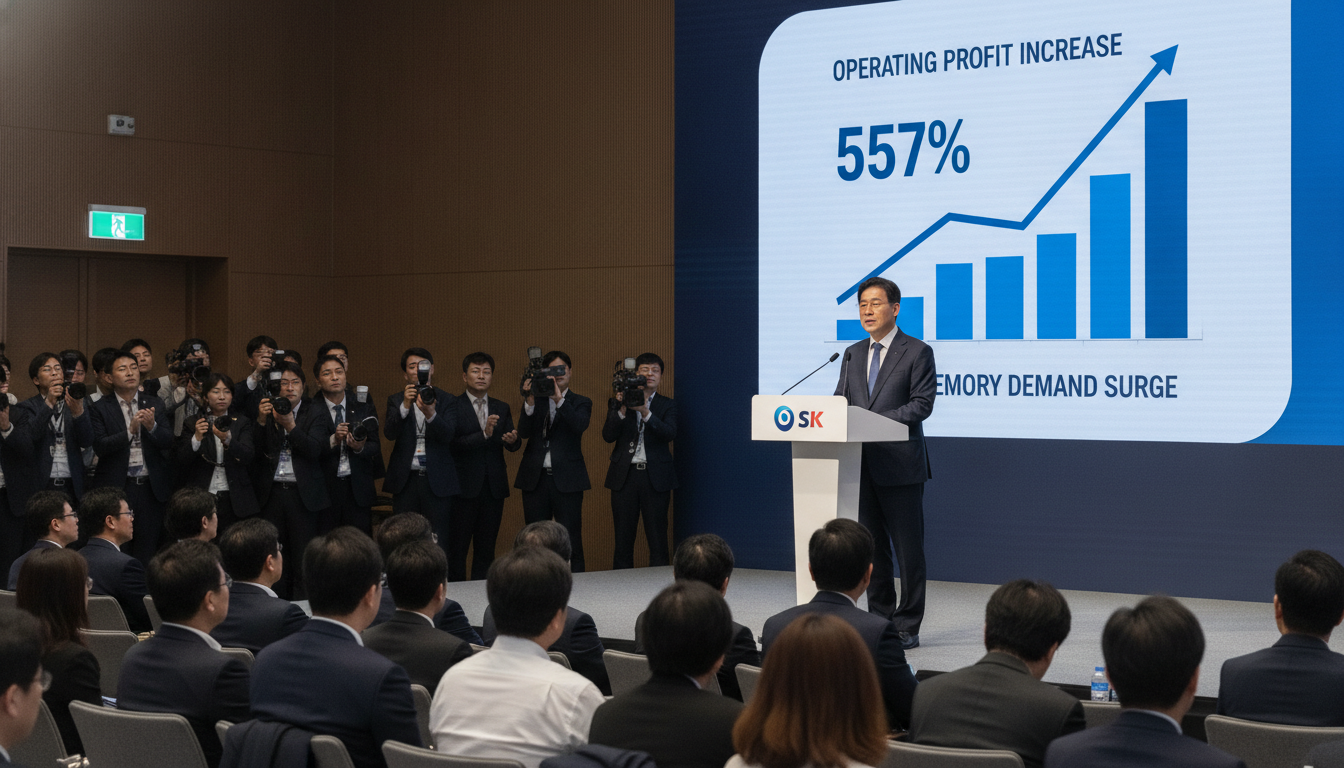
SK Hynix Q2 Operating Profit Surges 557% to 60.54 Trillion Won on AI-Driven Chip Demand
South Korea’s SK Hynix posted a 557% jump in Q2 operating profit to 60.54 trillion won ($41.6 billion), driven by booming demand for semiconductors tied to artificial intelligence infrastructure.
Strong quarterly results from SK Hynix
SK Hynix reported operating profit of 60.54 trillion won in the second quarter, a year‑on‑year rise of 557%, the company said, citing sustained expansion of artificial intelligence infrastructure as a primary driver. The surge reflects a sharp improvement in demand for memory chips and other products as data centers and AI hardware scale up worldwide. Company officials framed the performance as evidence that the AI-fueled semiconductor cycle is materially benefiting major memory suppliers.
AI infrastructure lifts memory chip demand
The company attributed the profit jump to continued expansion of AI infrastructure, which has raised demand for high‑performance memory solutions used in large language models and other generative AI workloads. Memory chips such as DRAM and high‑end NAND play a critical role in accelerating model training and inference, prompting data center operators and cloud providers to increase procurement. SK Hynix’s results underline how specialized AI compute requirements are reshaping purchasing patterns across the semiconductor supply chain.
Profit drivers and margin recovery
Improved pricing and higher factory utilization contributed to the company’s strong margins in the quarter, helping operating profits expand substantially from depressed levels a year earlier. The combination of recovering chip prices and more efficient production has allowed SK Hynix to capture a larger share of the upside in the memory market. Executives highlighted that revenue mix shifts toward products serving AI workloads supported the wider margin recovery during the period.
Investor and industry response
The exceptional quarter prompted renewed attention from investors and industry observers, who view SK Hynix’s performance as confirmation that AI demand is translating into tangible revenue gains for memory suppliers. Market participants have increasingly focused on the degree to which AI spending will sustain elevated demand for DRAM and advanced NAND. Analysts have noted that earnings of major memory makers will be a bellwether for how quickly the semiconductor industry can exit the cyclical downturn that weighed on prices in previous quarters.
Capacity, supply and longer‑term implications
SK Hynix’s results are likely to accelerate discussions within the industry about capacity expansion, supply chains and investment in next‑generation memory technologies. Meeting the growing needs of AI infrastructure often requires not only higher volumes but also products with faster speeds, larger capacities and new packaging technologies. How quickly suppliers ramp capacity, and whether demand remains concentrated among a handful of cloud and AI firms, will determine the durability of the current upcycle.
Outlook and strategic priorities
While the company reported a markedly stronger quarter, its future performance will hinge on the pace of AI deployments, macroeconomic conditions, and inventory dynamics across the technology stack. SK Hynix has emphasized product development and strategic investments to serve evolving AI applications, though the timing and scale of new capital expenditure decisions will reflect ongoing market signals. Observers expect the firm to balance near‑term returns with longer‑term commitments to advanced memory platforms.
SK Hynix’s second‑quarter results offer a clear snapshot of how the AI boom is lifting parts of the semiconductor industry, underscoring both the immediate financial benefits for major memory makers and the strategic questions that will shape investment and supply in the months ahead.

