
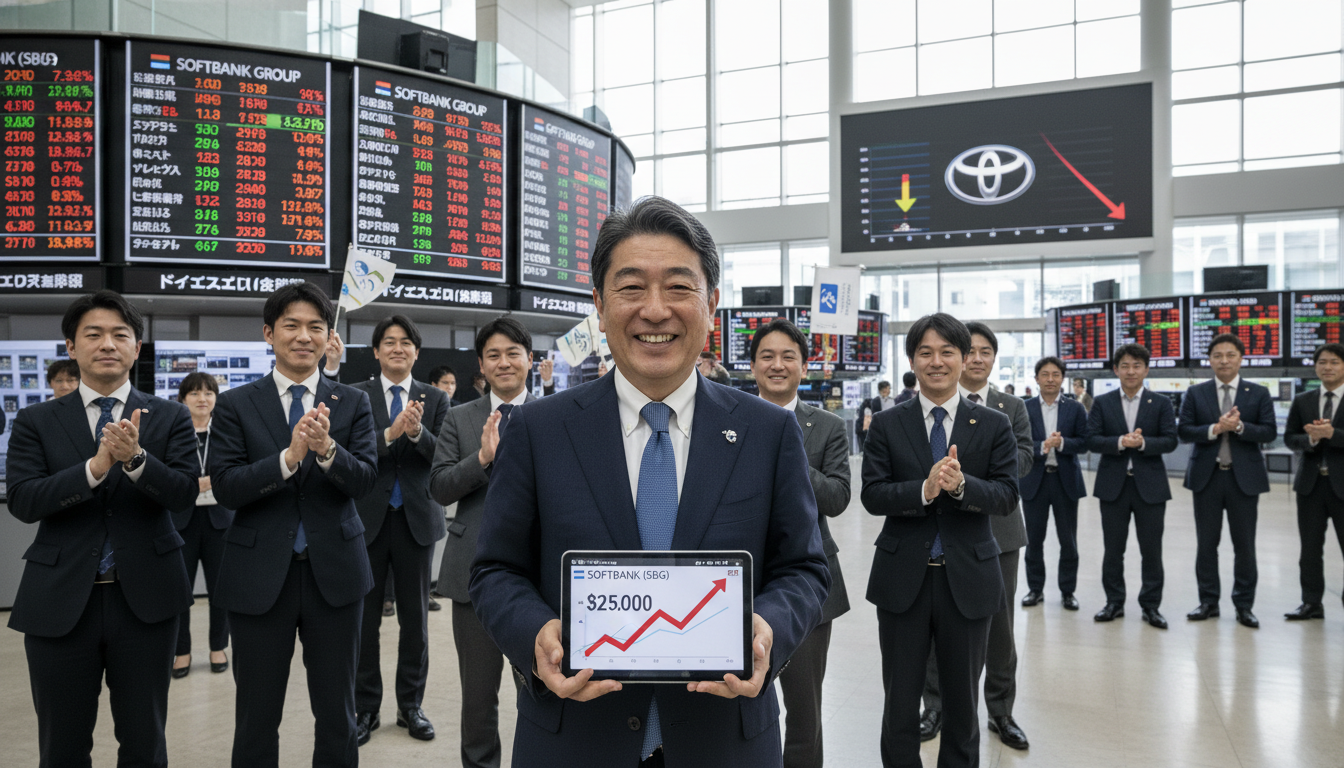
SoftBank market cap surpasses Toyota as AI rally and OpenAI stake lift shares
SoftBank market cap surpasses Toyota as AI rally and its OpenAI stake propel shares, reshaping Japan’s stock landscape and investor sentiment further.
SoftBank market cap overtakes Toyota for first time since 2000
SoftBank Group’s market capitalization climbed past that of Toyota Motor in Tokyo trading, marking the first time the tech conglomerate has exceeded the automaker in market value since 2000. The surge in SoftBank shares has been driven by a global rally in artificial intelligence stocks and renewed investor focus on the company’s holdings, including its stake in OpenAI, the creator of ChatGPT. Market watchers said the jump reflects a re-rating of technology assets as expectations for AI-powered revenue growth accelerate across sectors.
OpenAI stake cited as primary catalyst for share gains
Analysts point to SoftBank’s exposure to OpenAI and related AI ventures as a major factor behind the rally, with investors pricing in the potential upside from the rapid adoption of generative AI. While SoftBank does not directly disclose every detail of its private holdings, the company’s Vision Fund and strategic investments have increasingly been seen as vehicles for capturing value tied to AI development. Several brokerage notes and market commentaries attributed recent buying momentum to optimism over returns from early-stage AI stakes rather than short-term operational improvements at SoftBank itself.
Investor sentiment and trading dynamics in Tokyo
Trading in Tokyo reflected a shift toward high-growth, tech-oriented positions as domestic and international investors rebalanced portfolios following the AI fervor overseas. Fund managers told market reporters they were reallocating capital toward companies with meaningful AI exposure, and this repositioning supported broader demand for SoftBank stock. The change in investor appetite also contributed to volatility, with intraday swings amplified by algorithmic trading and sentiment-sensitive flows.
Implications for Japan’s market hierarchy and megacaps
SoftBank’s rise over Toyota signals a notable reshuffle among Japan’s largest listed companies, underscoring how valuation leadership can pivot from traditional manufacturing to technology-driven businesses. For decades, automakers and industrial groups anchored the country’s market cap rankings, but the AI cycle has highlighted the growth premium attached to software and platform plays. Market strategists said the episode may prompt institutional investors to reassess benchmark weightings and governance engagement as capital chases new sources of long-term growth.
Toyota’s position and sector context remain distinct
Toyota continues to be a global leader in automobile production, engineering and manufacturing scale, and executives maintain a long-term focus on electrification, hybrid systems and mobility services. Company fundamentals and cash flows differ markedly from a diversified investment group such as SoftBank, and analysts cautioned against conflating a headline valuation crossover with an operational superiority. Observers noted that cyclical factors, currency moves and sector rotations can compress or expand valuation gaps quickly, meaning leadership in market capitalization is not synonymous with company performance across the business cycle.
Risks and strategic considerations for SoftBank investors
Despite the market enthusiasm, investors and commentators highlighted risks tied to concentrated bets, valuation froth in private markets, and the difficulty of converting early-stage AI promise into durable profits. SoftBank’s balance sheet and exposure to a wide array of startups mean that returns could be uneven, and future markdowns of private assets remain a possibility. Corporate governance questions and the pace at which invested companies monetize AI technologies will be key determinants of whether current valuations are sustained.
The broader message for Japan’s capital markets is that technological shifts can rapidly alter investor priorities and market valuations, but such changes also bring higher scrutiny and shorter time horizons for value realization. As SoftBank and other AI-exposed firms navigate commercialization and regulatory developments, shareholders will be watching for clearer evidence that investments in artificial intelligence translate into sustained revenue and earnings growth.

