
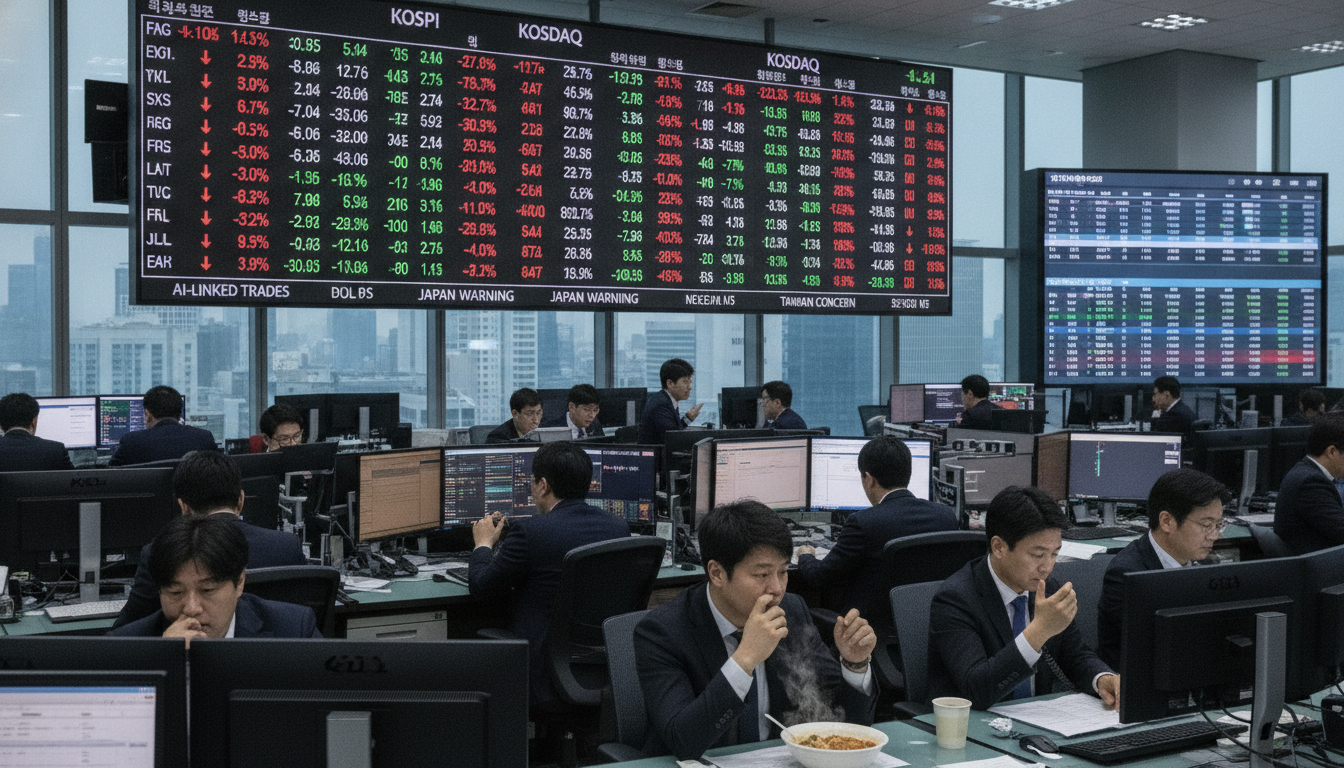
AI-linked trades unwind, rattling Japan and Taiwan markets as chip stocks tumble
AI-linked trades unwind, shaking Japan and Taiwan markets as chip stocks tumble; investors fret over Chinese competition, leverage and AI rally durability.
South Korea’s sharp sell-off in chip stocks and a broader pullback in Asia were driven by an unwinding of AI-linked trades that erased earlier gains and spread caution through Tokyo and Taipei markets. The correction has highlighted concerns about rising Chinese chip competition and the fragility of a rally that had been concentrated in semiconductor and AI-related names. (au.investing.com)
Market rout widens across Asia
The rout that began with steep losses in South Korean chipmakers extended to Japanese and Taiwanese equities, as investors reassessed valuations built on expectations of sustained AI demand. Major indexes in the region fell sharply, with technology-heavy segments bearing the brunt of selling amid thinner liquidity and heightened volatility. (investing.com)
Selling pressure accelerated after dealers and fund managers began reducing leveraged positions that had amplified gains earlier in the year. That forced a cascade of exits in names most closely tied to AI infrastructure spending, magnifying moves in markets where margin and speculative participation had grown. (live.euronext.com)
SK Hynix drops despite earnings report
SK Hynix shares fell notably even though the company released a strong earnings report earlier in the session, underscoring the distinction between corporate performance and market sentiment in a risk-off episode. Traders cited disappointment that the results did not fully match sky-high expectations after recent AI-driven rerating of memory stocks. (apnews.com)
The stock’s decline illustrated how fragile investor confidence had become after outsized gains, with some investors saying that earnings alone were no longer sufficient to insulate heavily valued chip names from broader deleveraging. Market circuit breakers and rapid intraday swings reflected the speed and scale of the re-pricing. (brecorder.com)
Chinese chip listings sharpen competitive fears
Investors pointed to the successful listing and rapid capital raise by Chinese memory-chip companies as a trigger for renewed worries about overcapacity and intensified competition in the global memory market. The emergence of new, well-funded Chinese entrants has forced market participants to revisit assumptions about profit margins and pricing power for established makers. (au.investing.com)
Analysts noted that fresh supply, combined with uncertain demand dynamics for memory used in AI systems, increases the risk of cyclical pressure on margins. That has led portfolio managers to reduce concentration in AI-exposed names until earnings trends and pricing signals become clearer. (au.investing.com)
Impact on Tokyo and Taipei trading floors
Japan’s Nikkei and Taiwan’s TAIEX both reflected the spillover from the chip sell-off, with index components tied to semiconductors and related equipment among the day’s biggest decliners. Market breadth turned negative as investors rotated out of high-multiple technology stocks and into defensive sectors. (investing.com)
In Taipei, heavyweights with direct exposure to foundry and memory demand underperformed, prompting portfolio rebalancing by both domestic and foreign investors. Tokyo’s losses were broader but still centered on names with visible AI-linked revenue streams. (investing.com)
Leverage and retail participation add to volatility
Market strategists warned that the scale of retail participation and margin use in the recent AI rally made the correction faster and deeper than a more diversified advance would have produced. When leveraged positions unwind, forced selling can push prices below fundamentals in the near term, exacerbating investor losses. (live.euronext.com)
Some broker reports highlighted increasing margin calls and a spike in short-term trading volumes, suggesting that mechanical deleveraging, rather than fresh fundamental news, accounted for a sizeable portion of the intraday moves. That dynamic frequently amplifies downside in concentrated rallies. (live.euronext.com)
Analysts urge earnings and policy clarity
Market commentators say the pathway back to steadier trading likely requires clearer corporate guidance from major chipmakers and visible signs that pricing in core memory markets is stabilizing. They also flagged the need for central-bank communications to remain predictable amid global rate uncertainty, which can influence risk appetite. (investing.com)
Portfolio managers told reporters they will be watching upcoming quarterly results, capacity announcements and supply-chain signals for evidence that the AI demand narrative is durable. Many plan to reduce concentration risk and increase cash buffers until a more settled backdrop emerges. (investing.com)
The unwinding of AI-linked trades has popped the froth on a concentrated rally and served as a reminder that rapid gains in thematic sectors can leave markets vulnerable to sudden reversals. Investors in Japan and Taiwan now face a period of reassessment as they weigh company fundamentals against broader structural shifts in the semiconductor industry.

