
Taiwan Drones Budget Blocked as Opposition Backs Alternative Plan
Opposition lawmakers blocked Taiwan’s drone budget on Aug. 27, 2026, endorsing an alternative plan that complicates Taipei’s push for an asymmetric drone defence
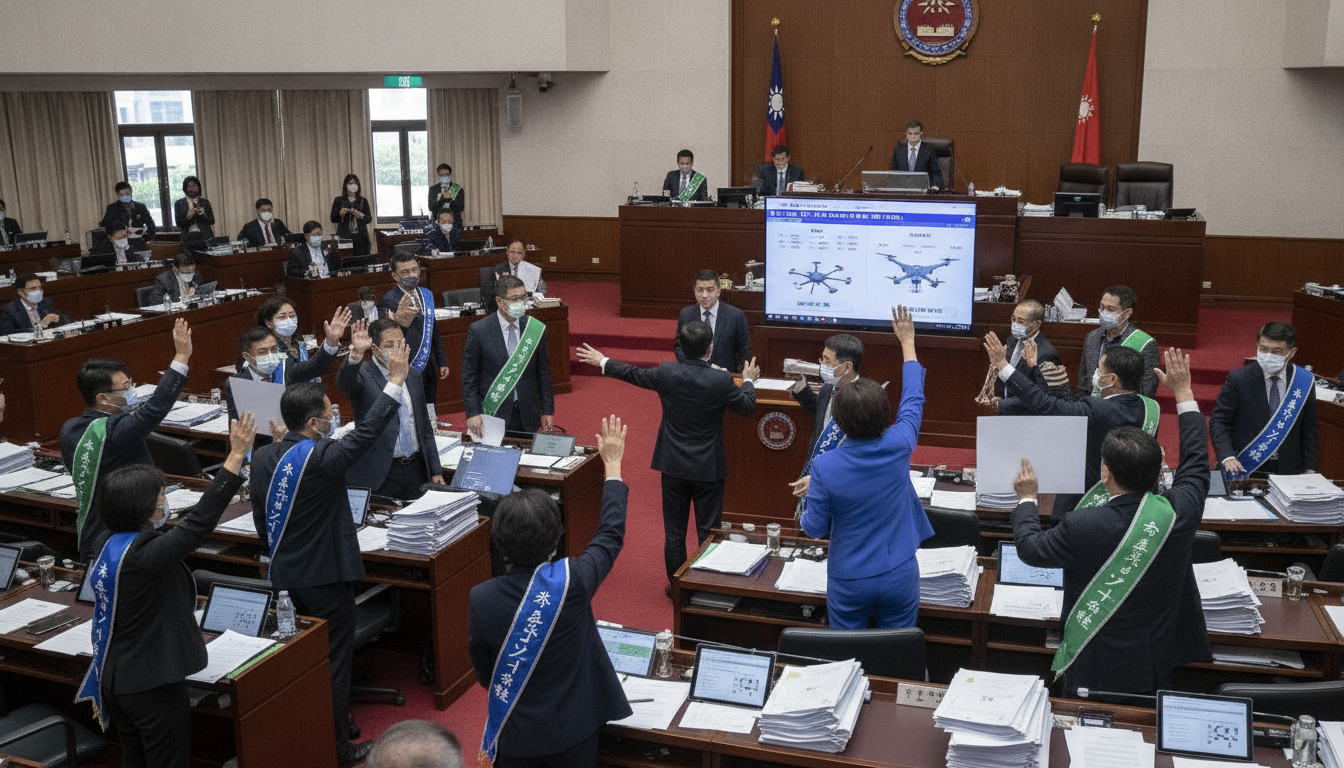
TAINAN, Taiwan — Opposition lawmakers on Aug. 27, 2026, rejected a government proposal for a special budget aimed at accelerating Taiwan drones acquisition and development, instead voting to advance their own funding scheme. The move came despite repeated pleas from President Lai Ching-te to approve the administration’s package as a priority for national defence. The parliamentary split marks a significant setback for Taipei’s short-term plans to scale up unmanned aerial capabilities under its asymmetric defence strategy.
Parliamentary Vote Defies Presidential Request
The vote in the legislature saw opposition members coalesce around an alternative measure, leaving the administration’s special appropriation unapproved for the moment. Lawmakers said their plan would address different fiscal priorities and oversight mechanisms, though details were framed as a matter for further negotiation.
Opposition leaders argued the alternative better balanced defence needs with budgetary accountability, while government ministers warned that delays could slow deployment of key systems. The immediate political consequence is a new round of bargaining over funding levels and procurement timelines.
Lai’s Case for Accelerating Drone Funding
President Lai had personally appealed to lawmakers to back the special budget, framing Taiwan drones as essential to deterring potential aggression and preserving the island’s tactical flexibility. The administration has presented unmanned systems as a cheaper, more survivable complement to traditional forces in contingency scenarios.
Officials have highlighted the ability of drones to perform surveillance, target acquisition and strike missions without risking personnel, arguing this makes them central to an asymmetric posture against larger adversaries. The president’s visits to defence research facilities this year underscored the political priority attached to rapid fielding.
Domestic Industry and the Mighty Hornet III
Taiwan’s defence research institutes and private makers have been mobilised to produce a range of unmanned aerial vehicles, from reconnaissance platforms to loitering munitions. Earlier this summer, President Lai inspected a Mighty Hornet III unmanned aerial vehicle at the National Chung-Shan Institute of Science and Technology, a showcase of domestically developed capability. (A Reuters photograph from the July inspection shows the president examining the system.)
Defence officials contend that accelerating local production would reduce dependence on foreign suppliers and shorten replenishment cycles in a crisis. Industry leaders have said expanded budgets would help scale manufacturing lines and speed certification of new models.
Budget Alternatives and Oversight Concerns
Opposition lawmakers have proposed an alternative funding route that, according to parliamentary briefings, emphasizes phased appropriations and stricter oversight by audit bodies. Critics in the ruling camp say such constraints risk slowing procurement and complicating contracts with manufacturers.
The dispute reflects a broader debate over emergency appropriations versus conventional budgetary discipline, with both sides invoking national security and fiscal prudence. Analysts predict a protracted negotiation process as legislators seek to reconcile competing priorities before any major procurement contracts can be signed.
Implications for Asymmetric Defence Posture
Taipei’s push to prioritise Taiwan drones is part of a wider strategy to develop asymmetric options that impose high costs on potential aggressors without mirroring their conventional strength. The parliamentary setback complicates immediate plans to expand fleets and integrate unmanned systems into operational units.
Military planners warn that delays in funding could affect training cycles, logistics planning and the timeline for deploying strike-capable systems. Nevertheless, officials stress that longer-term goals remain intact and that procurement can proceed through other budgetary channels if consensus is reached.
Regional Security and International Reactions
The parliamentary standoff arrives amid heightened security tensions in the broader Taiwan Strait and an intensified focus from regional partners on Taipei’s defence preparations. Observers in East Asia and beyond watch closely for policy signals that could affect deterrence calculations.
Foreign governments and defence partners have generally encouraged Taipei to field resilient capabilities, while also urging transparency and sound oversight. How the budget dispute is resolved may influence diplomatic and military consultations in the months ahead.
The legislature’s decision to pursue an alternative funding route underscores the political complexity of financing defence transformation in a democratic setting. As negotiations continue, both the administration and opposition say they are open to compromise, but the timing and scale of any drone expansion will depend on the outcome of those talks.

