
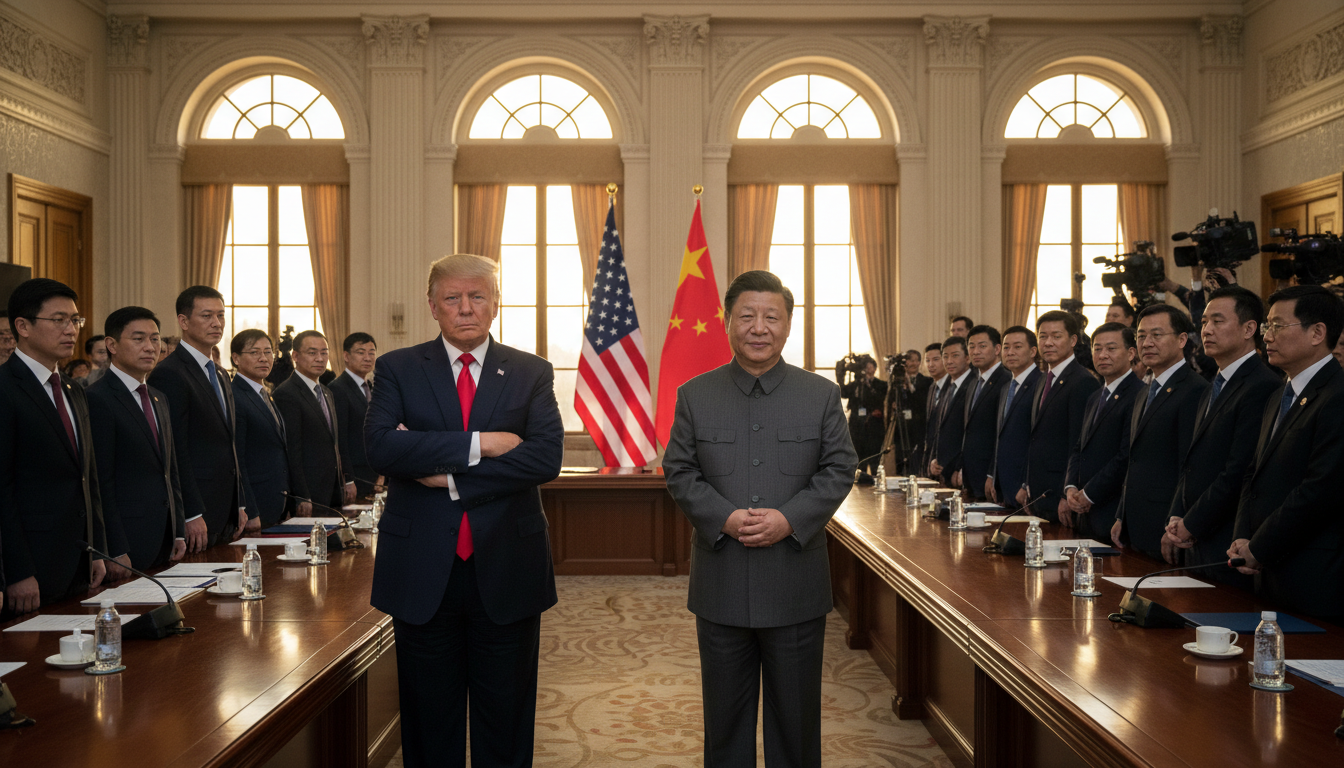
Trump-Xi summit ends with no trade commitments as Beijing portrays a stability win
Trump-Xi summit in Beijing ended with no trade commitments; leaders’ talks were ceremonial as Beijing claimed a stability win and observers assess next steps.
The Trump-Xi summit in Beijing concluded on May 15, 2026, after two days of high-profile meetings that produced ceremony but no concrete trade agreements, U.S. and Chinese officials said. The summit brought U.S. President Donald Trump and Chinese President Xi Jinping together at Zhongnanhai amid intense global attention, but it yielded limited deliverables on economic policy. Analysts described the encounter as emblematic of managed diplomacy: public gestures and strategic restraint rather than immediate policy breakthroughs.
Ceremony and symbolism at Zhongnanhai
The leaders met in the historic Zhongnanhai compound where carefully staged images underscored an appearance of calm and continuity between Washington and Beijing. Photographs of the two presidents walking and shaking hands circulated widely, reflecting an emphasis on optics and messaging rather than substantive accords. State media in Beijing framed the encounter as a reaffirmation of stability, while officials on both sides highlighted the value of direct communication in reducing miscalculation.
No trade deal or binding commitments secured
Despite extensive attention on tariffs, industrial policy and supply chains, the summit concluded without new trade commitments from either side. U.S. and Chinese statements issued after the meetings described discussions on economic cooperation and cautioned that detailed negotiations would continue at lower diplomatic and technical levels. Traders and corporate leaders had sought clarity on tariffs and investment restrictions, but the absence of binding agreements left many commercial decisions pending further consultations.
Security and strategic topics discussed but unresolved
Officials said the summit addressed broader strategic concerns, including regional security, technology competition and military-to-military channels, but produced few operational outcomes. Both capitals emphasized the importance of avoiding escalation and agreed to maintain lines of communication, according to senior aides and briefings released after the meetings. Experts noted that while high-level dialogue can reduce immediate tensions, long-term strategic divergence will require sustained, detailed engagement well beyond a single summit.
Market and economic reactions to the summit
Financial markets reacted to the news with measured volatility as investors digested the lack of major agreements alongside the signal of tempered tensions. Equity and currency moves were contained after initial swings, reflecting market relief that confrontation had not intensified even as policymakers deferred decisions on trade. Economists cautioned that the summit’s limited deliverables meant that uncertainty over tariffs, export controls and investment screening would continue to influence corporate planning and capital flows.
Domestic political responses in Washington and Beijing
In Washington, lawmakers and political commentators offered mixed assessments, with some praising the diplomatic engagement and others criticizing the absence of enforceable outcomes on trade and human rights. The White House framed the summit as a necessary step for direct leadership contact, while opposition voices called for clearer results. In Beijing, official outlets emphasized domestic stability and the narrative of a successful reception for a visiting head of state, portraying the talks as evidence that China remains a central actor in global diplomacy.
Diplomatic implications and next steps
Diplomats on both sides signaled that follow-up work would be carried out by trade teams, foreign ministries and technical experts rather than through additional high-level announcements in the immediate term. Observers expect working groups on economics, technology and security to resume negotiations, with results likely to emerge incrementally and be subject to domestic political constraints in both capitals. Regional partners and allied governments will watch whether the summit prompts tangible policy shifts or merely a temporary easing of rhetoric.
The Trump-Xi summit underscored the limits of summit diplomacy in resolving complex, structural issues between the United States and China, while also demonstrating the continuing value both sides place on direct leader engagement. Observers say that concrete progress on trade, technology controls and strategic competition will depend on weeks and months of follow-up, during which both governments must reconcile international objectives with domestic political pressures.

