
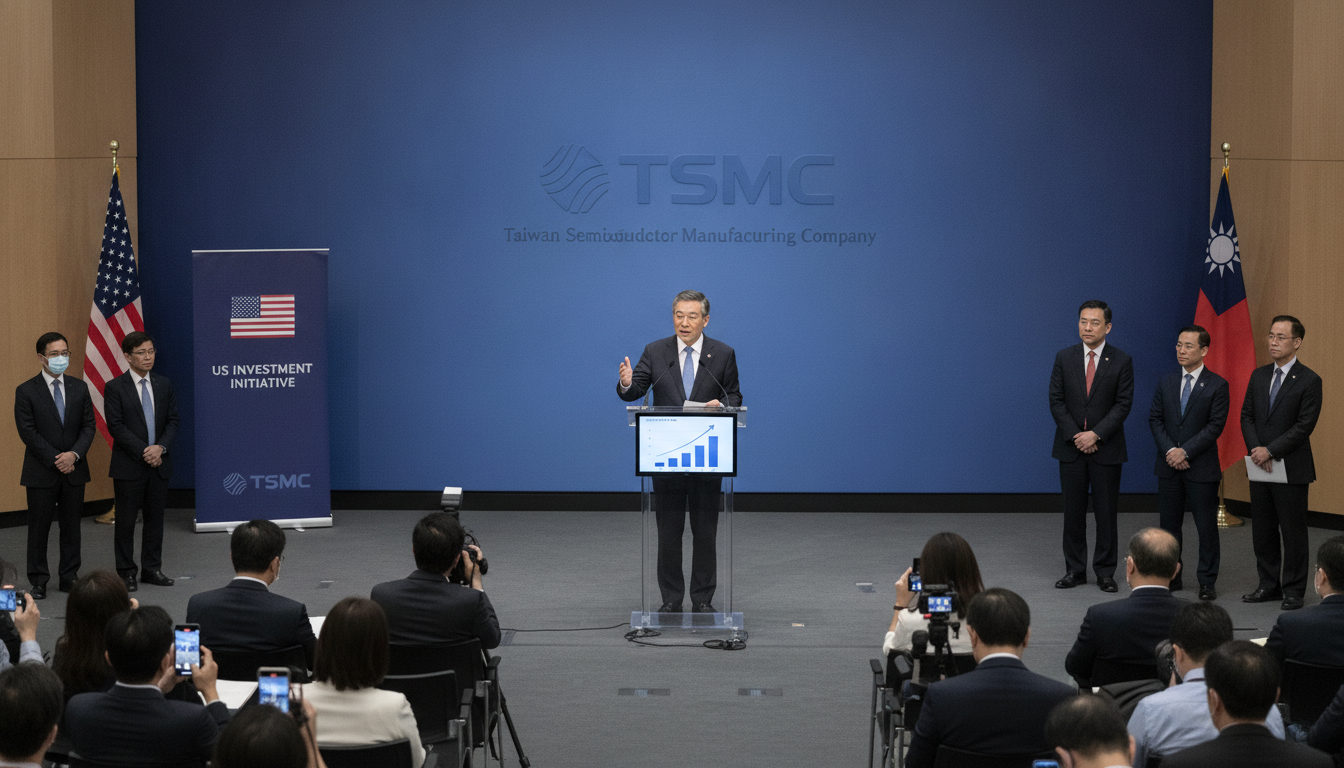
TSMC to Invest Additional $100 Billion in U.S. Fabs and Packaging, Raises 2026 Capex
TSMC confirms $100 billion U.S. expansion to build advanced fabs and packaging in Arizona, raises 2026 capex to $64bn and forecasts 40% revenue growth.
Taiwan Semiconductor Manufacturing Co. (TSMC) on July 16, 2026 announced plans to invest an additional $100 billion in the United States to expand chipmaking capacity and advanced packaging facilities. The company said the move will accompany an upward revision of its full-year capital expenditure to $64 billion and a revenue growth forecast near 40 percent. The decision underscores TSMC’s push to scale production of advanced logic chips and packaging services amid surging demand for artificial intelligence hardware.
TSMC Confirms $100 Billion U.S. Expansion
TSMC outlined that the new U.S. investment will fund multiple cutting-edge fabrication plants and packaging sites, with Arizona singled out as a focal location. Company executives framed the program as a response to long-term demand trends for AI accelerators and high-performance nodes. The announcement follows earlier U.S. investments and represents one of the largest corporate commitments to domestic semiconductor capacity in recent years.
Arizona Advanced Packaging and Fab Plans
TSMC said the expansion will include additional advanced packaging capacity in Arizona to serve customers seeking heterogeneous integration and chiplet-based designs. Advanced packaging facilities are intended to shorten supply chains for U.S.-based designers and to increase local assembly of multi-die modules used in data center accelerators. Executives noted that packaging plants can be brought online faster than new fabs, providing near-term throughput for critical customers.
The company also indicated that new fab proposals will target the most advanced process nodes used in AI training and inference chips. While precise site locations and timelines were not disclosed in full, TSMC committed to coordinating with state and federal authorities on permitting and workforce development. The firm emphasized phased construction to align capacity with customer demand and equipment delivery schedules.
Financial Outlook and Capex Revision
Alongside the investment pledge, TSMC raised its full-year capital expenditure target to $64 billion for 2026, reflecting both ongoing global projects and the newly announced U.S. program. The company projected about 40 percent revenue growth for the year, driven by strong orders from AI-focused customers and higher utilization across its manufacturing network. Management attributed the revised guidance to firm demand in data center chips and increased uptake of advanced packaging services.
TSMC said it expects the expanded U.S. footprint to contribute to revenue diversification and to mitigate geopolitical and logistical risks. The company plans to fund the increase through operating cash flow and existing balance-sheet capacity, while continuing prior investments across Taiwan, Japan, and other global sites. Financial officers emphasized disciplined deployment tied to long-term customer contracts.
Strategic Motives: AI Demand and Supply Security
Industry analysts see TSMC’s move as a direct response to the AI-driven surge for dense compute chips and the need for more geographically distributed capacity. Advanced nodes and integration services are central to building AI accelerators, and customers are pressing for regional supply assurances to support hyperscale growth. TSMC’s expansion aims to ensure lead times, protect intellectual property, and meet evolving design requirements.
The shift also reflects wider semiconductor policy trends in the United States, where incentives and regulatory measures have encouraged onshore production. TSMC’s announcement aligns with public objectives to secure supply chains for critical technologies, and the company indicated it will work with government partners to access supportive programs where applicable. Executives framed the investment as both commercially driven and strategically important.
Implications for Global Chip Supply and Competitors
The added U.S. capacity is likely to influence supply dynamics across leading-edge chips and packaging services, altering procurement strategies for major cloud and AI firms. Competitors and equipment suppliers may accelerate their own plans in response, raising investment activity across the sector. Market observers expect downstream effects on pricing, lead times, and the location choices of design houses pursuing closer ties to wafer fabrication and advanced assembly.
At the same time, the scale and timeline of equipment installation, yield ramp and skilled labor availability will determine how quickly new capacity eases tight markets. TSMC noted that ramping to high-volume production at advanced nodes remains a complex, capital-intensive process requiring incremental yield improvements over time. The company’s guidance suggests confidence in demand durability even as industry cycles persist.
Economic Impact in Arizona and Workforce Plans
TSMC forecast that the U.S. expansion will generate significant construction and ongoing employment opportunities in host states, particularly Arizona. The company signaled plans for workforce training partnerships with local institutions to develop technicians and engineers needed for advanced fabs and packaging lines. State officials are expected to coordinate incentive packages and infrastructure support to facilitate accelerated timelines.
Local suppliers of chemicals, utilities, logistics and equipment services stand to benefit from increased activity, while community groups anticipate broader economic multipliers from high-skilled jobs. TSMC said it will pursue sustainable construction and operational practices, including water and energy management measures customary for modern semiconductor sites.
TSMC’s $100 billion U.S. investment and the capex increase mark a major escalation of its global expansion strategy, anchoring more advanced production capacity outside Taiwan while seeking to meet a surge in AI-related demand. The commitment will reshape regional industry dynamics, influence supplier roadmaps, and test the pace at which advanced nodes and packaging can be brought online to serve the fastest-growing segments of the semiconductor market.

