
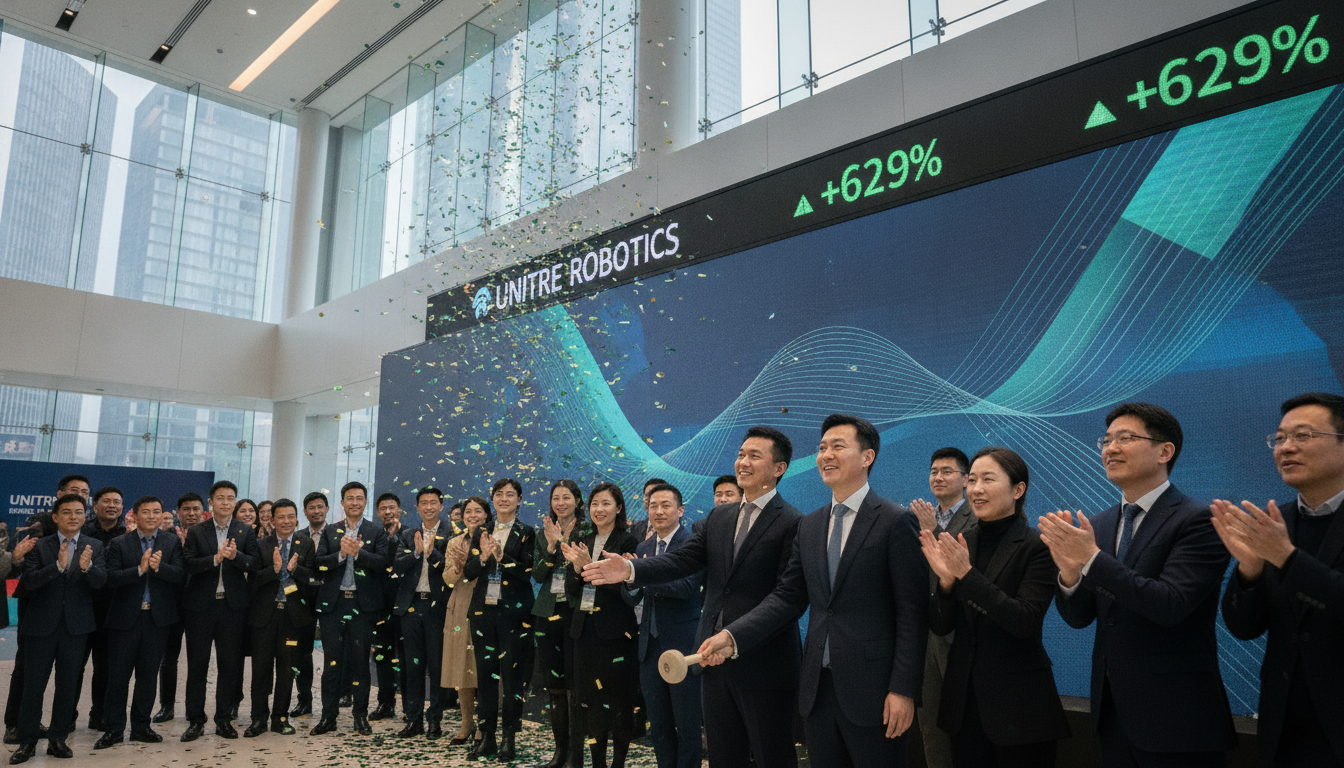
Unitree Robotics IPO surges as shares jump 629% on Shanghai debut
Unitree Robotics IPO surges on Shanghai debut, shares jump 629% as the humanoid maker raises ¥6.1bn; investors reassess valuation and China’s robotics outlook.
Unitree Robotics IPO opened in Shanghai on Aug. 19, 2026, with shares rocketing 629% to 1,100 yuan after the company raised 6.1 billion yuan in its offering. The debut transformed Unitree, a high-profile Chinese humanoid robot developer known for agile, athletic machines, into a focal point for investors chasing robotics and artificial intelligence plays. The trading leap reflected intense demand and renewed attention on domestic robotics firms as China accelerates commercialization of humanoid platforms.
Shares Surge on Shanghai Debut
The first day of trading delivered an extraordinary price move as Unitree’s stock climbed from its offering level to more than seven times that benchmark by midday. The move pushed the company’s market capitalization sharply higher, prompting widespread coverage and heavy trading volume on the Shanghai exchange. Market participants described the opening as emblematic of the current appetite for robotics companies that promise breakthrough hardware and AI-enabled motion.
Fundraising and Capital Plans
Unitree raised 6.1 billion yuan through the initial public offering, funds the company says will be used to scale production, invest in research and development, and expand commercial applications for its humanoid platforms. Management has signaled priorities that include refining control systems, enhancing battery and actuator performance, and broadening enterprise partnerships in logistics and inspection. Investors will be watching execution closely, since converting publicity and capital into sustainable revenue will determine long-term value.
Technology Spotlight: Humanoid G1 and Capabilities
Unitree has become known for humanoid prototypes that combine dynamic balance, rapid locomotion, and coordinated limb control, traits that have made its demonstrations viral in industry and consumer circles. The company’s G1 model, shown at recent events, is positioned as an “embodied intelligent” platform aimed at research labs, industrial customers, and selected commercial deployments. Engineers say the value proposition lies in software-hardware integration—real-time perception, precise motion control and modular payloads that allow varied use cases.
Investor Reaction and Market Composition
The buying surge reflected a mix of speculative retail demand and institutional interest seeking exposure to robotics hardware beyond pure software AI plays. Trading desks reported high turnover in the debut session, and brokers cautioned that elevated volatility could persist as investors reassess fundamentals versus headline-driven momentum. Analysts note that while enthusiasm can produce rapid paper gains, it also raises the bar for the company to demonstrate repeatable sales and margin expansion.
Competitive Landscape in China’s Robotics Sector
Unitree’s listing arrives amid growing competition in China’s robotics industry, where startups and established manufacturers are pursuing automation across logistics, manufacturing and service sectors. The IPO has been framed by observers as a milestone for humanoid developers trying to move from demonstrations to commercial scale. Domestic rivals and international players are accelerating product roadmaps, and the overall market is likely to see intensified R&D spending and alliances tied to component supply and software ecosystems.
Risks, Regulation and Production Challenges
Market watchers emphasize several near-term risks, including supply-chain constraints for advanced actuators and sensors, the high cost of scaling production for humanoid designs, and regulatory scrutiny around safety and data processing. Export controls and technology-transfer policies could also shape Unitree’s overseas ambitions, while product liability and certification for human-interactive robots remain evolving. These factors mean that, despite the IPO windfall, execution and regulatory navigation will be decisive in determining investor returns.
Unitree’s debut will be read as both a validation of commercial interest in humanoid robotics and a test case for translating that interest into predictable revenue streams. The company’s ability to move from headline-grabbing demonstrations to reliable service contracts, strategic partnerships and scaled manufacturing will shape its valuation over the coming quarters. For now, the Shanghai market’s dramatic reaction underscores how robotics—once a niche hardware pursuit—has moved to the center of investor attention in China.

