
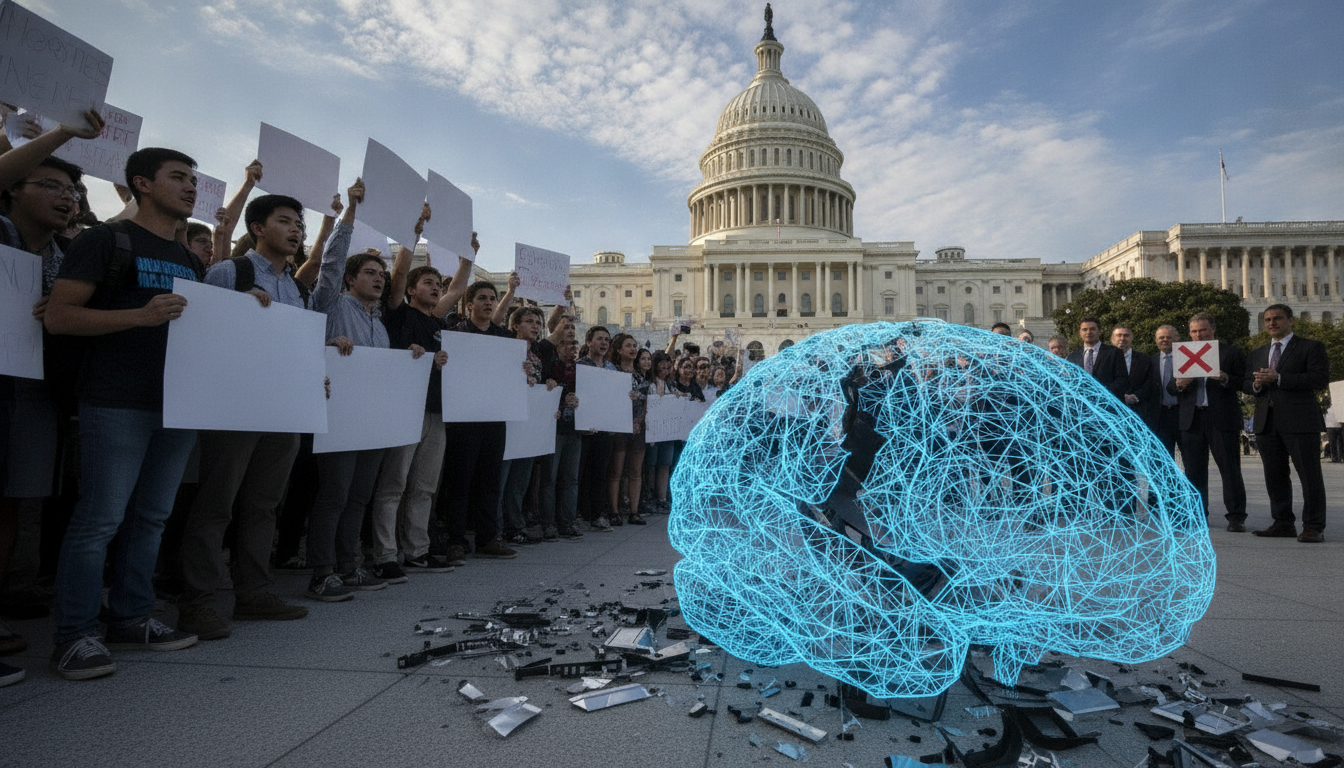
US proposal for ban on Chinese AI models sparks Silicon Valley backlash
US proposal to ban Chinese AI models prompts Silicon Valley backlash and global debate over security, innovation, export controls and AI collaboration.
The Trump administration’s proposal to ban Chinese open-weight AI models has ignited an immediate and vocal reaction from Silicon Valley, laying bare tensions between national security priorities and the technology industry’s commercial and research interests. The suggested ban on Chinese AI models, framed by officials as a measure to curb security risks, was met with protests from major US tech companies before Chinese firms or Beijing issued formal responses. The dispute highlights how quickly policy moves can ripple through global technology markets and raises questions about the future of cross-border AI research and supply chains.
White House proposal to restrict open-weight AI models
The administration presented the idea as a targeted restriction on so-called open-weight models—AI systems whose underlying parameters and training data can be widely shared or deployed. Officials argued such models could enable adversarial uses, from sophisticated cyber operations to rapid weaponization of generative tools. The proposal framed export controls as a means to prevent proliferation of high-capability models while preserving domestic technology advantages.
Silicon Valley raises concerns about innovation and enforcement
Leading technology firms and research groups pushed back, warning that a ban on Chinese AI models could curtail legitimate collaboration, impede academic exchange, and create significant compliance burdens. Executives stressed that many AI advances depend on open research and interoperability, and they questioned whether a prohibition would be practical to enforce without harming US competitiveness. Companies also urged clearer definitions and carve-outs for benign research and for tools used in safety and verification work.
Technical debate over ‘open-weight’ definition and risk
Experts note that the term “open-weight” covers a wide range of architectures and release models, complicating regulatory approaches. Some models are shared as full parameter dumps, while others expose APIs or distilled versions that retain capabilities without providing raw weights. Regulators face the technical challenge of distinguishing harmful dual-use releases from benign datasets and frameworks, and technology firms say overly broad rules could criminalize routine practices in model development.
National security officials emphasize potential threats
National security advocates argue that certain high-capacity models can lower the barrier for malicious actors by packaging complex capabilities into easily deployable formats. Officials point to risks including automated disinformation, advanced malware generation, and the acceleration of biological design tools as reasons for pre-emptive controls. Their position is that export and distribution restrictions can slow the spread of capabilities that could be turned against US interests or allies.
Economic and trade implications for US–China tech relations
A formal ban on Chinese AI models would add a new layer to already strained technology and trade relations between Washington and Beijing. Industry analysts warn the measure could prompt reciprocal actions, spur alternative ecosystems, and fragment global standards for AI development. Smaller companies and research labs could be caught between competing regulatory regimes, raising costs and creating barriers to market entry that disadvantage emerging innovators.
Legal, diplomatic and industry pathways forward
Stakeholders say the next phase will likely involve a mix of regulatory rule-making, industry engagement and diplomatic negotiation. Tech companies are seeking exemptions, clearer compliance guidance, and time-limited measures tied to verifiable risk metrics, while some lawmakers press for tougher controls. Diplomats and multilateral bodies may also be drawn into efforts to harmonize rules so that national security objectives do not wholly undermine international research cooperation.
The debate over a ban on Chinese AI models underscores a broader struggle to balance openness and control in a field that evolves rapidly. As policymakers, companies and researchers contest definitions and safeguards, the outcome will shape how AI capabilities are shared, governed and integrated into global markets. The coming weeks and months are likely to determine whether the proposal becomes binding policy, is narrowed through negotiation, or is replaced by alternative mechanisms that attempt to thread the needle between security and innovation.

