
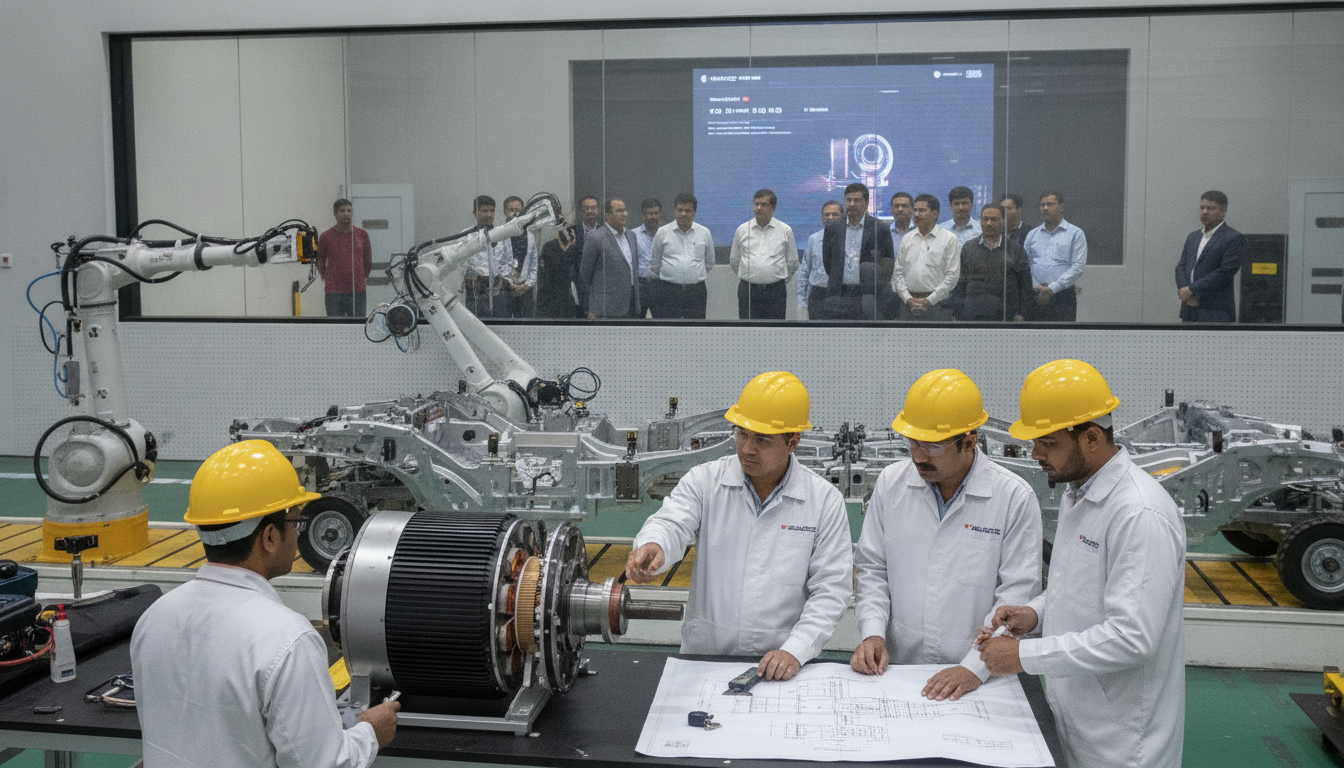
Varroc Engineering Develops Rare-Earth-Free Traction Motors After China Export Curbs
Varroc Engineering develops rare-earth-free traction motors for EVs after Beijing’s 2025 export curbs, aiming to cut China dependence and boost global supply resilience.
BENGALURU — Varroc Engineering said it is accelerating development of rare-earth-free traction motors for electric vehicles as a direct response to Beijing’s 2025 export curbs on key rare earth materials. Company leaders described the move as part of a broader effort to lessen dependence on Chinese-mined magnets and secure long-term supply-chain resilience. The initiative signals a strategic shift for one of India’s largest auto components manufacturers as demand for EV powertrains grows worldwide.
Varroc shifts product strategy following Beijing’s 2025 curbs
Varroc has reprioritized engineering and procurement to reduce exposure to heavy rare earths used in permanent magnet motors. Executives said the company is investing in alternative motor topologies and materials that avoid or minimize the need for neodymium and dysprosium. The shift follows a wave of export restrictions Beijing imposed in 2025 that tightened global access to several magnets and alloys essential to current EV traction systems.
Engineering approaches to rare-earth-free traction motors
Engineers at Varroc are exploring electrically excited synchronous machines and induction motors that rely less on permanent magnets. These architectures can increase weight or energy draw in some applications, so Varroc is pairing design changes with advanced power electronics and thermal management to narrow performance gaps. The company emphasized iterative testing and collaboration with academic partners to maintain efficiency while eliminating heavy rare earth inputs.
Supply-chain adjustments and sourcing strategy
Procurement teams have diversified suppliers for magnet materials and accelerated domestic sourcing of critical components where feasible. Varroc is also re-evaluating inventory policies, increasing on-hand buffer stocks of strategic parts and qualifying multiple vendors across Asia and Europe. Company officials said reducing single-source dependence on China for magnets and finished assemblies is now a standing objective in contract negotiations.
Commercial implications for India’s auto-component sector
Analysts say Varroc’s technical pivot could strengthen India’s role in the EV supply chain by enabling exports that would otherwise be constrained by raw-material bottlenecks. If adopted widely, rare-earth-free traction motors may open new market opportunities for Indian suppliers in regions sensitive to China-linked supply risks. However, margin pressures could rise during the transition as engineering costs and new testing regimes are absorbed.
Customer response and market positioning
Varroc is engaging global OEMs to demonstrate prototype motors and secure development contracts tied to upcoming EV programs. Company leaders indicated early interest from customers that prioritize supply-chain transparency and geopolitical diversification. Varroc is positioning itself not only as a parts supplier but as a systems integrator capable of delivering complete motor assemblies and matched inverters for passenger and two-wheeler EV platforms.
Industry alternatives and competitive landscape
Beyond design changes, the broader industry is pursuing recycled magnet programs, expanded mining outside China, and materials-science breakthroughs to lower rare-earth intensity. Competitors in Europe and Japan have announced parallel initiatives aimed at the same risk, creating a competitive environment for engineers and suppliers. Varroc’s advantage, executives argue, lies in its scale in India and its established relationships across vehicle segments, from two-wheelers to light commercial vehicles.
Varroc’s transition underscores a wider strategic recalibration in the global EV ecosystem spurred by Beijing’s 2025 export curbs; manufacturers and suppliers are now actively redesigning products and contracts to withstand material shocks. The company said it expects gradual commercialization of its rare-earth-free traction motors over the next two to three years, contingent on validation cycles and customer sign-offs. As the industry adapts, automakers and parts makers will likely continue to weigh trade-offs between performance, cost and supply resilience.

