
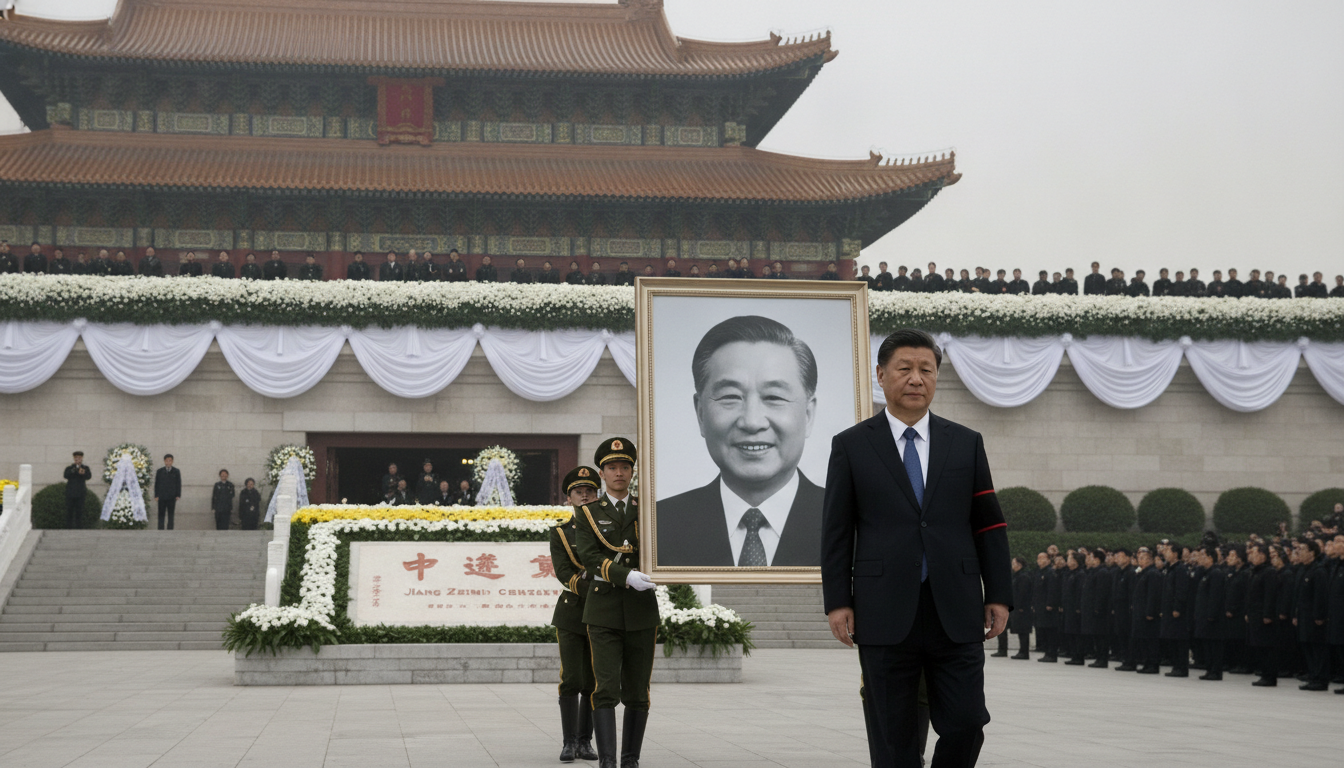
Zhu Rongji funeral held in Beijing as Xi Jinping attends Jiang Zemin centenary tribute
Zhu Rongji funeral held in Beijing as flags flew at half-staff; Xi Jinping attended a centenary tribute to Jiang Zemin the day before, underscoring transitions in China’s leadership.
China held a state farewell for former premier Zhu Rongji on Tuesday, with flags lowered to half-staff and a cremation service conducted in Beijing following his death last week at age 97. The Zhu Rongji funeral came a day after President Xi Jinping and top officials gathered to commemorate what would have been the 100th birthday of former president Jiang Zemin, highlighting back-to-back high-profile events at the center of the Communist Party’s recent schedule. State outlets and official statements framed both occasions as moments to honour continuity and the contributions of senior leaders to the country’s development.
State farewell in Beijing
Official sources said flags across government compounds in Beijing and other major cities were lowered as the nation observed the Zhu Rongji funeral and related rites. The ceremonies culminated in a cremation, consistent with the party-state’s arrangements for former senior officials, and were accompanied by official statements extolling Zhu’s public service. Authorities emphasized respect for his long career in government and the orderly conduct of memorial activities.
Xi Jinping’s back-to-back appearances
President Xi Jinping attended the centenary tribute to Jiang Zemin on Monday and was present at formal commemorations linked to Zhu Rongji the following day, according to accounts of the events. Xi’s close schedule underscored the leadership’s desire to project unity and to draw lines of continuity between successive generations of party stewardship. Analysts said the sequence of appearances allowed senior officials to publicly reaffirm party narratives around stability and reform.
Zhu Rongji’s political and economic legacy
Zhu Rongji, who served as premier in the late 1990s and early 2000s, is widely credited with steering significant economic reforms and overseeing difficult restructuring of state-owned enterprises. He was known for a pragmatic, often blunt style that paired market-oriented reforms with firm central control over policy implementation. Many observers, inside China and abroad, point to his stewardship during regional financial turmoil and to policy shifts that helped integrate China more deeply into the global economy.
Ceremony details and official protocol
The Zhu Rongji funeral followed established state ceremonial procedures for a senior official, including official mourning notices and public acknowledgements from central party organs. Media and government statements detailed the timing of rites and the presence of senior cadres, without extensive public elaboration of private family arrangements. The use of cremation and the lowering of flags were presented as standard components of official memorial practice for a leader of Zhu’s rank.
Photographs and historical context
Archival images circulated by news agencies showed Zhu Rongji alongside other senior leaders in earlier decades, including moments at party congresses where collective decisions were visibly staged for public consumption. One widely shared photograph captures a 2002 scene with then-president Jiang Zemin and Zhu Rongji at the close of a party congress, underscoring the long-running relationships among China’s senior leadership. Such historical images were invoked in commentary to situate the Zhu Rongji funeral within the broader arc of recent political history.
Domestic and international reaction
Coverage inside China was measured and respectful, with state media emphasizing Zhu’s role in economic policy and governance. Overseas reaction from diplomatic circles and foreign media noted Zhu’s impact on China’s economic trajectory and his reputation as a technocratic reformer. International commentaries also linked the timing of the Zhu Rongji funeral with the centenary tribute to Jiang, interpreting the two events as moments for Beijing to underscore continuity amid a changing domestic and geopolitical environment.
China’s current leadership framed both ceremonies as an occasion to reaffirm party legitimacy and to highlight managerial competence from previous administrations. Officials cited Zhu’s record in areas such as financial stability and enterprise reform as lessons for ongoing policy debates. Observers caution that public commemorations also serve contemporary political messaging, signaling how the party wishes historical memory to inform present governance.
The Zhu Rongji funeral and the centenary tribute to Jiang Zemin together shaped a compact period of official remembrance in Beijing, bringing the party’s past stewardship into the spotlight. Those events provide a window into how China balances acknowledgement of past leaders’ contributions with the political imperatives of the current leadership as it seeks to manage both domestic expectations and international scrutiny.

