
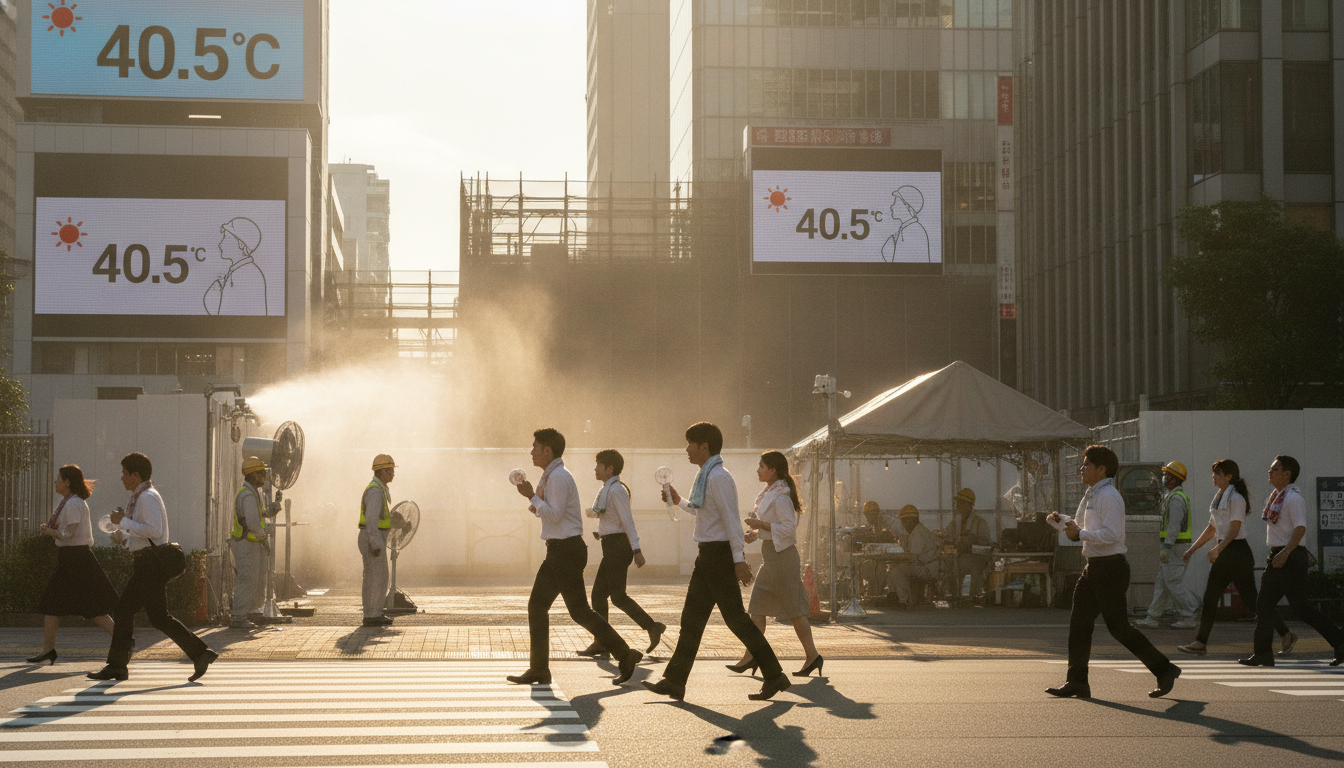
Japanese companies ramp up heatstroke prevention as summer temperatures top 40°C
Major firms and rail operators introduce earlier shifts, apps, cooled rest hubs, uniforms and monitoring stickers to strengthen heatstroke prevention for workers.
This summer, Japanese employers accelerated heatstroke prevention measures as parts of the country recorded temperatures above 40°C, prompting changes ranging from altered shift patterns to wearable monitoring aids. Construction company Obayashi moved site work to 7 a.m.–1 p.m. in July and August to avoid peak heat, while railway operators and retailers launched apps, new uniforms and mobile rest hubs to protect staff. The steps follow a revised industrial safety ordinance and growing corporate concern after a survey found half of companies experienced operational disruptions from intense heat.
Construction firms shift work hours
Obayashi implemented an early-morning schedule this summer, starting work an hour earlier and finishing at 1 p.m., a company spokesperson said, to reduce workers’ exposure during the hottest hours. The firm plans to make up any lost time by extending hours when temperatures are lower to keep projects on track. Management framed the adjustment as a targeted safety measure to lower heatstroke incidence among on-site staff while preserving overall construction timelines. Other contractors have signaled interest in similar flexible scheduling as heat records continue to break.
Rail operators deploy apps and trial cooled uniforms
Since May, West Japan Railway has rolled out an in-house app that gives maintenance and inspection crews practical guidance on heatstroke prevention, company sources said. The app also serves as a platform to share best practices and product ideas for staying cool on the job. In September, the operator will trial short-sleeved polo uniforms for roughly 15,000 station staff and crew, citing improved breathability and sweat absorption as priorities. The move aims to balance comfort, hygiene and professional appearance while reducing heat stress for frontline workers.
Seibu Railway introduces mobile rest hubs for mountain routes
Seibu Railway provided personnel who work in mountainous service areas with recreational vehicles outfitted with air conditioning and refrigeration to serve as on-site rest areas. The company said the mobile units cut the 40-minute round-trip needed to reach traditional rest points, improving both worker comfort and operational efficiency. These mobile hubs also allow staff to cool down quickly and store cold drinks and medical supplies, lowering the immediate risk of heat-related illness. Transport operators say such on-the-spot solutions are increasingly necessary where response times matter and ambient temperatures can spike.
Retail and hospitality test wearable monitoring tools
At a rooftop beer garden on Matsuya department store in Ginza, staff participated in a demonstration using thermochromic stickers supplied by a health and cosmetics company to show shifts in body temperature. Employees placed the stickers on their arms and monitored color changes as a visual prompt to hydrate or seek a cooler environment. “The kitchen is especially hot,” said a 23-year-old employee who took part in the trial, noting the sticker made her more conscious about drinking water during shifts. Retailers and hospitality operators are testing similar low-cost monitoring aids alongside increased access to cold beverages and shaded break areas.
Regulatory change and corporate surveys spur wider adoption
An amendment to Japan’s industrial safety and health ordinance last year obliged business operators to implement measures against heatstroke, pushing many employers to formalize prevention plans. That legal backdrop coincides with market signals: a July survey by Teikoku Databank found that 50.0% of companies reported operational disruptions due to intense heat. The combination of regulatory pressure and documented business impact has prompted firms across sectors to invest in both short-term adaptations and longer-term workplace redesigns. Companies are weighing capital expenditures on cooling infrastructure against recurring costs of schedule adjustments and staffing flexibility.
Balancing safety with productivity during extreme heat
Employers face difficult trade-offs between maintaining schedules and protecting employees from heat-related illness, and the responses vary by industry and location. Construction projects have leaned toward early shifts and dynamic scheduling, while rail operators focus on information tools, clothing and rest facilities to protect mobility staff. Retail and leisure businesses are piloting behavioral nudges and wearable tech to prompt hydration and breaks without disrupting service. Analysts say a layered approach—combining engineering controls, work practice changes and personal monitoring—will be essential as summers grow hotter.
As companies refine their heatstroke prevention strategies, workers and managers both emphasize the need for ongoing evaluation and adaptation. Many firms plan to extend trials of new uniforms and monitoring tools into the autumn to collect performance data, and some operators are considering permanent changes to rest infrastructure and shift patterns. With legal obligations now clearer and business impacts evident, Japanese employers appear set to make heat readiness a sustained part of workplace safety policy.

