
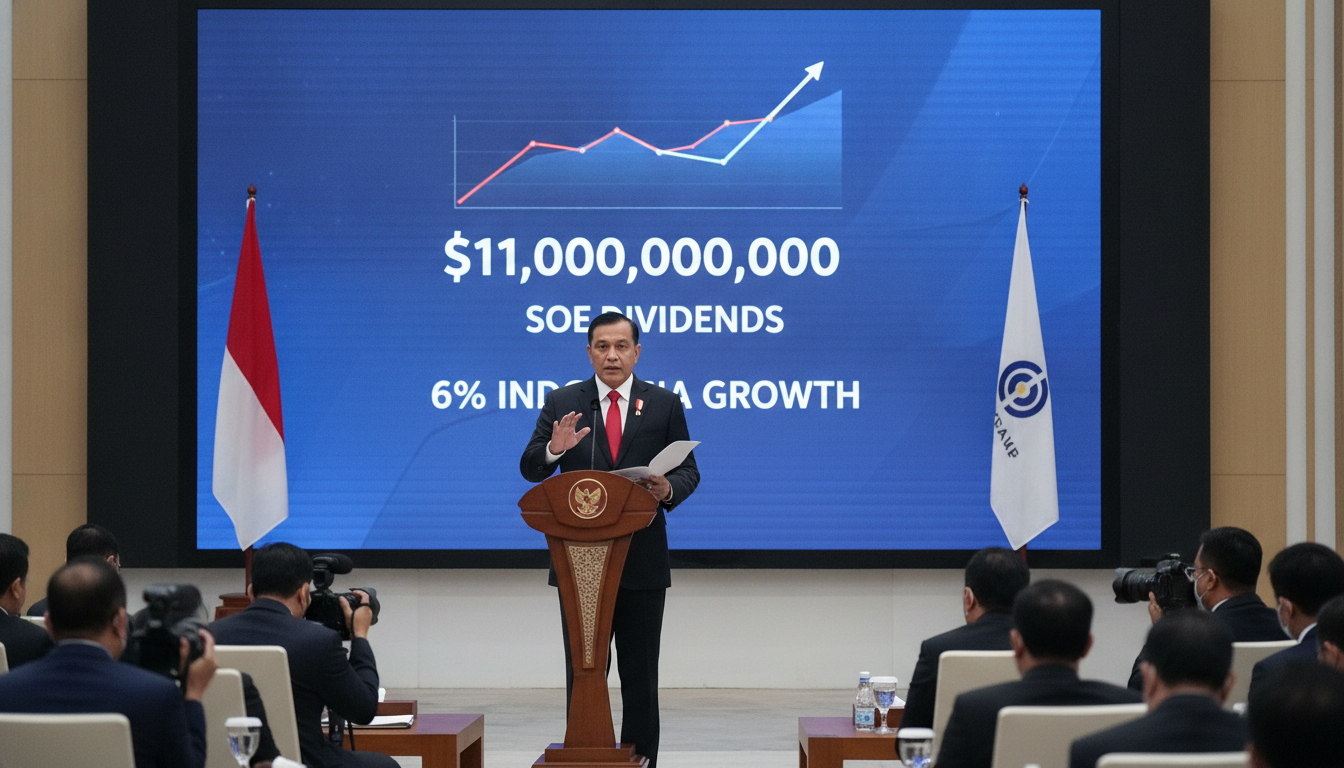
Prabowo Seeks $11bn in SOE Dividends to Drive Indonesia Economy Toward 6% Growth
Prabowo Subianto on Aug. 14, 2026 announced a plan to extract $11 billion in dividends from state-owned enterprises to finance industrial “downstreaming” and overseas acquisitions, aiming to push the Indonesia economy toward 6% growth this year. The president framed the measure as part of a broader push that includes village cooperatives and food self-sufficiency programs to boost domestic production and employment. Lawmakers and market participants will now assess whether state firms can meet higher payout demands without undermining investment or fiscal stability.
Presidential address and dividend target
President Prabowo delivered the pledge during his annual state of the nation address to parliament in Jakarta on Aug. 14, 2026. He said higher returns from state-owned enterprises would be redirected to fund downstream processing, strengthen agri-food programs and support strategic overseas purchases.
The $11 billion figure was presented as a targeted dividend flow rather than a fixed appropriation, intended to complement existing budget resources as the administration pursues an acceleration of economic activity. Officials described the measure as a way to mobilize state assets for development priorities without immediate increases in taxation.
Allocation for downstreaming and strategic acquisitions
Government officials signaled that the dividend proceeds would be used to finance “downstreaming,” a term used to describe moving more stages of production and processing onshore to capture greater value. Investments are expected in sectors such as food processing, logistics and selected industrial supply chains.
Prabowo also referenced planned acquisitions of foreign businesses as a tool to secure technology, market access and raw materials that could speed domestic industrial upgrading. The administration argued such purchases would be complementary to capacity building at home, not a substitute for local investment in factories and cooperatives.
Implications for state-owned enterprises
The president’s call for larger dividends places renewed emphasis on the profit performance and cash distribution policies of state-owned enterprises. Analysts warn that while higher payouts can strengthen short-term government finances, they may reduce the reinvestment capacity of companies that provide public services and infrastructure.
Some SOEs will face trade-offs between meeting dividend expectations and preserving capital for expansion and maintenance. Companies with strong balance sheets may be better positioned to accommodate larger distributions, while others could see pressure on credit ratings or investment plans if dividends are raised sharply.
Fiscal and market reaction
The proposal represents a reorientation of fiscal resources toward government-prioritized development programs without an immediate change to headline spending. That approach could ease near-term budget pressures but raises questions about sustainable financing if SOE earnings prove volatile.
Financial markets are likely to scrutinize corporate earnings guidance and dividend commitments from major state-owned groups in the coming months. Investors will watch for clarifications on whether increases are one-off distributions, recurring targets, or linked to asset sales and other balance-sheet adjustments.
Political framing and parliamentary scrutiny
Prabowo framed the dividend initiative as part of a national drive to elevate economic self-reliance and rural prosperity. He highlighted expanded support for village cooperatives and food security measures as pillars of the administration’s strategy to broaden growth benefits.
Members of parliament will now examine the legal and budgetary mechanisms needed to transfer larger dividends to state coffers and to ensure transparency in how funds are allocated. Debates are expected to focus on oversight, the balance between dividends and capital needs of SOEs, and safeguards to prevent erosion of public assets.
Risks to achieving the 6% growth target
Reaching a 6% growth rate will depend on execution across several fronts: SOE earnings remaining robust, effective use of proceeds for productive investment, and resilient external demand. Global economic volatility, commodity price swings and implementation delays could all undermine the administration’s target.
Moreover, diverting too much cash from SOEs to immediate distribution risks weakening long-term investment in infrastructure, technology and capacity, which are essential to sustain higher growth. Economists caution that careful calibration is required to preserve both fiscal stability and corporate investment plans.
Indonesia’s immediate economic outlook will hinge on how quickly state firms respond to the president’s call and how parliament shapes the legal framework for transfers and spending. Clear timelines, performance benchmarks and safeguards will be critical if the dividend plan is to translate into durable gains in industrial capacity and employment.
The coming weeks are likely to bring detailed proposals from ministries and state enterprise boards on dividend schedules, asset management strategies and specific downstreaming projects meant to absorb the funds and convert them into measurable economic outcomes.

