
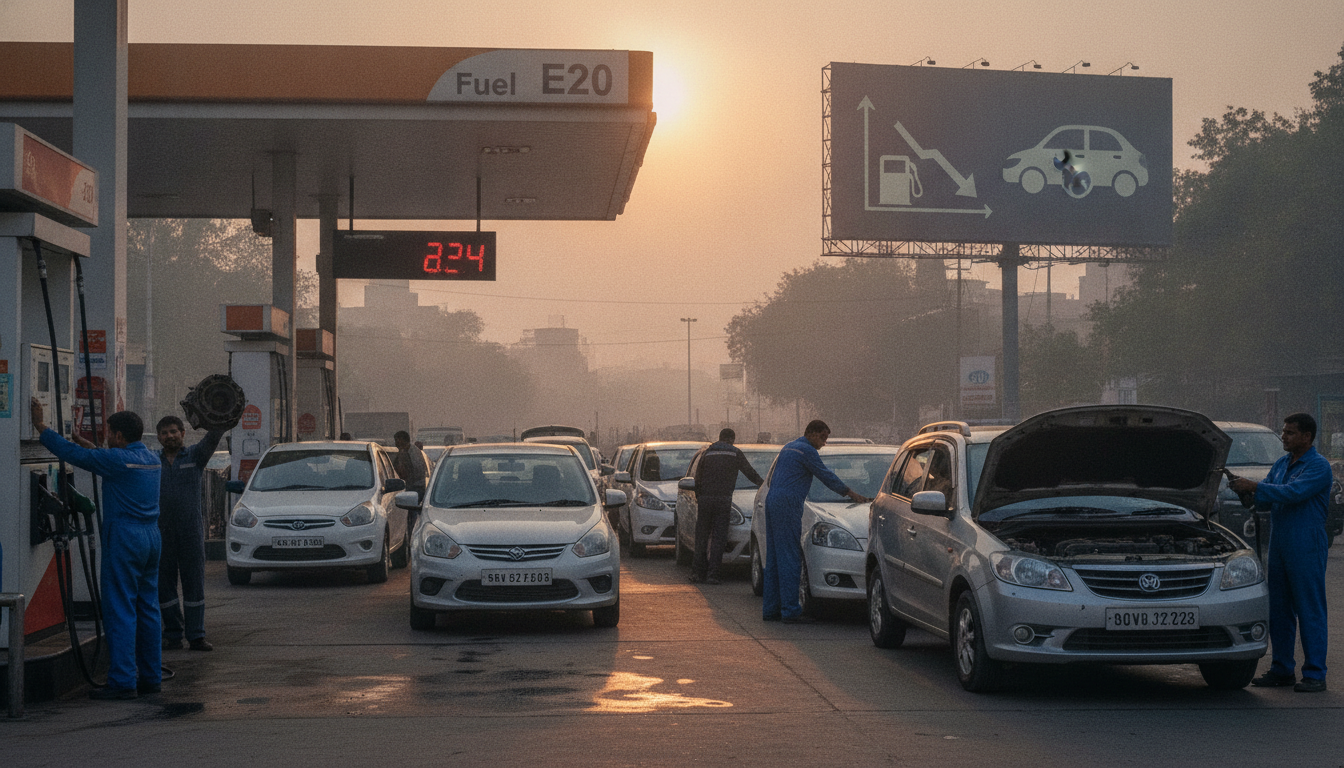
India’s E20 ethanol rollout raises fuel-efficiency and vehicle-compatibility concerns
India’s rollout of E20 ethanol fuel is prompting concerns about lower fuel economy and wear on older cars, sparking debate among regulators, automakers and drivers.
India pushes E20 ethanol nationwide
India has accelerated a nationwide switch to E20 ethanol — petrol blended with 20% ethanol — as part of a push to cut emissions and reduce dependence on imported crude. Officials say the policy also supports domestic agriculture by providing a larger market for sugarcane and other biomass feedstocks. The move is being implemented across retail networks even as scientists and vehicle owners raise questions about real-world impacts.
The government frames E20 ethanol as a tool for energy security and rural income support, but deployment timelines and communication with motorists have become central points of contention. Analysts note that the scale of the change means effects will be felt across fuel supply chains, vehicle service networks, and consumer fuel bills.
Scientists and analysts raise fuel-economy questions
Independent researchers and automotive analysts are reporting that E20 can lower miles per litre for some vehicles, which could offset part of the environmental and energy-security gains. Laboratory certification and controlled tests do not always mirror everyday driving conditions, and experts warn that real-world fuel efficiency may decline, particularly in older engines not designed for higher ethanol content. Reduced volumetric energy density of ethanol compared with petrol is the main technical explanation cited by engineers.
There are also unknowns around cold-start performance, fuel-line corrosion, and compatibility with seals and sensors on legacy vehicles. Some analysts stress that a comprehensive, transparent testing programme across vehicle ages and driving conditions is essential to quantify trade-offs and guide mitigation measures.
Vehicle compatibility and warranty concerns
Automakers have provided mixed guidance: newer models designed for higher ethanol blends are typically compatible, while many older cars and motorcycles were built for lower ethanol ratios. Manufacturers and dealers have warned vehicle owners to check warranty terms and recommended fuel types, and several have committed to technical updates or service advisories where necessary. Independent garages and parts suppliers are concerned about increased wear on components such as fuel pumps, injectors and rubber fittings not specified for E20.
For owners of older and imported vehicles, the options are limited to fuel-system retrofits, more frequent maintenance, or continued use of lower-ethanol alternatives where available. Each option carries cost implications, and consumer groups are pressing for clearer guidance and support mechanisms for low-income motorists who are most exposed to potential increases in running costs.
Impact on drivers, mechanics and the fuel market
Petrol stations that have switched to E20 report mixed feedback from customers, with some drivers noting a loss of distance per tank and others seeing no perceptible change. Mechanics in urban and rural areas say they are beginning to encounter fuel-related breakdowns that they attribute to ethanol-related material incompatibilities, though a clear causal link in each case remains to be established. The variability in reported experiences underscores the uneven fleet readiness across India’s vast vehicle population.
On the supply side, increased ethanol demand is reshaping commodity flows and prices for feedstocks such as sugarcane and by-products. Farmers in sugar-producing regions may gain from stronger demand, but agricultural analysts caution that rapid shifts in crop use can create volatility and require careful policy coordination to avoid unintended food-market impacts.
Policy trade-offs and next steps for regulators
Policymakers face a balancing act: advancing climate and energy-security goals while managing short-term disruption for motorists and the auto service industry. Regulators have signalled plans for expanded testing, clearer labeling at pumps, and phased roll-outs to allow older fleets time to adapt. There is also discussion of incentives or subsidies to encourage conversion to E20-compatible components and to support mechanics in training and parts availability.
Transparent monitoring, independent verification of vehicle performance, and active engagement with automakers, fuel retailers and consumer groups will be critical to maintaining public confidence. Authorities will need to publish concrete testing outcomes and to set timelines tied to fleet readiness rather than fixed calendar dates alone.
Industry and consumer responses
Automakers and fuel distributors are increasing outreach to explain engine compatibility and recommended practices for E20 use. Some vehicle manufacturers are promoting models certified for higher ethanol blends as a way to reassure buyers, while repair networks are preparing inventories of ethanol-resistant parts. Consumer advocacy groups are calling for clear warranty protections and accessible complaint channels to address post-conversion issues.
Ultimately, acceptance of E20 will hinge on demonstrable benefits that outweigh costs to drivers and fleet operators, along with credible safeguards for those most at risk of adverse impacts. Real-world performance data and visible, timely responses to problems will play a decisive role.
India’s energy transition through E20 ethanol presents both opportunity and complexity, threading together emissions goals, farm incomes and the realities of a diverse vehicle fleet. As the programme unfolds, practical testing, targeted support for older vehicles, and clear communication from regulators will determine whether the benefits are realised with minimal disruption.

