
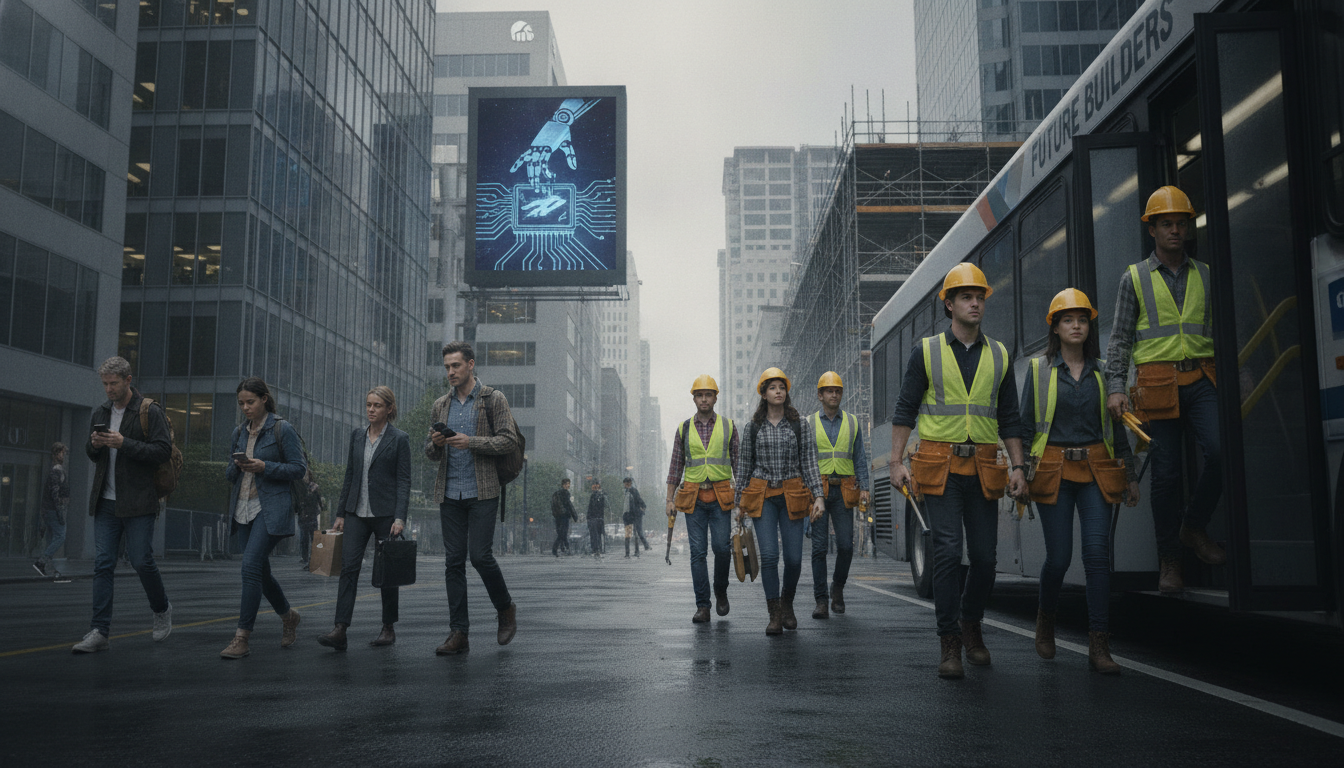
AI job displacement pushes U.S. tech workers into blue-collar jobs
AI job displacement forces former U.S. software engineers into gig work and trades, driving demand for vocational training as workers seek stable income and retraining.
AI job displacement is reshaping careers across the United States as former software engineers find themselves pushed out of office roles and into gig work, vocational programs and manual trades. Workers who once earned high salaries now face shorter paychecks and new decisions about retraining and family support. The trend is raising questions about corporate automation strategies and the ability of the labor market to absorb skilled technical workers.
From engineer to Uber driver
Akhil Kumar, 34, is one of several engineers in the San Francisco Bay Area who lost a stable tech job and now drives for a ride‑hail firm to make ends meet. Kumar, who previously worked as a software engineer at a major telecommunications company, said he was let go in October 2025 after internal automation teams replaced engineering tasks with AI tools. He described the transition as abrupt and disorienting; monthly pay that once reached roughly $9,000 dropped sharply after he left the firm.
Kumar’s experience highlights how implementation of AI systems in product development and operations can quickly alter employment expectations. He said the team that had built automation systems “suddenly disappeared” as AI began to perform coding and testing tasks, a change he noticed months before his dismissal. The move from salaried engineering work to gig driving underscores the human cost of rapid tech adoption for individual households.
Companies’ automation decisions and employee notices
Workers at large tech firms report receiving terse layoff notices even as companies publicly emphasize AI investment and productivity gains. One employee in her 20s who handled event operations at a major e‑commerce company received an email on Jan. 28, 2026, informing her that the firm was reshaping priorities and that her role would be eliminated. The message echoed a pattern seen across the sector: managerial decisions framed as strategic shifts often coincide with workforce reductions driven or accelerated by AI capabilities.
Corporate leaders argue that automation is necessary to remain competitive, but employees and labor experts say those choices entail difficult tradeoffs. The speed at which AI can generate code, analyze systems and propose solutions has compressed timeframes for retraining, redeployment and meaningful consultation with affected staff. For many workers, the result has been a sudden move out of technical roles rather than a gradual transition to new positions inside firms.
Rising interest in vocational training and trades
As traditional tech jobs become less secure, vocational schools and trade programs are reporting increased enrollment from younger people and displaced professionals. In Sacramento on March 3, 2026, local vocational centers documented a rise in students learning mechanical and technical skills, including engine repair and industrial maintenance. Instructors say some enrollees are recent college graduates or former IT workers attracted to hands‑on roles that promise steady demand.
Programs offering short, targeted certifications are appealing because they can be completed more quickly than degree programs and lead to roles that are harder to automate. Trade occupations such as electric work, plumbing and machinery maintenance remain reliant on physical presence and tacit knowledge, qualities that complicate full automation. For many displaced tech workers, the promise of predictable hours and defined career paths in blue‑collar fields is increasingly persuasive.
Household impact and income strain
The shift away from high‑paying technical roles has immediate financial consequences for families. Former engineers who supported households on tech salaries now face tightened budgets while exploring retraining options or supplementing income through gig platforms. Parents with young children report acute stress over reduced savings and uncertain benefits, including healthcare tied to previous employers.
Economists warn that without coordinated retraining and social support, sudden displacement could widen economic insecurity for mid‑career workers. The transition costs include lost pension accruals, reduced eligibility for employer benefits and expenses for new education or certification. For some, gig work provides a stopgap; for others, it becomes a long‑term fallback that does not match prior earning levels.
Industry and policy responses under consideration
Policymakers and industry groups are debating responses ranging from public funding for retraining programs to incentives for companies that prioritize internal redeployment. Some regional apprenticeship models have gained attention for combining classroom instruction with paid on‑the‑job training, aiming to bridge the gap between displaced tech talent and in‑demand manual trades. Labor advocates are also calling for greater transparency in how companies evaluate roles for automation and for stronger transition supports for affected workers.
Technology firms face growing pressure to create pathways for employees whose tasks are automated, whether through internal reskilling, severance packages that support retraining, or partnerships with community colleges. At the same time, employers argue that rapid innovation and global competition necessitate hard choices about staffing and investment priorities.
The era of AI job displacement is prompting a recalibration of career expectations in the U.S. tech industry, with measurable effects on workers’ livelihoods and education choices. As former engineers weigh the relative security of blue‑collar roles against the prestige and pay of their old professions, communities and policymakers must decide how best to ease transitions and ensure that technological progress does not leave large segments of the workforce behind.

