
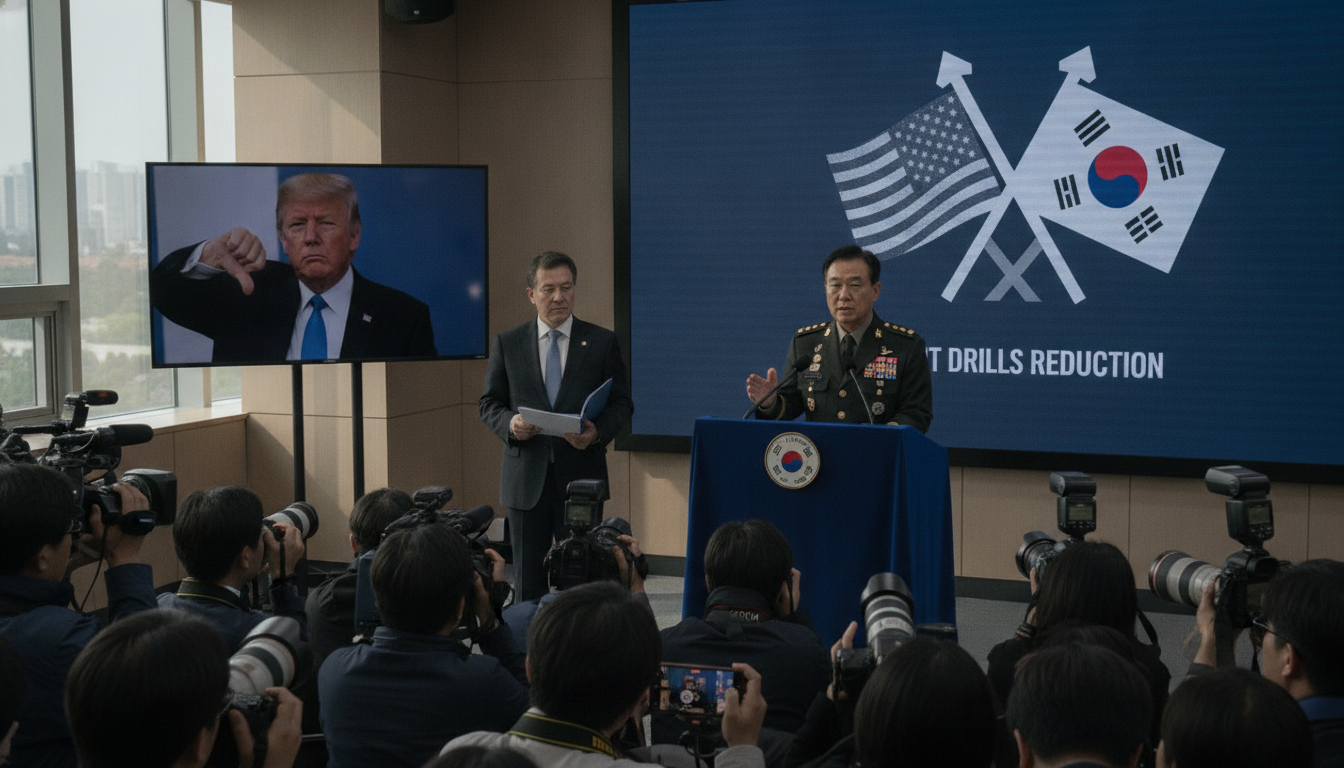
U.S.-South Korea military drills cut short as Seoul says annual exercises will end Friday
South Korea says U.S.-South Korea military drills will end Friday after being shortened after U.S. presidential criticism; Hanwha wins US Army cannon contract.
Seoul — South Korea’s Joint Chiefs of Staff announced on Aug. 19, 2026 that the annual U.S.-South Korea military drills will be curtailed and will conclude on Friday, a decision made days after U.S. President Donald Trump publicly condemned the exercises as “costly” and “hostile” toward North Korea.
The announcement confirmed a planned acceleration of the exercise schedule and a reduction in some training activities close to the Demilitarized Zone.
Military officials described the change as an operational adjustment rather than a permanent halt to joint readiness activities.
Joint drills to end Friday, JCS says
The Joint Chiefs of Staff said the combined exercises, traditionally held each summer, will finish earlier than initially planned and that several larger-scale maneuvers would be scaled back.
Officials pointed to a compressed timetable and limited live-fire components in specified areas, while maintaining that core training objectives would still be completed.
The JCS emphasized continued coordination with U.S. forces stationed in the Republic of Korea and framed the decision as responsive to evolving diplomatic and security considerations.
Presidential criticism and timing of the cut
President Trump had criticized the drills in public remarks earlier this week, calling them expensive and antagonistic toward Pyongyang, comments that U.S. and South Korean officials said factored into discussions about the exercise schedule.
The timing of the JCS announcement — coming days after those remarks — prompted swift attention in Seoul and Washington, where officials from both governments engaged in consultations.
Diplomatic sources said the move reflects a balancing act between demonstrating military readiness and managing high-level political messaging aimed at defusing tensions on the Korean Peninsula.
Training activities near the DMZ adjusted
Troops continued limited field activities through Aug. 18, including river-crossing and patrol exercises near Yeoncheon, close to the North Korean border, where U.S. Army units conducted maneuvers with South Korean counterparts.
Commanders ordered the suspension of some live-fire drills in forward areas and consolidated training to fewer, pre-designated zones to reduce the footprint of operations near the Demilitarized Zone.
Military planners described the approach as a way to preserve interoperability and unit readiness while reducing actions that could be interpreted as escalatory.
Hanwha wins breakthrough US Army cannon contract
In parallel with the drills update, South Korea’s Hanwha Defense announced a significant breakthrough, winning a contract to supply cannon systems to the U.S. Army.
The award marks a notable expansion of South Korean defense industry participation in U.S. procurement and is expected to bolster bilateral defense industrial ties.
Officials associated with the procurement said the contract will involve supply chains across both countries and could influence future cooperation on artillery modernization programs.
Seoul’s political and military leadership respond
South Korean government representatives framed the decision as a measured adjustment made in consultation with U.S. commanders on the ground, stressing that alliance commitments remain intact.
Lawmakers and opposition figures urged transparency about the decision-making process and called for a detailed briefing on how the shorter drills will affect deterrence posture.
The defense ministry pledged to release further information on the exercises’ revised scope and any follow-on planning for combined training later in the year.
Regional reactions and security implications
Neighboring governments and defense analysts noted the shortened exercises could ease immediate tensions but warned against interpreting the move as a long-term shift in alliance policy.
Analysts said shrinking the visible footprint of drills can reduce short-term risk while preserving the essential mechanics of joint operations, though they emphasized the importance of sustained signaling to deterrence partners.
China and Russia typically monitor such developments closely; officials in Tokyo and other regional capitals will likely weigh the change when assessing near-term stability dynamics on the peninsula.
The adjustment to the U.S.-South Korea military drills comes at a sensitive juncture for the alliance, combining operational recalibration with a notable defense-industry milestone for South Korea.
Seoul and Washington will face pressure to demonstrate that shortened field activity does not undermine long-term deterrence, even as diplomatic openings and procurement cooperation advance in parallel.
Military leaders on both sides have indicated that routine combined training will continue in other formats and that future exercise planning will remain subject to operational needs and political developments.

