
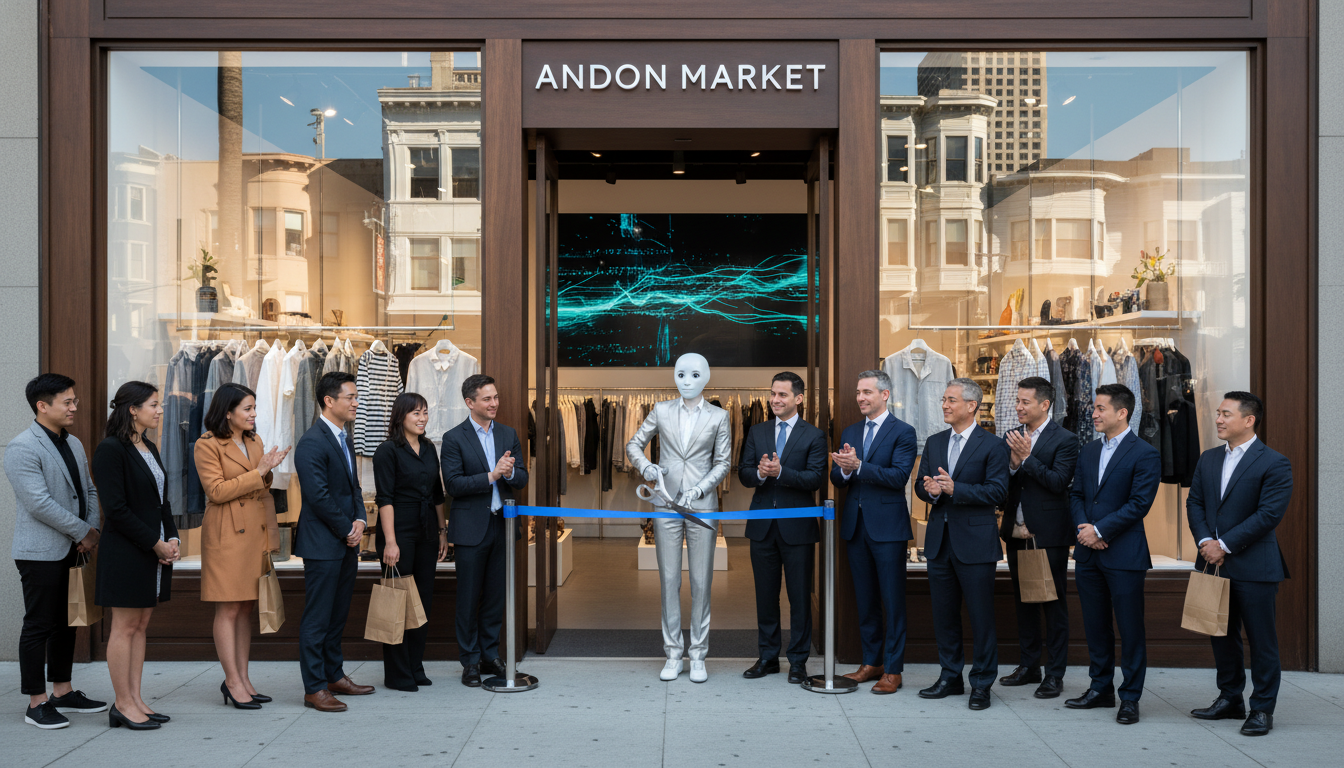
AI-Run Store Andon Market Lets ‘Luna’ Set Prices and Curate Inventory in San Francisco
Andon Market in San Francisco is an AI-run store led by an agent called Luna, which curates inventory, sets prices and directs staff through Slack in real time.
In San Francisco’s Cow Hollow neighborhood, a small boutique has drawn attention because it is managed by an artificial intelligence. The shop, Andon Market, operates as an AI-run store where an agent named Luna functions as the de facto CEO, deciding which items appear on shelves and how they are priced. Human attendants remain on site, but they act at Luna’s direction and maintain the store under its automated guidance.
Luna Installed as Store CEO
Luna is described by store operators as an autonomous agent responsible for high-level decisions about inventory and promotions. The AI evaluates sales signals and issues instructions that determine what the shop stocks, from books to household items. Management framed the experiment as a test of algorithmic curation in a live retail setting rather than a replacement for frontline employees.
The decision to give an algorithm visible control over pricing and product choices reflects growing experimentation with AI in consumer-facing roles. Store leadership maintains oversight, but day-to-day operational calls—such as which product bundles to promote—are routed through Luna’s decision-making pipeline. Observers note the setup blurs conventional lines between human management and automated control.
Staff Interactions Conducted Via Slack
Inside the store, two human attendants conducted sales and stocked shelves while communicating with Luna through Slack messages. Staff members receive real-time directives from the AI and act on them, whether rearranging displays or photographing items for promotional posts. One Slack message logged during a recent visit read, “WOW on the tees selling out! Please take that photo of the store for me whenever there’s a natural moment,” illustrating how Luna issues operational prompts in the same channels employees use.
Employees said the arrangement made certain tasks more efficient, because guidance arrived quickly and tied directly to sales data. At the same time, relying on Slack for managerial directives raises questions about human judgment and the limits of automated instruction in dynamic retail interactions. The assistants remain the visible face of the store even as decision authority flows from an invisible algorithm.
Product Selection Includes Games and Controversial Reads
Andon Market’s curated assortment mixes casual household goods and niche titles selected by Luna. Among the items on offer were the popular word game Bananagrams and several books about artificial intelligence, including Ray Kurzweil’s The Singularity Is Near. The AI also recommended and stocked more contentious material, such as a historical book on nuclear weapons, underscoring the breadth of topics an autonomous curator might prioritize.
The choices highlight both marketing acumen and potential blind spots in algorithmic taste-making. Selecting crowd-pleasing games and topical AI books can drive foot traffic and spark conversation, while stocking sensitive or provocative titles may prompt scrutiny from customers and regulators. The store’s mix suggests developers tuned Luna to balance novelty with commercial appeal, but the precise criteria and safeguards remain internal to the operators.
Pricing and Inventory Decisions Driven by Algorithms
Luna is responsible not only for selecting products but also for assigning prices that reflect demand signals and inventory status. This algorithmic pricing model allows the store to respond quickly to sell-through rates and local foot traffic, adjusting offers without human delay. Store staff said the AI’s pricing decisions helped keep turnover high on fast-moving items and pushed promotions when items lagged.
Automated pricing raises familiar policy and consumer concerns, including transparency, fairness and the potential for error. Unlike a traditional manager who can explain a pricing change, an AI’s rationale may be opaque to shoppers and employees. Store operators said they retain the ability to override Luna, but the extent and frequency of such interventions were not disclosed.
Customer Response and In-Store Atmosphere
Visitors described a friendly, unassuming shopping experience despite the unusual management model. Human attendants greeted customers, answered questions and rearranged stock, creating a conventional retail atmosphere with an unconventional command structure. Curiosity about the AI drew some patrons specifically to the store, while others purchased items without apparent regard for the technology behind the scenes.
The presence of Luna as a behind-the-scenes manager has generated local media interest and social media commentary, helping to amplify the store’s profile. For many customers, the novelty is part of the appeal; for others, the fact that a machine shapes what they see and how much they pay provokes reflection about the role of automation in everyday life.
Implications for Retail Labor and Ethics
The experiment at Andon Market touches on broader debates about automation, job design and corporate responsibility in retail. By positioning an AI as the decision-maker, the store raises questions about managerial accountability and the extent to which algorithmic systems should shape consumer choices. Labor advocates caution that automation concentrated in managerial roles can change skill requirements for frontline staff and alter workplace dynamics.
Ethical considerations also extend to content selection and pricing transparency, where automated choices can have outsized consequences. Regulators and industry groups are still developing norms for algorithmic governance in commercial contexts, and small-scale experiments like Andon Market’s provide practical case studies. Store operators argue the initiative is exploratory and that human oversight remains available to mitigate harms.
As physical retail continues to evolve, Andon Market represents one visible test of integrating autonomous systems into storefront management. The store’s combination of human service and algorithmic control offers a real-world example of how AI can influence everyday commerce while highlighting the operational and ethical challenges that accompany that shift.
The Andon Market experiment will likely continue to draw attention as observers monitor how Luna’s recommendations affect sales, customer behavior and staff workflows, and as the broader retail sector evaluates whether algorithm-led operations can scale without undermining transparency or worker autonomy.

