
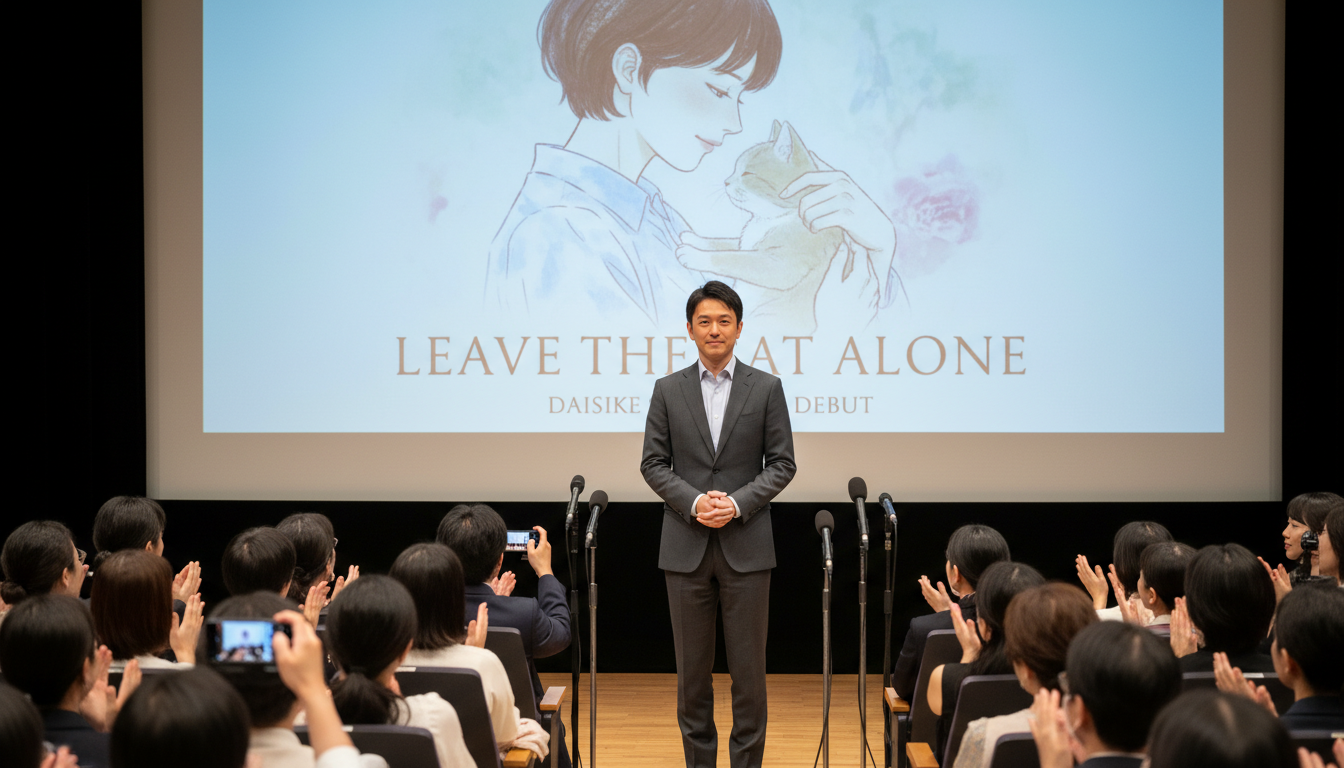
Leave the Cat Alone: Daisuke Shigaya’s debut blends memory, music and millennial malaise
Daisuke Shigaya’s debut film "Leave the Cat Alone" examines memory, music and millennial relationships. Premiered at Busan; opens in Japan on May 2, 2026.
Daisuke Shigaya’s first feature, Leave the Cat Alone, arrives as a quietly observant drama that traces an uneasy reunion between former lovers and the creative fractures of adulthood. The film follows Mori and Asako as they meet again under subtly uncanny circumstances, and it foregrounds questions of memory, music and the pressures on millennial relationships. Leave the Cat Alone unfolds through shifts in perspective and repeated sequences that ask viewers to reassess what they have seen. The film opens in Japan on May 2, 2026, after a festival premiere that signalled strong early attention.
Plot outline and central performances
Mori, played by Soma Fujii, is a musician whose career and personal life have become strained, and Asako, portrayed by Yukino Murakami, is a figure from his past whose reappearance unsettles his present. Ran Taniguchi co-stars as Maiko, Mori’s photographer wife, whose professional success contrasts with Mori’s stalled creativity and anonymity. Meiry Mochizuki appears as Chika, a recently engaged friend whose presence triggers a New Year gathering that is refracted and revisited. The ensemble delivers muted, internally focused performances that emphasize what characters leave unsaid as much as what they speak.
Direction, origins and production timeline
Shigaya conceived Leave the Cat Alone as a short in 2018 but abandoned the project before completion, later returning with an expanded script and cast to develop it into a feature. That six-year gap between initial shooting and final production is evident in the film’s layered temporal approach, which deliberately plays with continuity and perspective. Shigaya’s direction is restrained and attentive to everyday details, allowing scenes to breathe while small gestures accumulate emotional weight. The film’s evolution from short to feature gives it a lived-in quality that benefits from the director’s patient recalibration.
Narrative structure and use of memory
The film repeatedly revisits key scenes with shifts in viewpoint, including a notable sequence that is shown twice with roles reversed, prompting viewers to question the reliability of memory. These formal choices make memory itself a subject rather than a vehicle, and the narrative’s subtle temporal trickery reframes past events as contested territory. Rather than relying on dramatic revelations, Shigaya mines the discrepancies of recollection to examine how people reconstruct intimacy and loss. The effect is less a mystery than a meditation on how subjective histories shape present behaviour.
Music, art and the film’s creative ecology
Music is integral to the film’s atmosphere and to Mori’s character; Soma Fujii supplies much of the soundtrack, lending credibility to on-screen performances and to the film’s quiet sonic world. Maiko’s career as a professional photographer is treated with equal seriousness, and the film pays careful attention to artistic practice as a means of identity. Scenes of composition, recording and image-making are depicted with modest specificity, portraying creativity not as spectacle but as a fragile daily discipline. That balance gives the film emotional texture while foregrounding generational anxieties about vocation and self-expression.
Festival reception and critical context
Leave the Cat Alone was selected for the inaugural competition at the Busan International Film Festival, a notable achievement for a debut director and a sign that programmers found the film’s formal risks and tonal subtlety compelling. The film screened alongside established filmmakers, and its inclusion drew attention to Shigaya’s restrained but assured filmmaking voice. Early responses praised the film’s observational precision and the way it renders ordinary ruptures with care, while noting that its leisurely pacing and elliptical structure demand patient viewing. The Busan selection positions Shigaya among a cohort of new directors gaining traction in East Asian festival circuits.
Running time, release schedule and audience notes
The film runs approximately 102 minutes and is presented in Japanese with a tone that privileges interiority over exposition. Domestic release is scheduled to begin in Japan on May 2, 2026, giving local audiences an opportunity to see a film that addresses contemporary relational dilemmas with an unflashy sensibility. Viewers inclined toward understated, character-driven cinema will find the film’s observational approach rewarding, while those seeking conventional plot resolution may find its ambivalence challenging. The film’s modest scale and concentrated focus suggest it will build an audience gradually through word of mouth and festival momentum.
Leave the Cat Alone marks a confident emergence for Daisuke Shigaya, delivering a film that privileges emotional honesty and formal restraint over easy conclusions. Its study of memory, creative work and the slow wear of adult relationships is carried by strong ensemble performances and a quietly disciplined visual style. As the film opens in May, its nuanced take on millennial life and artistic survival will likely provoke discussion among critics and cinephiles seeking intimate, thoughtfully made contemporary Japanese cinema.

