
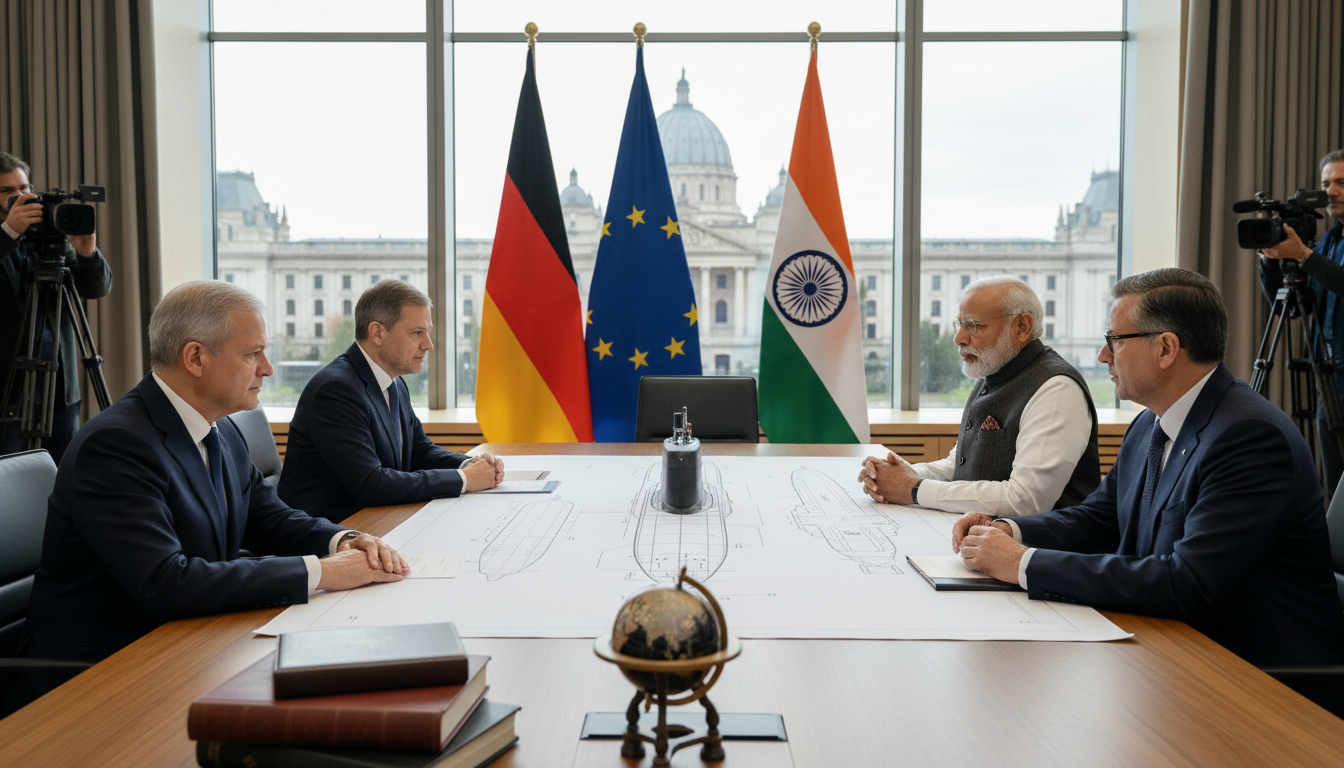
Germany-India submarine deal nears signing after Rajnath Singh inspects TKMS Kiel shipyard
Germany-India submarine deal nears signing after Defence Minister Rajnath Singh visited TKMS Kiel; planned technology transfer raises political debate now.
Singh’s visit brings the Germany-India submarine deal into sharper focus
India’s Defence Minister Rajnath Singh last week toured the Thyssenkrupp Marine Systems (TKMS) shipyard in Kiel, bringing the Germany-India submarine deal a step closer to conclusion. The visit showcased the U34-class diesel-electric boats built at the yard and underscored plans for a six-boat acquisition. Officials and industry representatives framed the trip as progress toward finalizing technical and industrial arrangements.
The ministerial visit followed wider talks between Berlin and New Delhi aimed at deepening bilateral defence ties. A photograph circulated by Germany’s defence ministry showed Defence Ministers Boris Pistorius and Rajnath Singh at the shipyard, signalling a high level of political engagement on the procurement.
The submarines on offer and the scale of the agreement
The package under discussion centres on six diesel-electric submarines of a U34-type design constructed by TKMS in Kiel. These boats are designed for conventional battery-powered propulsion with modern sensors and weapon systems suitable for regional maritime operations. German officials have described the vessels as proven platforms that could be delivered under a framework involving close collaboration.
Beyond the hulls themselves, the procurement is reportedly intended to include accompanying support systems and training packages. The size of the order positions it among the most significant bilateral defence equipment agreements between Germany and India in recent years.
Technology transfer and industrial offsets promised to India
A central pillar of the Germany-India submarine deal is the planned technology transfer to Indian industry, which New Delhi views as essential to bolster domestic shipbuilding and sustainment capability. Indian officials have long prioritized transfers and local industrial participation as part of major defence purchases, and the TKMS proposal reportedly includes provisions to meet those demands.
If implemented, the transfer would allow Indian shipyards to maintain and possibly build future units, while creating support and supply-chain work domestically. Proponents highlight potential job creation, skill development and reduced long-term lifecycle costs as benefits of an extensive industrial cooperation package.
Strategic implications for India’s naval posture in the Indo-Pacific
For New Delhi, the planned acquisition addresses a persistent need to modernize and expand its submarine fleet amid evolving maritime security challenges. Diesel-electric boats remain central to India’s undersea deterrent and patrol capability in littoral and island environments across the Indian Ocean Region. Analysts who have followed the talks say the deal would enhance India’s operational reach and anti-access capabilities in key sea lanes.
The addition of six boats would help replace older platforms and fill short-term capability gaps while India continues to develop and procure its indigenous submarine designs. Defence planners in India consider such platforms a cost-effective means to sustain undersea presence alongside nuclear and air assets.
Political scrutiny in Germany as critics raise values concerns
Despite the strategic rationale, the Germany-India submarine deal has prompted scrutiny from critics who question whether closer defence ties align with Germany’s export and human-rights policy considerations. Civil society groups and some legislators in Germany have argued that arms exports should be carefully weighed against concerns around governance, rule of law and potential downstream use.
German officials have navigated these sensitivities by stressing rigorous export-control assessments and by highlighting clauses intended to ensure end-use compliance. Still, the debate underscores the political balancing act Berlin faces when reconciling industrial and strategic interests with public and parliamentary expectations.
Timeline and the next procedural steps toward a signature
Both governments are reported to be working through the details of contracts, industrial participation terms and legal approvals required for an export agreement of this scale. Procurement specialists note that such deals typically move through stages of technical agreement, intergovernmental approvals and final commercial contracts before signatures are exchanged. The Germany-India submarine deal has been described by officials as “close” to signing, but no definitive date for a formal contract has been announced.
Key outstanding items include the precise scope of technology transfer, training schedules, logistics support arrangements and export licence clearances. Industry sources say those elements will determine delivery timelines and the extent of local Indian involvement over the life of the boats.
Observers expect sustained diplomatic engagement as both capitals seek to lock down the framework for cooperation. The visibility of defence ministers at the TKMS yard signals political intent, but final implementation will hinge on negotiated contractual language and approvals across ministries.
The planned sale of six diesel-electric submarines and the proposed transfer of technical know-how reflect a deeper strategic and industrial partnership taking shape between Germany and India. As the two governments work toward a formal agreement, supporters emphasise capability gains and industrial benefits while critics press for strict oversight and alignment with policy values. The coming weeks will likely reveal whether the Germany-India submarine deal moves from intent to signed contract, and how its terms balance security, economics and political considerations.

