
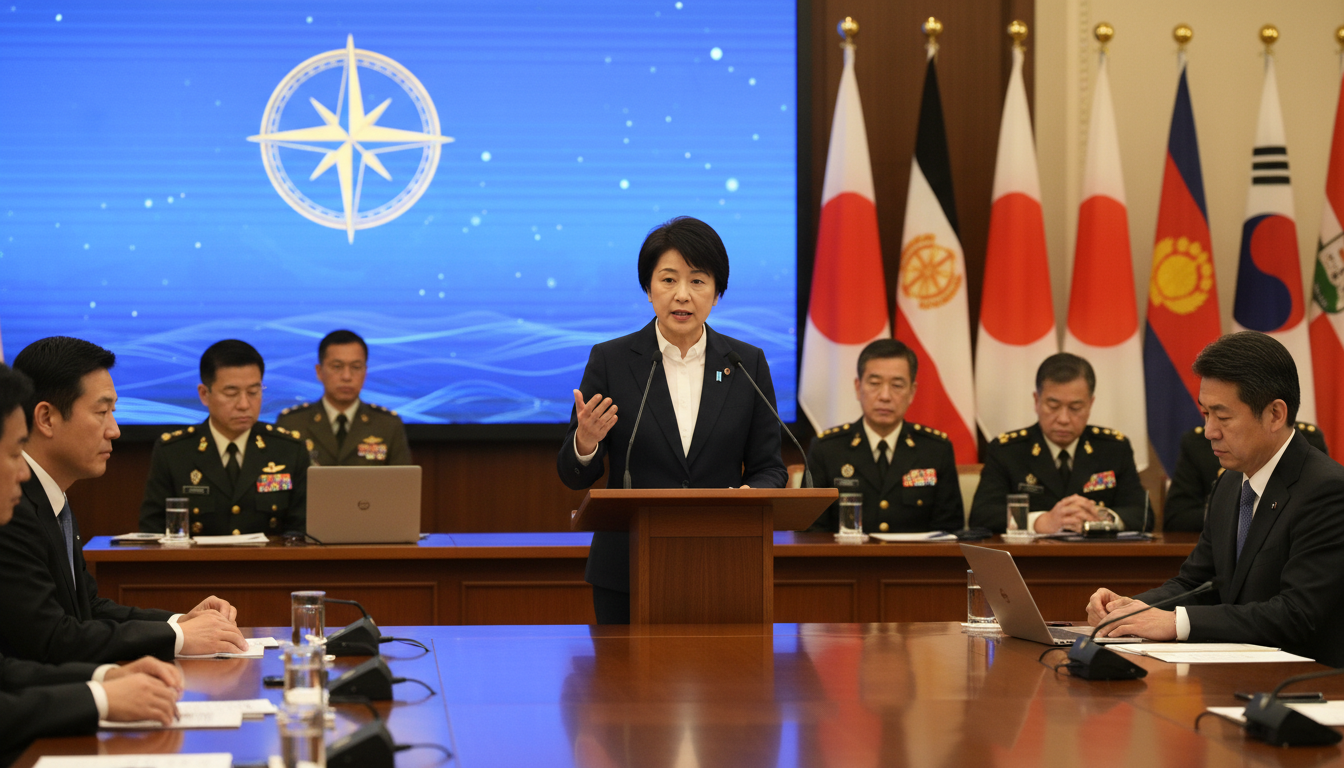
Takaichi Announces Revised FOIP in Hanoi, Calls for Southeast Asian Autonomy and Resilience
PM Sanae Takaichi unveiled a revised Freedom and Open Indo-Pacific (FOIP) in Hanoi on May 2, 2026, urging Southeast Asian autonomy and resilience.
Japan’s prime minister presented an updated version of the Freedom and Open Indo-Pacific (FOIP) doctrine in Hanoi on May 2, 2026, framing the policy around greater autonomy and resilience for Southeast Asian states. In a speech at Vietnam National University, Prime Minister Sanae Takaichi linked the new FOIP to historic maritime ties between Japan and Vietnam and emphasised the role of a rules-based order. The announcement underscores Tokyo’s intention to broaden partnerships in the region even as strategic competition and credibility challenges complicate implementation.
Takaichi Chooses Vietnam to Present Evolved FOIP
Prime Minister Takaichi opened her Hanoi address by invoking centuries of maritime trade between Japan and the countries of Southeast Asia, saying the region best understands the value of open seas. By delivering the revision in Vietnam, Tokyo signalled a shift from past public framings of FOIP and put Southeast Asia at the centre of its diplomacy. Officials described the speech as an effort to recast FOIP as an instrument to bolster local agency rather than a narrow security bloc.
Focus on Autonomy and Resilience for ASEAN States
Tokyo’s revised FOIP stresses “autonomy” and “resilience” for Southeast Asian partners, urging them to reduce vulnerability to coercion and external economic pressure. The new language aims to provide tools and cooperation mechanisms that help nations withstand disruptions — from supply-chain shocks to maritime disputes. Japanese officials say practical support could include infrastructure financing, disaster response collaboration, and capacity-building for maritime governance.
Rule of Law Message Meets Global Credibility Tests
A central plank of the revised FOIP is promotion of the rule of law and respect for international norms, an explicit counterpoint to coercive practices in the region. Yet Tokyo faces a difficult sell when major powers demonstrate uneven adherence to those same norms, officials and analysts note. The perceived willingness of the United States under President Donald Trump to act outside established legal frameworks complicates efforts to present FOIP as a universal standard rather than a selective diplomatic slogan.
FOIP Positioned as a Rules-Based Alternative to Competing Projects
While not naming specific initiatives, Takaichi’s team frames the “evolved” FOIP as an alternative to large-scale foreign infrastructure projects that, Tokyo argues, may lack transparency and consistent standards. Japan seeks to extend linkages based on shared rules, market economy practices and open maritime routes. The pitch is to offer Southeast Asian governments a choice: diversified partnerships built on predictable rules rather than dependency on a single economic patron.
ASEAN Outreach and AOIP Provide Strategic Partnership
Tokyo pointed to the 2019 ASEAN Outlook on the Indo-Pacific (AOIP) as evidence of overlapping goals and a basis for cooperation, stressing that Japan and ASEAN share many core principles. ASEAN countries have long occupied a central place in Indo-Pacific strategies because of their geographic and economic position between the Indian and Pacific Oceans. Japanese diplomats say closer alignment with AOIP priorities, including maritime security and sustainable infrastructure, will guide bilateral and multilateral initiatives going forward.
Japan’s announcement also reflects a political calculation at home, where policymakers see Southeast Asia as fertile ground for expanding economic ties amid an increasingly fraught great-power rivalry. Tokyo is attempting to translate high-level principles into projects and partnerships that offer immediate benefits to regional governments, while maintaining a neutral tone that avoids forcing countries to choose sides.
The practical obstacles are significant: competing offers of financing, differing threat perceptions among ASEAN members, and the need for credible enforcement mechanisms to uphold rules. Tokyo must also reconcile its call for legal norms with the messy realities of alliance politics, where partners’ actions do not always align with stated principles.
Takaichi’s Hanoi speech marks a notable moment for Japan’s diplomacy by explicitly recentering FOIP in Southeast Asia and reframing it around resilience and autonomy. Whether the revised policy will gain traction depends on Tokyo’s ability to deliver concrete programs, coordinate with ASEAN institutions, and persuade regional governments that a rules-based approach will yield tangible economic and security dividends.
As implementation begins, Japan faces the twin tasks of translating diplomatic rhetoric into operational support for partners and managing the credibility gap created by uneven adherence to international norms among major powers. The success of the revised FOIP will hinge on measurable cooperation in infrastructure, maritime governance and crisis response that Southeast Asian states find politically and economically compelling.

