
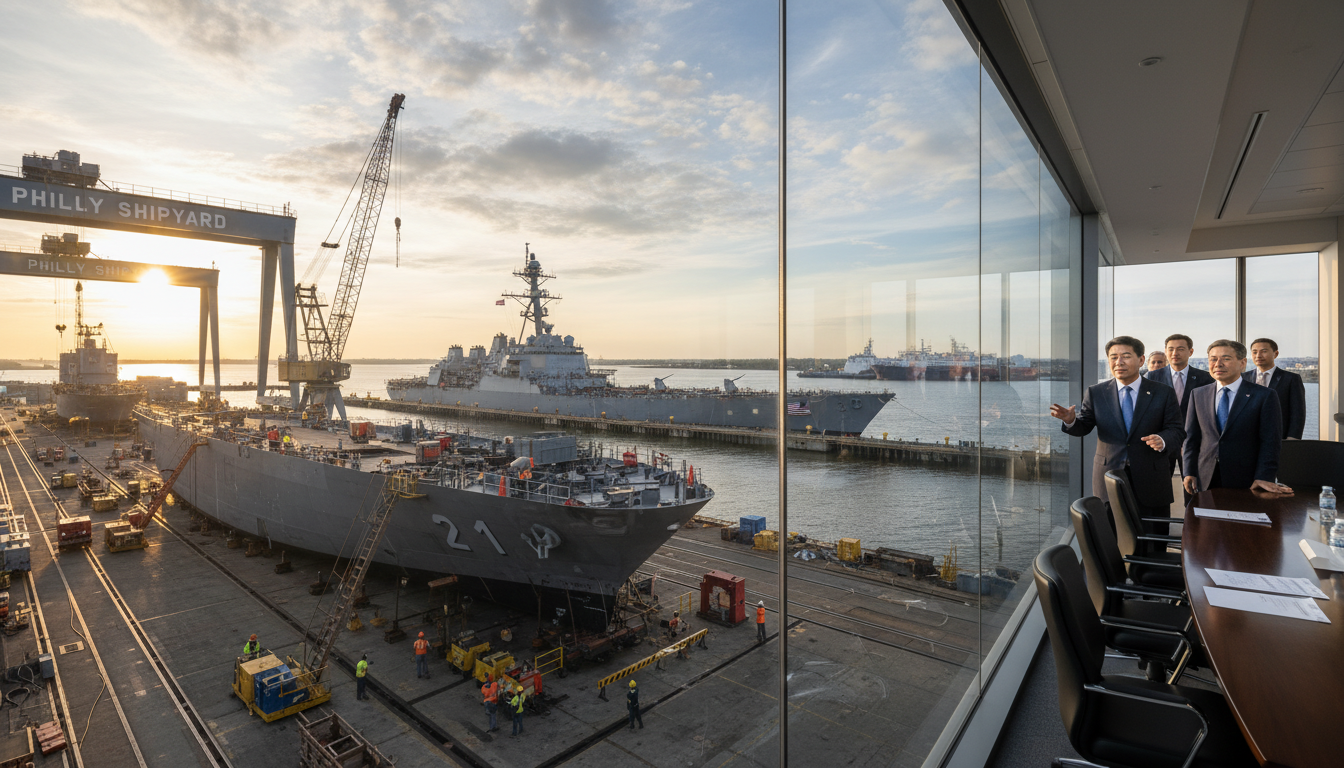
Hanwwa Philly Shipyard Drives Shipbuilding Push for U.S. Navy After 2024 Acquisition
Hanwha Philly Shipyard is accelerating NSMV construction and related projects after its 2024 acquisition, positioning the yard at the centre of the South Korean conglomerate’s drive into U.S. naval work. U.S. Navy cadets toured the National Security Multi‑Mission Vessel State of Maine at the Philadelphia yard on Aug. 26, 2025, underscoring its growing role in allied shipbuilding. The facility now serves as a visible symbol of Hanwha’s strategy to expand maritime defense sales and deepen industrial ties with American suppliers.
Hanwha’s strategic entry into U.S. shipbuilding
The 2024 purchase of the Philadelphia shipyard marked Hanwha’s most prominent industrial move in the United States to date. Company leaders have described the site as a base for constructing a range of vessels that meet U.S. Navy and commercial specifications. For Hanwha, the acquisition is both a market entry and a statement of intent to compete in high‑value maritime defence projects.
Hanwha Philly Shipyard has been repositioned to handle vessels that require close coordination with U.S. regulators, subcontractors and naval planners. The firm emphasizes transfer of production know‑how, local hiring and supplier partnerships as part of a broader localization effort. Observers say those commitments are aimed at winning trust and work on complex government programmes.
Progress on the National Security Multi‑Mission Vessel
Work on the National Security Multi‑Mission Vessel State of Maine at the Philadelphia yard has advanced into visible stages of outfitting and trials. The NSMV class is designed to serve training, humanitarian and logistical roles, and the State of Maine’s construction offers a test case for the yard’s technical capacity. Visits by U.S. cadets and military observers have highlighted the ship’s role in training pipelines and disaster response planning.
Hanwha’s teams are focusing on meeting U.S. safety and performance standards while integrating systems that may later be adapted for defence variants. Industry sources say the ability to deliver on schedule and within regulatory frameworks will be critical to securing future naval contracts. The State of Maine project therefore functions both as operational work and as a commercial reference for the company.
Implications for U.S.-South Korea defence industrial ties
The Philadelphia operation strengthens industrial links between the United States and a major South Korean defence conglomerate. By building ships on U.S. soil, Hanwha reduces political frictions tied to foreign‑built platforms while offering a route for bilateral cooperation in ship design and systems integration. Washington and Seoul have both shown interest in closer defence industry collaboration amid evolving security concerns in the Indo‑Pacific.
Analysts caution that deeper ties will require continued transparency on subcontracting, supply chain origins and technology transfer. For U.S. officials, the presence of a foreign‑owned firm on American territory that adheres to domestic rules can be both an asset and a point of scrutiny. Still, proponents argue that the arrangement expands capacity at a time when demand for naval and support vessels is rising.
Economic ripple effects around Philadelphia
The yard’s ramp‑up has created work for local firms in steel, electronics, and marine engineering, according to suppliers and municipal officials. Hanwha has publicly signalled hiring initiatives and efforts to integrate regional subcontractors into its production plans. For a manufacturing base that has weathered cycles of contraction, renewed shipbuilding activity offers a measurable boost to employment and investment.
Beyond direct hiring, contracts for parts, maintenance and logistics have stimulated adjacent sectors such as port services and vocational training. Local colleges and technical programmes are adapting curricula to meet shipyard needs, while workforce development efforts aim to provide the specialised skills required for complex vessel construction.
Regulatory and security considerations for future projects
Despite economic upside, the yard’s new role invites close regulatory attention on export controls, classified work and foreign investment safeguards. Government reviews and contracting rules require clear lines of compliance before certain naval programmes can proceed. Officials and industry legal teams are therefore engaged in detailed assessments of where Hanwha can operate freely and where additional approvals are necessary.
Security reviewers will weigh the benefits of increased industrial capacity against potential risks related to sensitive technologies and operational control. Hanwha’s success in navigating that environment will depend on rigorous compliance, transparent partnerships with U.S. firms and adherence to procurement requirements for national security projects.
Competition and the global maritime sales push
Hanwha’s investment in the Philadelphia yard is part of a wider effort to grow its share of the global shipbuilding and defence market. The company is leveraging shipyard capacity to pursue orders both within the United States and from allied navies seeking modern platforms. Competitive pressures from established U.S. and European yards mean Hanwha must demonstrate cost competitiveness, timely delivery and credible after‑sales support.
Securing more work will likely hinge on the firm’s ability to transform the Philadelphia site into a repeatable source of quality vessels, while maintaining constructive ties with local suppliers and regulators. If it succeeds, Hanwha could emerge as a more prominent supplier to allied fleets and a channel for technology collaboration.
The Philadelphia yard’s recent activity reflects a broader shift in the international shipbuilding landscape, where geopolitical alignments and industrial strategy increasingly shape commercial decisions.
Hanwha Philly Shipyard’s trajectory in the coming years will be watched closely by naval planners, local communities and competing shipbuilders as the company seeks to convert its U.S. foothold into sustained programme wins.

