
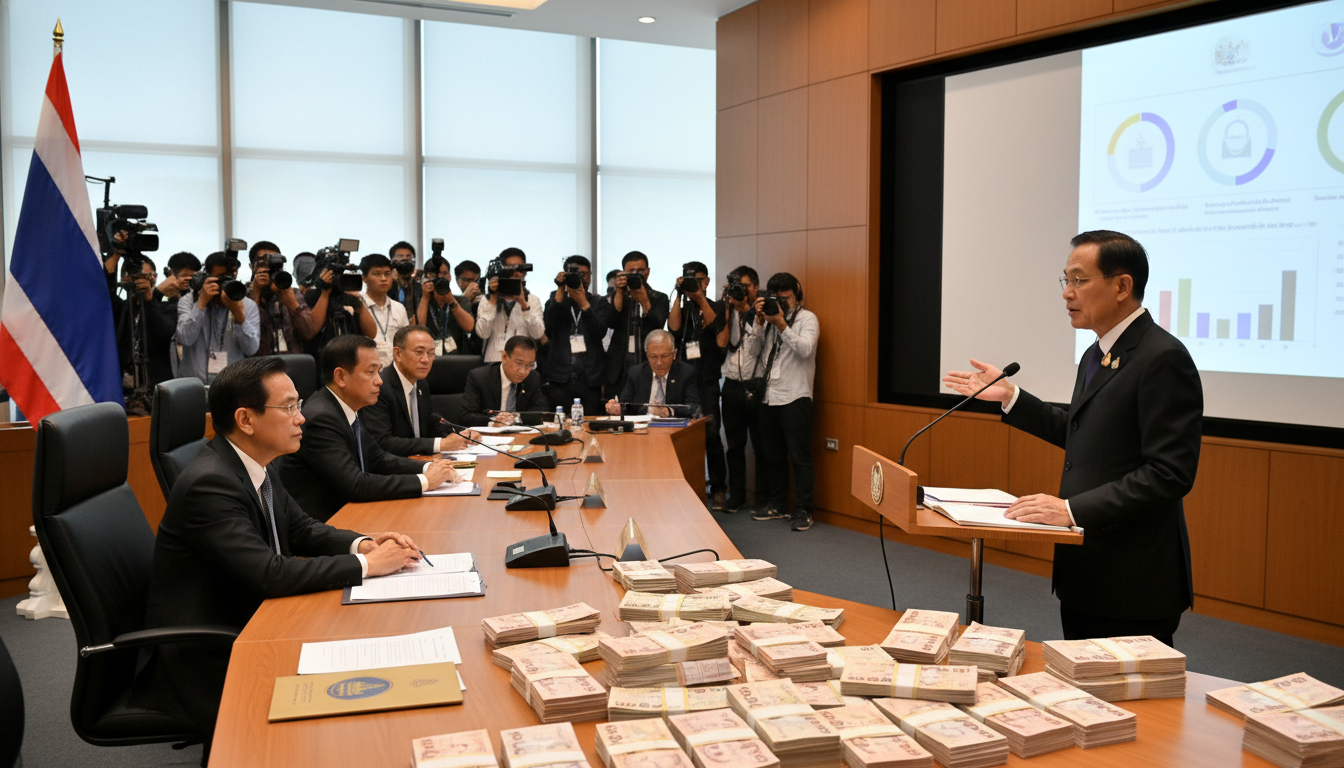
Thailand emergency borrowing: Cabinet approves 400 billion baht decree to shield households and energy sector
Thailand’s cabinet has approved an emergency borrowing decree authorizing up to 400 billion baht, a move framed as urgent support against rising energy costs and cost-of-living pressures. Thailand emergency borrowing is the central government response to volatility linked to the Middle East conflict, Prime Minister Anutin Charnvirakul said following the Cabinet meeting. (marketscreener.com)
Cabinet approval and scope
The cabinet voted on May 5 to back a draft royal decree that would empower the Finance Ministry to borrow up to 400 billion baht to fund immediate relief measures and medium-term energy projects. The package is described by officials as an emergency tool, separate from the annual budget process, and will be presented to parliament for ratification in the coming weeks. (nationthailand.com)
Officials say the decree allows borrowing to be deployed rapidly to cushion households and firms against a sharp rise in fuel and power costs. Prime Minister Anutin has emphasized the borrowing will be targeted to prevent a simultaneous slowdown in growth and spike in inflation that could erode living standards. (marketscreener.com)
Government’s stated aims
The government has presented the loan as a twofold response: immediate relief for households facing higher energy and transport bills, and financing for an accelerated shift toward cleaner domestic energy sources. Ministries outlined plans to channel funds into subsidies, targeted cash transfers and investments in rooftop solar and other renewable infrastructure to reduce future exposure to global fuel-price shocks. (nationthailand.com)
Beyond relief, officials contend the borrowing will back projects aimed at long-term energy security and competitiveness, including investments intended to lower Thailand’s import dependence on fossil fuels. The Finance Ministry and the Prime Minister’s Office have pledged to set up monitoring mechanisms to track disbursement and prevent leakages. (english.news.cn)
Financing mechanics and parliamentary timetable
According to government statements, the emergency borrowing will be sourced largely from domestic markets and state-owned financial channels to limit foreign-exchange exposure. The decree is expected to be submitted to parliament mid-May, where lawmakers will debate the scope, repayment terms and oversight arrangements before any funds are released. (english.news.cn)
Treasury officials say portions of the loan would be disbursed in tranches tied to clearly defined projects and relief windows, with the first registrations and payments scheduled to begin in June if parliament grants approval. A project monitoring committee is proposed to publish regular updates on allocations and outcomes. (english.news.cn)
Fiscal risks and credit-rating concerns
Analysts warn that while the measure may be necessary to shield households in the near term, it will raise Thailand’s already elevated public debt ratio and could complicate medium-term fiscal consolidation. Thailand’s public debt stood near 66% of GDP at the start of 2026, a level that narrows fiscal headroom and draws greater scrutiny from markets and policymakers. (ceicdata.com)
The finance ministry has previously set targets under the multi-year fiscal framework to contain the deficit and cap public debt, but the emergency borrowing will test those commitments. Observers stress that transparent tracking, clear repayment plans and credible medium-term consolidation will be critical to avoid negative market reactions. (nationthailand.com)
Ratings agencies and investor reaction
Credit-watchers and rating agencies have signalled sensitivity to additional large-scale borrowing, noting political stability and fiscal governance as decisive factors for sovereign scores. Fitch and other agencies have previously warned that policy slippage or persistent deficit increases could weigh on Thailand’s credit profile, even where short-term support is justified. (nationthailand.com)
Market participants said the immediate effect in bond and currency markets was muted as details remained thin and much of the borrowing is planned to be raised domestically. Still, investors will be watching how the government balances emergency spending with commitments to reduce structural fiscal risks. (marketscreener.com)
Political calculus and public response
Politically, the government frames the decree as a necessary, prompt intervention to protect households and the economy from external shocks. The measure gives the administration visible tools to address fuel and electricity costs ahead of summer consumption peaks and elections-level scrutiny in a politically charged environment. (en.thairath.co.th)
Opposition voices and some civil-society groups have called for strict oversight and for funds to be targeted to the most vulnerable, warning that broad subsidies can be inefficient and regressive. Lawmakers preparing to scrutinize the decree in parliament are expected to press for clear eligibility rules and publication of spending plans. (nationthailand.com)
Thailand’s emergency borrowing marks a decisive fiscal intervention intended to blunt the domestic fallout from a volatile global energy market, but it also highlights the trade-offs facing policymakers between short-term protection and medium-term fiscal sustainability.

